
The average self-service customer-support success rate is only 14%, according to Gartner. That changes how to create an FAQ: the job isn't to publish answers, but to help customers finish tasks. For an AI support agent, those answers must also remain accurate when retrieved without the surrounding page.
Table of Contents
- Why Self-Service FAQs Still Send People to Humans
- Fields Every FAQ Answer Needs
- Which Questions to Publish First
- How to Write the First FAQ Set
- Structure Metadata and Chunks for Retrieval
- Test and Launch the FAQ
Why Self-Service FAQs Still Send People to Humans
A customer can find the right page and still leave without a usable answer. They might recognize the topic but miss an exception, misunderstand their eligibility, or reach instructions that require help from support.
Treat your FAQ as a self-service navigation system, not a collection of approved statements. Customers need a route from their own words to a resolution, including a clear exit when self-service can't complete the task.
The difference between publishing information and resolving an issue is the central challenge.
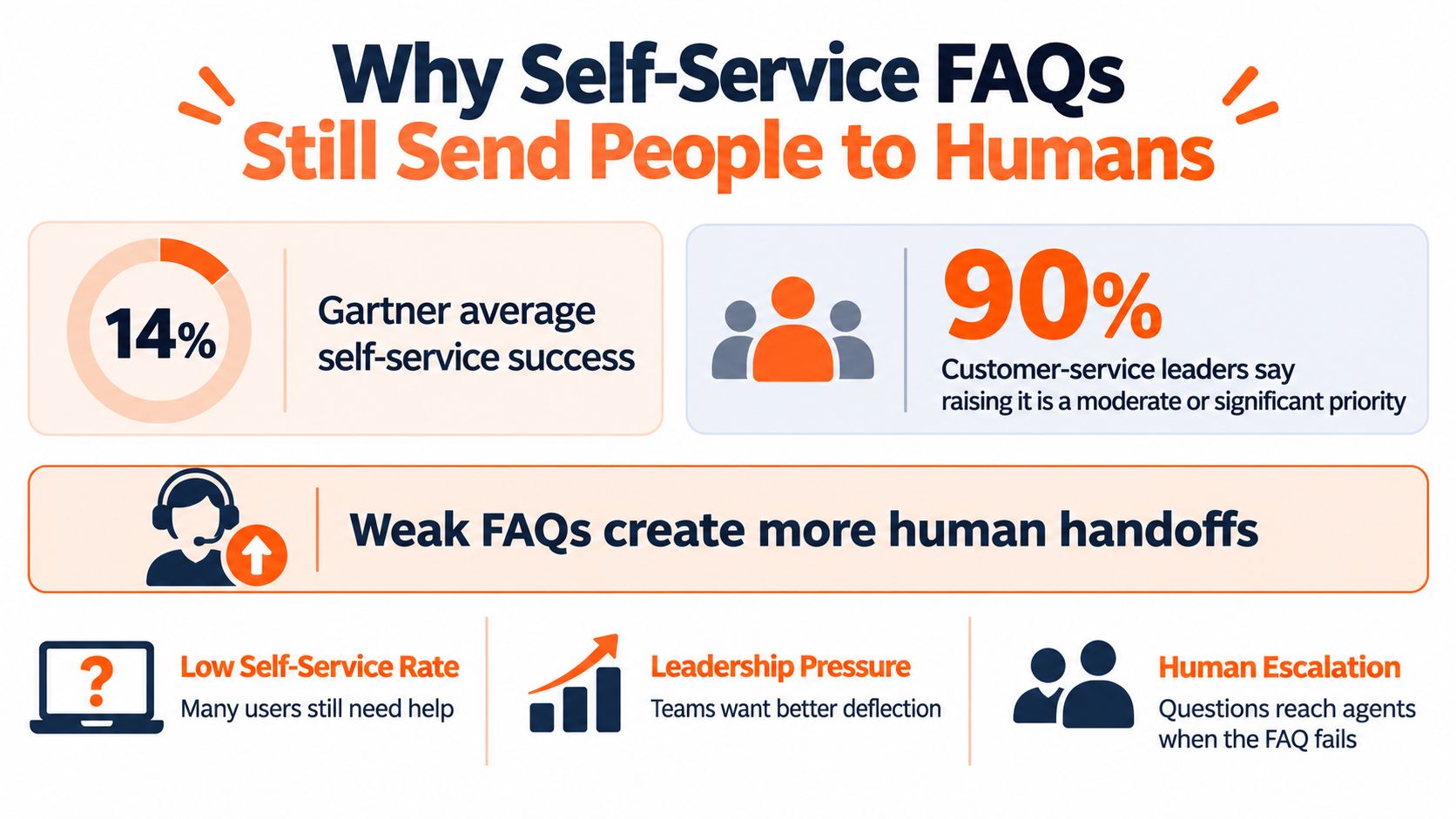
Build around the customer's journey
Start with these requirements:
- Identify customer intents. Separate finding a receipt from disputing a charge, even if both reach the billing team.
- Use recognizable wording. A customer searching for a missing order shouldn't need to understand your fulfillment terminology.
- Make routes consistent. Categories, search results, and contextual links should lead to the same maintained answer.
- Provide an exit. Explain when support is required and how to contact the right team.
Measure answer views, search refinements, unanswered queries, successful resolution, and transfers to human support. Views show exposure, not completion. Compare completed journeys before and after a content change rather than treating additional traffic as proof of improvement.
Before choosing a page layout or adding markup, give each answer enough context to work on its own.
Fields Every FAQ Answer Needs
| Field | What to write | Why retrieval needs it |
|---|---|---|
| Question title | Customer's own phrase | Matches search and chat wording |
| Intent | One job, such as refund timing | Stops mixed chunks |
| Direct answer | Resolution in the first two sentences | Usable without the page |
| Scope | Plan, region, product, or audience | Prevents wrong-customer answers |
| Exceptions | Limits in the same answer | Stops hidden qualifications |
| Effective date | Policy or price version | Flags stale claims |
| Next action | One concrete step | Gives a finishable path |
| Escalation | When and how to reach a human | Covers what self-service cannot |
| Source and owner | URL, team, review date | Makes updates traceable |
A retrieval-ready answer makes sense when someone extracts it into chat, email, Slack, or voice. Avoid phrases such as the option above or this plan. Name the option or plan directly so the answer doesn't depend on page position.
Write the resolution first, then explain its boundaries. Scope tells the reader whether the answer applies; exceptions explain when the normal rule doesn't apply. Keep both attached to the resolution rather than relying on a separate policy paragraph that an agent might not retrieve.
A complete returns example
Consider a hypothetical retailer whose approved policy allows US orders to be returned within thirty days of delivery. Its policy excludes final-sale items and opened software licenses.
The published answer could read:
Can I return my order?
Orders placed in the US can be returned within thirty days of delivery, except final-sale items and opened software licenses. Start your return from Order history by selecting the order and choosing the return option. If the order is missing, contact support through the help page and provide your order number.
The associated record should also identify:
- Intent and scope: Start a return for an eligible US order.
- Effective version: The approved returns-policy version currently in force.
- Source: The authoritative returns policy, not a copied promotional page.
- Ownership: The customer experience team responsible for checking the answer.
- Review record: The actual date of the latest policy verification and the next review trigger.
Don't copy the hypothetical return window into a real FAQ. Replace it with your approved policy, and record the policy's actual effective date before publication.
Write knowledge, not a search enhancement
Google's June 2025 Search announcement described the phasing out of several structured-data features. Don't build your content strategy around the assumption that markup will produce a prominent search treatment.
Keep the customer-facing answer readable and the operational fields attached to its underlying record. An owner's name needn't interrupt a voice response, but the system maintaining that response needs a traceable owner and source.
If a required field is missing, the item isn't ready to publish or index. An explicit not applicable is acceptable when justified. An empty field that nobody checked isn't.
Which Questions to Publish First
A rare question that could cause a compliance mistake deserves attention before a popular question about changing a profile picture. Frequency is a signal, not the whole priority decision.
Guides such as Shopify's FAQ-page guide provide a useful starting point for assembling a page. Running a dependable support resource also requires deciding which questions shouldn't receive a short, automated answer.
| Bucket | When it qualifies | What you publish |
|---|---|---|
| Publish as FAQ | Public stable policy and high volume or high risk | One self-contained Q&A chunk |
| Guide plus short FAQ | Needs steps, screenshots, or many exceptions | One-line answer linking to the article |
| Escalate to a human | Account, payment, or judgment required | Escalation line and no invented answer |
| Watch, do not write yet | One-off, low risk, already answered elsewhere | A logged query and no new page |
Evaluate impact and answerability
For each candidate, record how often customers ask it, what a wrong answer could cost, whether existing documentation already resolves it, and whether the customer can finish without an account-specific lookup.
Use simple labels such as high, medium, and low, accompanied by a reason. A numerical score without an explanation can hide an important distinction: a question may be easy to answer generally but unsafe to resolve for a particular account.
For example:
- Publish now: Can I change the billing email? qualifies when authorized users can follow a documented, stable settings path.
- Escalate: Why was my enterprise invoice taxed? requires inspection of the invoice and account details. Explain what information support needs rather than guessing.
- Write a guide: How do I migrate from the legacy API? needs a workflow, compatibility checks, and troubleshooting. Keep the FAQ entry short and direct readers to the migration guide.
Use a customer service question inventory to check topic coverage, then confirm relevance against your own customer conversations. A broad list can reveal missing categories, but it can't establish your customers' priorities.
Keep an evidence queue
Log unresolved questions even when you decide not to publish them. Record the customer's wording, affected task, existing answer, and reason for the decision.
A useful FAQ backlog includes decisions not to automate, not just requests for more content.
Repeated handoffs and searches with no result deserve investigation. They can reveal missing vocabulary, a documentation gap, or a task that requires product changes rather than another article.
Don't create a new page because someone asked a new variation. First check whether improving an existing answer would solve the same problem without creating another maintenance obligation.
How to Write the First FAQ Set
Build the first release from customer evidence and approved policy. Preserve the language people use to ask for help while checking every answer against an authoritative source.
The collection process should stay practical.
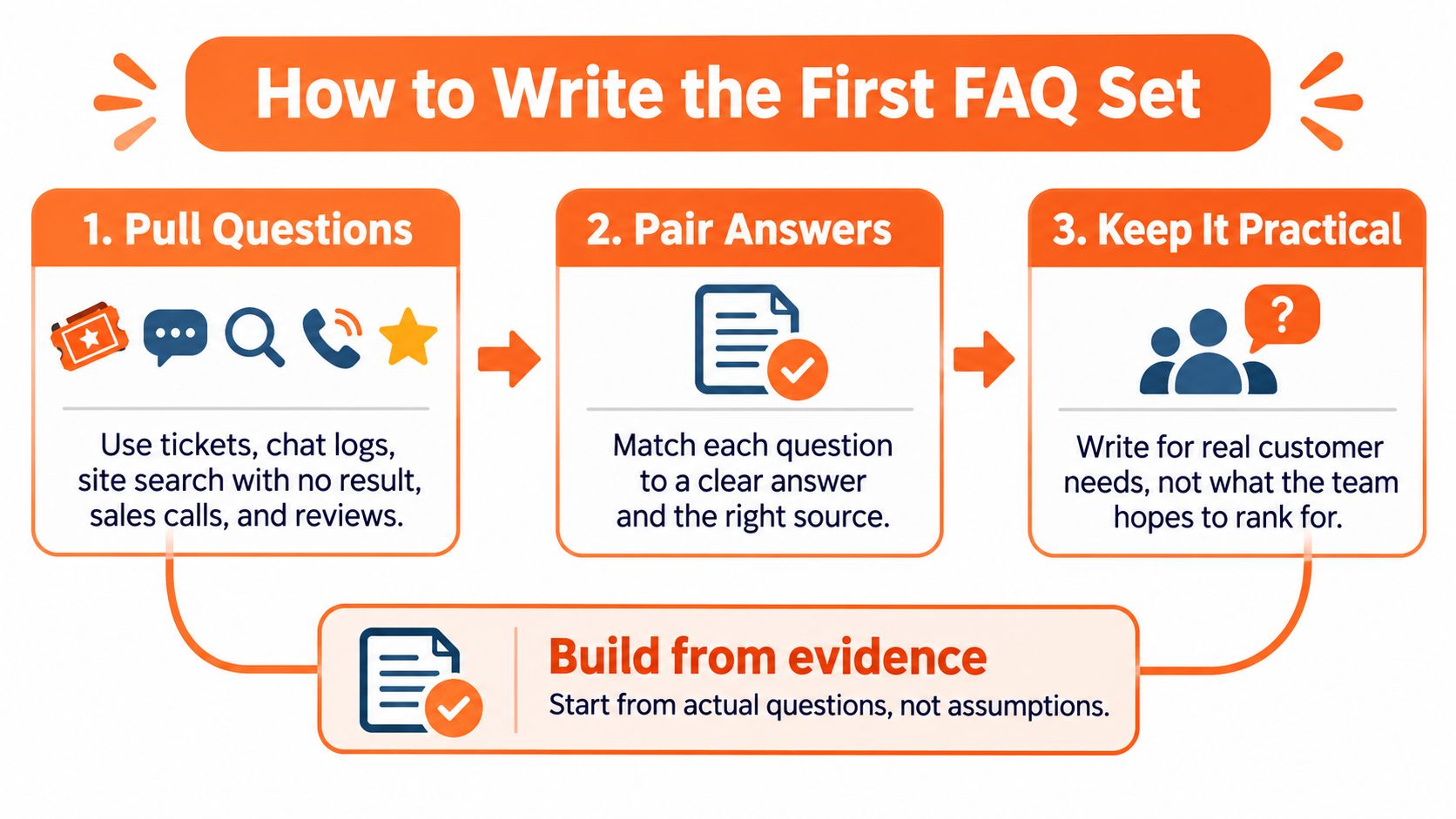
Collect and organize the questions
-
Pull actual questions. Export recurring tickets, chat conversations, unsuccessful site searches, sales-call notes, and review questions. Remove personal information before using those records in a drafting or testing environment. Keep enough surrounding context to distinguish a general policy question from a request to act on an account.
-
Match customer wording to an approved answer. In its e-commerce usability testing, Baymard found that 70% of tested sites lacked the ideal combination of site-authored FAQs and community-generated Q&A. The practical lesson is to retain both perspectives: customers reveal the uncertainty, while the organization supplies the verified policy or procedure.
-
Cluster by user goal. Use categories such as buying, onboarding, billing, and access. Don't make customers choose between internal teams such as revenue operations and customer success. Keep related wording variations together, but separate tasks that require different resolutions.
-
Place answers where uncertainty occurs. Maintain general policy answers in a sitewide help area, then expose specialized answers on the relevant product or workflow page. A setup limitation belongs near setup instructions, not only in a distant FAQ hub.
Draft and maintain the release
-
Draft a deliberately small set. Choose high-volume or high-risk items that have verified answers and named owners. Use the answer fields to expose missing information before editing for style. If the team can't establish an exception or escalation route, hold that item back.
-
Assign revision triggers alongside ownership. A policy change, renamed interface control, product retirement, or pricing update should trigger review of the affected answers. The owner should verify the source and instructions, not merely change the review date.
-
Release the smallest useful set. Expand from unresolved searches and repeated contacts rather than filling categories for visual symmetry. A short, dependable category is better than a full category padded with questions customers don't ask.
Two drafting failures deserve particular attention. The first is inventing questions solely for search traffic, which can produce polished answers unrelated to customer tasks. The second is leaving conflicting versions of the same answer across product, policy, and help pages.
Editorial check: Search for the intent across your own site before approving a new FAQ entry.
When duplication is necessary for placement, reuse a maintained source record or establish an explicit update relationship. Don't rely on someone remembering every page that contains the old wording.
Structure Metadata and Chunks for Retrieval
A retrieval system selects passages, not entire customer journeys. Design each passage so it contains the information needed to answer its intended question without importing unrelated instructions.
The visible navigation still matters for people browsing directly.
Set boundaries around each intent
Use one question and its complete answer as the default chunk boundary. Repeat the question at the beginning of the extracted passage, then include the resolution, applicable limits, and next action.
Don't force every answer into an arbitrary word count. A short answer is appropriate when it completes the task; a longer answer is justified when removing a qualification would make it misleading. Move extended workflows into a guide rather than combining unrelated questions into a large chunk.
Apply these retrieval controls:
- Filter before ranking: Store product, intent, audience, region, channel, effective date, owner, and source URL as metadata where the retrieval system supports them.
- Preserve qualifications: Keep exclusions attached to the rule they modify, including in extracted text.
- Retire superseded versions: Preserve revision history for maintenance, but prevent obsolete policy text from competing with current answers.
- Check extraction: Inspect the indexed passage, not only the rendered page. A visually clear layout can still produce scrambled text.
For a returns answer, metadata might identify product=apparel and region=US, together with the approved policy version and authoritative source location. These tags should reflect the content, not compensate for an answer that never states its scope.
The retrieval-augmented generation best-practices guide provides additional context for connecting source quality, retrieval, and response generation.
Separate navigation from technical validation
Expose clear category labels, search, and contextual links from the pages that raise the question. If you use accordions, ensure customers can operate them with a keyboard and that extracted answers retain their essential qualifications.
For a visual companion to FAQ organization, use the following video.
When structured data is appropriate, Google's structured-data documentation recommends JSON-LD as the easiest format to implement and maintain at scale. Markup must match visible content, stay current, and pass validation; missing required properties can make it ineligible.
Don't use QAPage for a conventional FAQ containing multiple questions. Reserve that distinction for the appropriate question-and-answer page type, and treat schema as a technical check rather than a retrieval strategy.
If your current content system can't maintain ownership, revisions, and reusable records, compare internal knowledge base tools using Magnitude Marketing's overview. Evaluate those maintenance capabilities before choosing on editor appearance alone.
Test and Launch the FAQ
A correct source doesn't guarantee a correct response. Retrieval can select the wrong passage, a prompt can encourage unsupported inference, and a deployed agent can behave differently from a preview.
Before saving a configuration, run a three-question gate using representative supported, unsupported, and ambiguous questions. Save only a model-and-prompt combination that passes every type.
The launch checklist should cover response quality as well as publishing mechanics.

Apply the three-question gate
A supported question should return the relevant rule, its exception, and the next step without adding a promise. For the hypothetical returns policy, test a request involving an excluded item as well as an eligible order. A response that gives the general rule while omitting the exclusion fails.
An unsupported question should acknowledge the knowledge boundary and offer the appropriate escalation route. Ask about a feature your documentation doesn't establish. The agent shouldn't infer availability from a similar feature or invent a release commitment.
An ambiguous question should request a useful clarification or offer a small set of likely interpretations. For it isn't working, the agent might ask whether the customer means signing in or completing setup. Returning a random troubleshooting article isn't a successful answer.
Pass condition: The response must be useful, supported, and appropriately bounded. Plausible wording isn't enough.
In our Playground, you can change the model and system prompt, select Apply & Test, and compare configurations without saving every experiment. Keep the test questions consistent across configurations so you can identify whether a change fixes the failure.
Load sources and verify the live surface
AgentStack knowledge can come from a website, a single page, files, Notion pages, or explicit Q&A pairs. Use a controlled loading order: start with the website or help center, add key files, include authoritative policy documents wherever they live, then add the curated Q&A records.
Treat that sequence as an audit workflow, not an automatic priority rule. Adding a Q&A last doesn't by itself prove that retrieval will prefer it. Test which source the agent selects, and remove or replace conflicting material.
Before deployment, confirm that:
- Actions stay authorized. An answer describing a refund process mustn't become permission to issue an unapproved refund.
- Human boundaries work. Questions marked for escalation reach the intended support route.
- The interface is usable. Check keyboard access, visible focus, screen-reader labels, contrast, and mobile scanning.
- Publishing checks pass. Verify links, available schema validation, and the visibility of the published answer.
Deploy, inspect indexing, and rerun the supported, unsupported, and ambiguous questions on the live surface. Test the actual customer channel, not just the editor preview.
Run a local failure loop
After launch, review searches with no result, repeated handoffs, low-confidence replies, and negative sentiment concentrated around a task. Use confidence and retrieval diagnostics to investigate candidate failures rather than treating a confidence label as proof of correctness.
| Signal | Likely gap | Fix |
|---|---|---|
| Search with no result | Title misses customer words | Add a question using that phrase |
| Repeat contact after a view | Exception or next step missing | Rewrite the same answer |
| High escalation on one intent | Job cannot finish in self-service | State the handoff and drop false promises |
| Stale price or eligibility cited | Review date has passed | Update or unpublish before the next index |
| Random article on a vague ask | Chunk mixes several intents | Split into separate Q&A pairs |
Treat these as diagnostic hypotheses. A failed search can also indicate an indexing problem, and repeated contact may reveal a broken product workflow rather than missing prose.
Distinguish an answer nobody opened from an answer that resolved the issue without a support conversation. Neither page views nor silence establishes the outcome alone. Combine journey events, feedback, and subsequent contacts where your measurement setup permits.
Give the review owner a queue containing the failed question, retrieved passage, response, and proposed fix. Retitle, split, correct, or retire the smallest affected item, then rerun its tests. Create a new guide when the gap repeats or the business risk already justifies deeper documentation.
AgentStack lets you build support agents from your own documentation and explicit Q&A pairs, then test how they handle supported, unsupported, and ambiguous requests. Visit AgentStack to turn a small, verified FAQ set into an agent you can test before putting it in front of customers.