
A customer asks whether a refund applies to their plan. The assistant answers immediately, cites a help page, and sounds certain. The problem is that the page was replaced last month, the relevant paragraph was split across two chunks, or the retrieval filter excluded the customer's plan. The language model didn't necessarily fail. The system supplied the wrong evidence, too little evidence, or no reliable way to detect the mistake.
That's why retrieval augmented generation best practices need to follow the path a question takes through production. Start with what enters the knowledge base, then control how the system retrieves and presents evidence, and finally measure what happened after launch. This approach also applies beyond support, including workflows such as AI for Government Contracting, where current documents and precise retrieval matter.
Table of Contents
- 1. Implement Intelligent Document Chunking and Indexing
- 2. Use Multi-Model Routing for Query Complexity
- 3. Establish a Feedback Loop for Continuous Improvement
- 4. Implement Hybrid Retrieval
- 5. Optimize Embedding Models for Your Domain
- 6. Structure Metadata and Enable Filtering at Retrieval Time
- 7. Implement Context Windowing and Prompt Engineering
- 8. Monitor and Optimize Retrieval Metrics
- 9. Implement Knowledge Base Versioning and Rollback Capabilities
- 10. Establish Security, Privacy, and Compliance Controls for Retrieved Data
- 10-Point Comparison of RAG Best Practices
- Turn These Practices Into a Weekly RAG Review Routine
1. Implement Intelligent Document Chunking and Indexing
A retriever can't recover context that ingestion destroyed. Splitting every document into identical blocks may be easy to implement, but it can separate a policy condition from its exception, detach an API method from its parameters, or bury a product qualification inside unrelated text.
Use document-aware boundaries first. Keep headings, lists, tables, warning notes, and parent-child relationships attached to the passage they describe. A billing FAQ might produce separate chunks for “eligibility,” “refund timing,” and “exceptions,” while an API reference should preserve the endpoint, method, authentication requirement, parameters, and response details together.
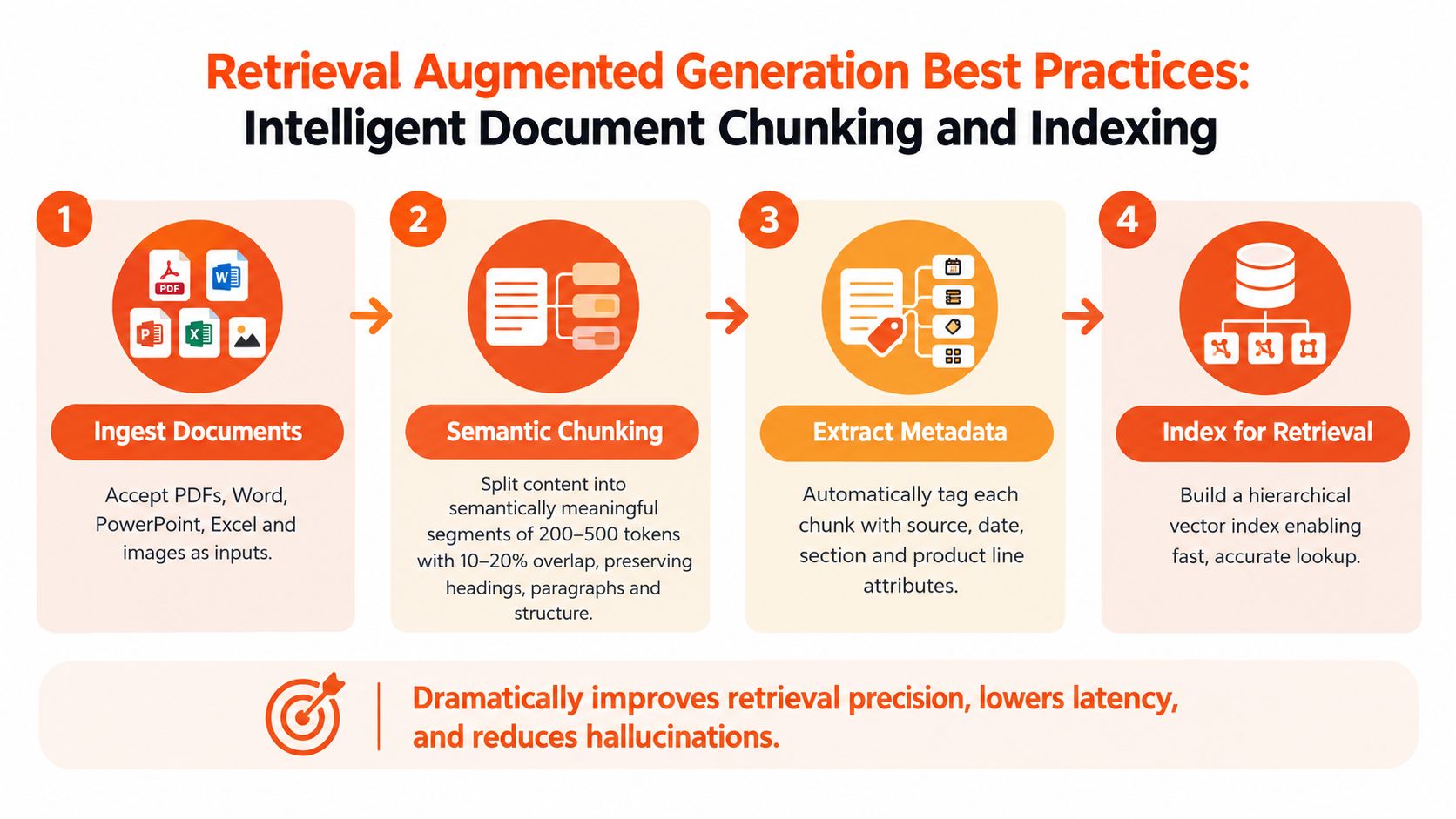
A 2025 LaRA benchmark found no universally optimal chunk setting. Its standardized configuration used 600-token chunks, 100-token overlap, and five chunks per document. The benchmark also found that both excessively small and excessively large chunks reduced performance, while adding retrieved chunks within a practical range generally helped more than just making each chunk larger. See the LaRA benchmark results for the full comparison.
What to attach to every chunk
- Source identity: Store the document title, canonical URL or file identifier, section path, and content owner.
- Freshness data: Record publication, update, and retirement timestamps so stale material can be filtered.
- Business scope: Add product line, plan, region, language, and support tier where those attributes affect the answer.
- Retrieval text: Keep clean text for search, but preserve the original structure for citations and display.
A useful starting point is approximately 300 to 600 tokens per chunk with controlled overlap, then evaluation on real support questions. Don't treat that range as a standard. Compare chunk variants using labeled queries and inspect whether the retrieved passage contains enough context to answer without neighboring chunks.
AgentStack can automate chunking and indexing for website crawls and document uploads. Whatever tooling you use, test retrieval before generation. If the correct policy passage isn't in the candidate set, prompt improvements won't repair the failure.
Here's a practical implementation check: for each representative question, record whether the expected source appears, where it ranks, and whether the passage includes the condition needed for a correct answer. That distinguishes a parsing problem from a ranking problem.
2. Use Multi-Model Routing for Query Complexity
A customer asks, “Why was this enterprise exception approved in Europe but rejected for our US renewal?” That question has already made it past ingestion and retrieval. The next failure point is generation. If the router sends it to the same fast path used for “How do I reset my password?”, the system can answer with confidence and still miss the policy conflict that matters.
Treat routing as a control point in the question's path, not as a model popularity contest. The job is to match the request to the cheapest path that still handles the risk. In practice, I look at signals you can inspect and log: query type, retrieved context length, number of candidate sources, policy disagreement, required format, and whether the user is asking for an explanation, a decision, or an action. A single-source lookup with clear evidence can go to a fast model. Requests that require comparison, qualification, or exception handling should go to a stronger reasoning route.
AgentStack includes model-agnostic orchestration for this setup, and its AI model comparison guidance is a useful starting point for defining route criteria. The production threshold still needs to come from your own evaluation set.
One way to keep the logic practical is to route by failure mode:
- Clear factual lookup: Use a fast model if retrieval returns one current, relevant source and the answer needs minimal synthesis.
- Ambiguous intent: Ask a clarification question or rewrite the query before choosing the generation model.
- Conflicting sources: Send the case to a stronger model or a human queue, and surface the disagreement in the answer.
- Action requests or sensitive topics: Apply stricter confidence and authorization checks, even if the question looks simple.
Then test the router the same way customers will break it. Start with a limited traffic slice. Compare correctness, citation support, latency, escalation rate, and cost between routes. If the faster path lowers latency but increases unsupported answers, the router is under-classifying hard questions.
Log the decision itself. Store the classifier score, selected model, retrieved source IDs, and final outcome so you can tell whether the miss came from routing, retrieval, or generation.
3. Establish a Feedback Loop for Continuous Improvement
A customer asks a reasonable question, gets a polished answer, clicks thumbs down, and leaves. That signal matters only if the team can trace the miss to a specific step in the path, ingestion, retrieval, routing, prompt, or answer behavior, then ship a fix tied to that failure.
Start with low-friction feedback in the chat. A simple positive or negative signal is enough for the first pass. If the response is negative, ask for a short reason: missing information, incorrect answer, irrelevant answer, unclear wording, access problem, or human handoff needed. Keep the taxonomy small enough that reviewers will use it consistently.
What happens next is the part that improves the system. AgentStack's continuous improvement cycles show the operational pattern, but the engineering requirement is straightforward. Every complaint needs the full trace attached to it: retrieved documents, rank order, filters, prompt version, model route, and final response. Without that record, teams guess at causes and often fix the wrong layer.
Use the review queue to translate complaints into concrete work:
- Missing content: Add or revise the source article, then put the original question into the regression set.
- Wrong retrieval: Inspect chunking, metadata, reranking, hybrid weights, or query rewriting.
- Unsupported generation: Tighten abstention behavior and citation checks, then retry the same question with adversarial variants.
- Stale content: Remove or replace the source, repair the update path, and confirm old chunks no longer appear in retrieval.
- Poor conversation handling: Read the full exchange, because the failure may have started before the final turn.
Review this queue on a fixed cadence and group issues by root cause, not by surface wording alone. A cluster of unanswered questions around one workflow usually points to a structural gap in the knowledge base or routing policy.
Then verify the fix. Mark the issue resolved only after the affected test cases pass again. Without that final verification, the loop never closes, and the team ends up measuring frustration instead of shipping fixes.
4. Implement Hybrid Retrieval
A customer types an exact error code, and the system answers with a vaguely related troubleshooting article because the vector search liked the wording. Another customer asks the same question in plain language, and keyword search misses it because none of the right terms appear in the docs. Hybrid retrieval addresses both failure modes in one path.
Semantic retrieval handles paraphrase. Keyword retrieval protects exact strings such as plan names, endpoint paths, legal clauses, SKUs, and error identifiers. In production support systems, relying on one method alone usually creates a predictable blind spot.
A practical setup runs sparse search and dense search in parallel, then merges the candidate lists. BM25 or full-text search catches rare tokens that embeddings often underweight. Vector search recovers documents that match the meaning but not the wording. Reciprocal Rank Fusion works well here because it combines rank positions without forcing incompatible score scales into a single number.
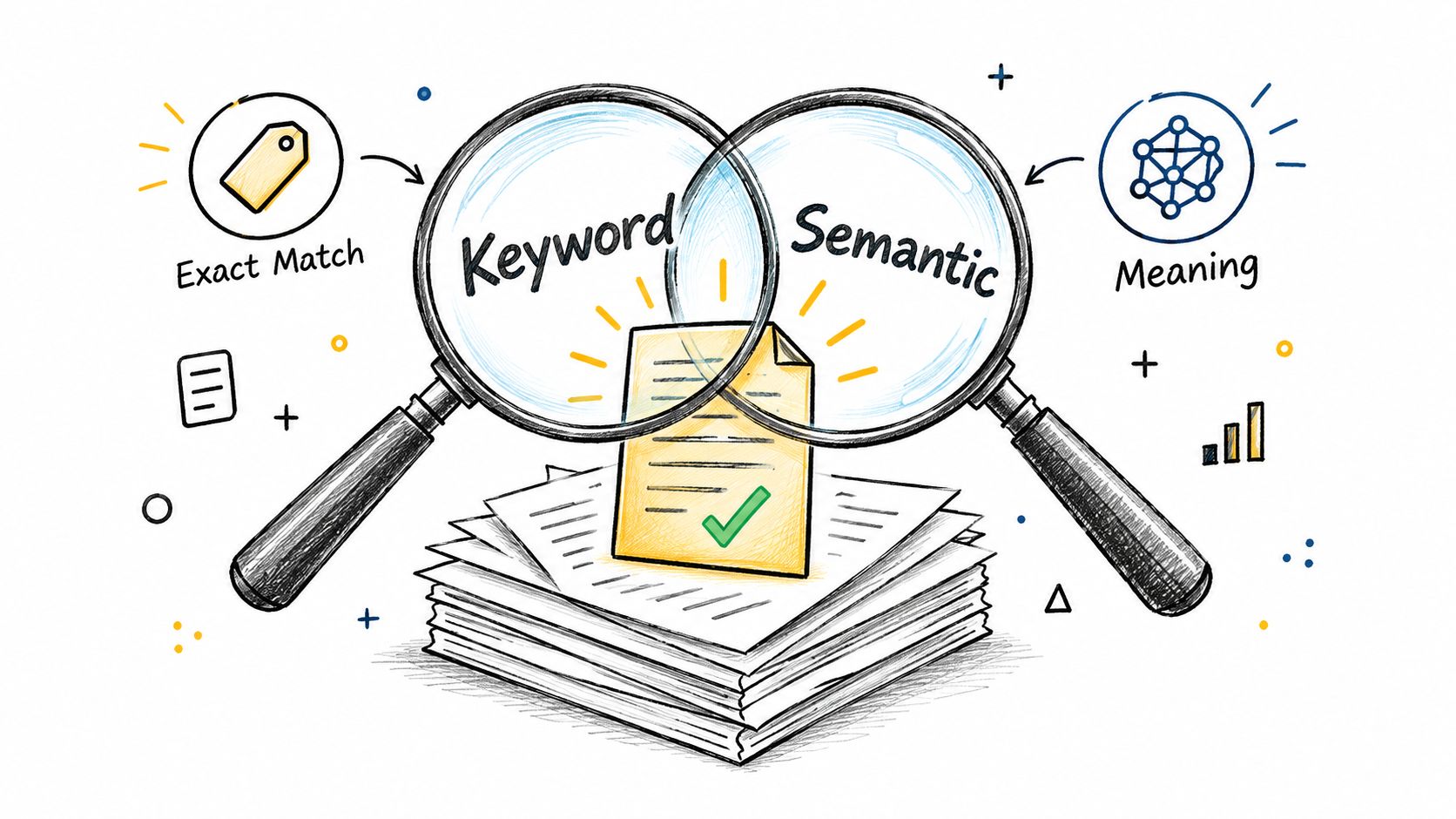
Set the first version to a neutral balance, then adjust it with real queries. If support traffic contains lots of product codes, contract terms, or region-specific labels, sparse retrieval may need more influence. If customers ask in shorthand, partial sentences, or paraphrases, vector retrieval usually needs more room. The right mix is the one that reduces misses on your labeled set.
Evaluation should mirror the kinds of questions that break each method:
- Exact-term queries: Verify that error codes, model numbers, policy phrases, and plan labels surface the right passages.
- Paraphrased questions: Test informal wording, alternate phrasing, and incomplete descriptions.
- Tail queries: Review rare questions separately from common FAQ traffic.
- Confusable terms: Check whether similarly named products or regions stay separated.
Measure candidate recall, ranking quality, and latency before generation. Compare keyword-only, vector-only, and hybrid retrieval on the same test set. Then inspect the misses. If hybrid retrieval raises recall but adds enough latency to shrink the prompt budget, tune the candidate count, fusion method, or reranking step. Add synonyms and acronyms to the sparse index, and if you rewrite queries, log the original text so debugging stays honest.
5. Optimize Embedding Models for Your Domain
A customer asks why a “workspace locked” warning appeared. If your embedding model was trained mostly on generic web text, that phrase can land near billing issues, access-control docs, outage notes, or an internal workflow page. Retrieval fails before generation has a chance to help.
Start with a general model, then test it on the language your users send. Build a labeled set of real questions and the passages that should answer them, including near-miss negatives that look plausible but would send the user down the wrong path. Score retrieval with MRR and nDCG, then review failure cases by topic. Average gains can hide the cases that matter most, especially policy, compliance, or account-access questions where one wrong passage creates a confident but unusable answer.
Fine-tuning helps when the baseline keeps collapsing distinct domain concepts into the same neighborhood. It also adds operational cost. You need representative training pairs, a fixed evaluation split, drift checks, and a clear reindexing process, because a model change usually means regenerating document and query vectors across the corpus.
Use a practical review checklist:
- Ranking quality: Judge whether the right passages move up on real queries. Vector similarity is only a proxy.
- Dimensionality: Measure retrieval quality against storage and search cost before shrinking vectors.
- Language coverage: Test the languages, shorthand, and mixed phrasing your support queue receives.
- Update behavior: Re-run evaluation after major product, taxonomy, or documentation changes.
- Hard negatives: Include similar but wrong plans, regions, versions, and product families.
Run controlled comparisons. Change one component at a time so you can see whether the lift came from embeddings, chunking, or the hybrid stack around them. I have seen teams replace the model, celebrate a benchmark gain, and later find that sparse retrieval was doing most of the work.
This practice prevents a specific failure. You choose a model that looks strong in a generic test, then customers ask in your terminology, drop key context, or use internal abbreviations, and relevant passages stop surfacing when they should.
6. Structure Metadata and Enable Filtering at Retrieval Time
A customer asks about coverage, the retriever finds a passage with near-perfect similarity, and the answer is still wrong because the passage belongs to a different plan or region. This failure happens before generation. Retrieval pulled evidence from the wrong scope.
Metadata is part of the knowledge model. Every chunk should carry the attributes needed to narrow retrieval and to explain why that source was selected. Common fields include product, plan, region, language, audience, document type, owner, publication state, effective date, and permission group.
The useful test is simple. For any answer that cites a source, you should be able to inspect the chunk and see whether it matched the user's scope on purpose or by accident.
Known context should drive filters at query time. A logged-in customer may already supply plan and region. An internal support agent may be allowed to search a broader document set. If an attribute is missing or unreliable, do not guess. Ask a clarifying question, or widen retrieval in a controlled way and mark the answer as potentially cross-scope.
A flexible filter policy works better than a single hard gate:
- High-confidence scope: Apply product, region, and permission filters before similarity search.
- No results: Log the zero-result event and relax only the uncertain filter.
- Conflicting scope: Keep both candidates available and route the case for clarification or escalation.
- Permission mismatch: Return a safe access response. Never reveal the existence or contents of restricted material.
Automate metadata extraction from file paths, headings, source systems, and document properties. Validate high-risk fields before they affect retrieval. One bad parser rule can tag a global policy as region-specific and suppress the right evidence for an entire customer segment.
Measure filtering on its own, separate from ranking. Run the same query with correct metadata, missing metadata, and conflicting metadata. Track zero-result rates, false exclusions, and answers sourced from the wrong scope. The goal is targeted retrieval that removes irrelevant evidence without blocking the passage that answers the question.
7. Implement Context Windowing and Prompt Engineering
A customer asks a narrow question. Retrieval finds the right passage plus five near-matches from older docs, adjacent policies, and a glossary. The answer still fails if the model sees the wrong evidence first, loses the exception in the middle, or treats unsupported filler as fact. This stage decides what the model reads, in what order, and under what rules.
Set the prompt up like an operating contract. Define what counts as support, how to handle conflicting sources, how citations attach to claims, and when the system must abstain, ask for clarification, or escalate. Tell the model to stay inside retrieved content, separate documented facts from uncertainty, and avoid filling gaps from general knowledge. For material claims, require the source section or passage label.
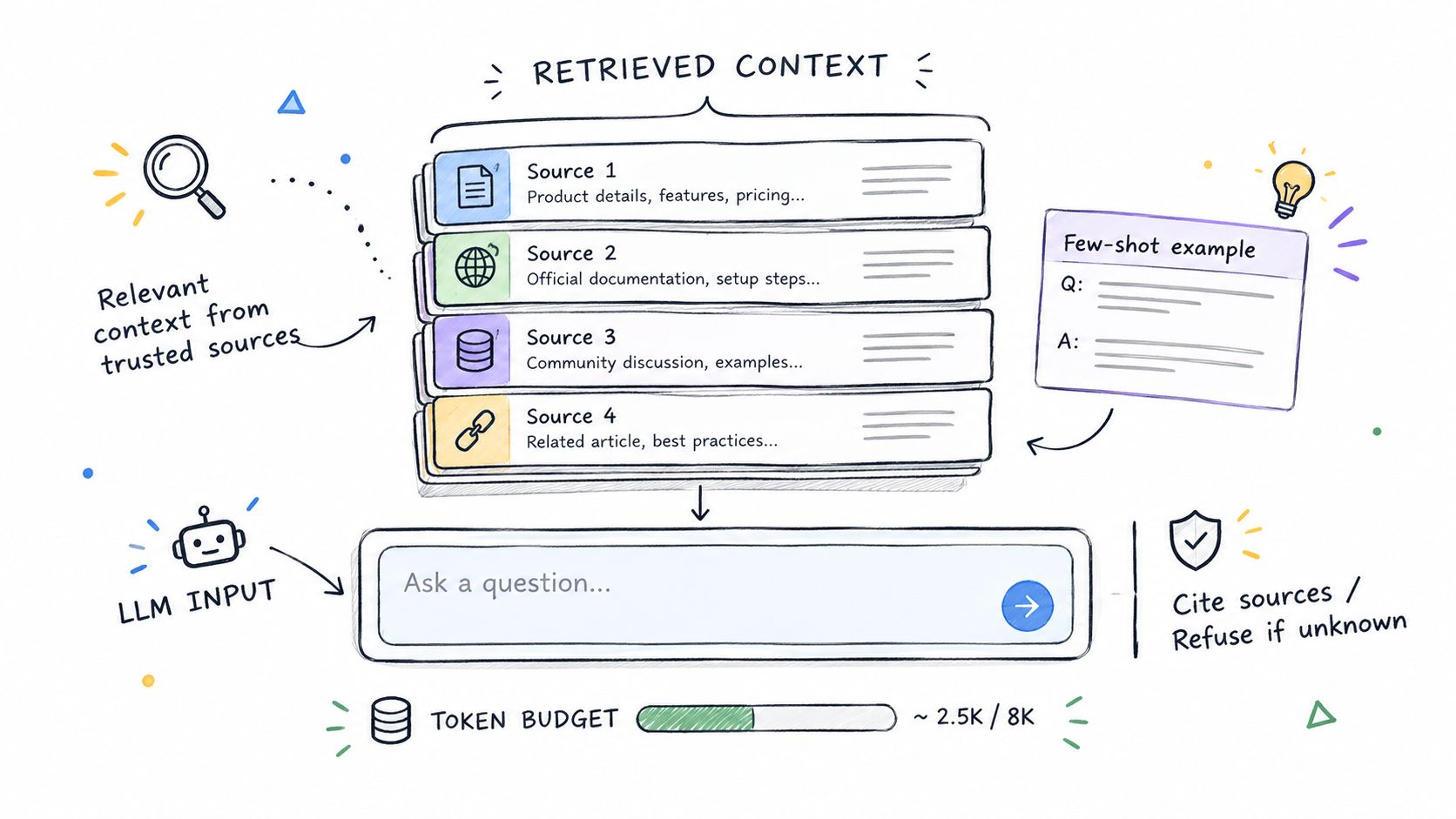
Context windowing is primarily a ranking decision. The token budget only sets the outer limit. Send every retrieved passage and the model has more chances to absorb contradictions, stale rules, or side details. Trim too hard and you drop the exception, definition, or prerequisite that makes the top passage usable. Order the window deliberately, lead with the strongest evidence, label each source clearly, and keep enough surrounding text to preserve meaning.
Use failure-driven tests instead of one generic prompt review. Run unanswerable questions and confirm the assistant declines rather than guessing. Run conflicting documents and confirm it surfaces the conflict and prefers the current, authorized source. Run ambiguous references such as “that plan” or “the previous order” and verify the system resolves them to the right conversational entity. Check citation completeness claim by claim. An answer with citations can still leave its key statement unsupported. When downstream systems need predictable fields, enforce a structured output contract and validate it in traces.
Keep prompts portable when you can. Test each routed model anyway. The same template may overproduce, ignore source labels, or mishandle refusals on a different destination. Review production traces after each prompt change, not just clean examples.
8. Monitor and Optimize Retrieval Metrics
A customer asks about a refund exception, the assistant answers confidently, and the reply still fails because retrieval surfaced the wrong policy version. That is why retrieval metrics need their own review. Final answer quality can look fine while search, ranking, or citation grounding is already drifting.
Build the eval set from real support traffic, then label it at the passage level. For each query, mark which chunks answer it, whether retrieval returned them, where they ranked, and whether the response used them correctly. Review retrieval metrics such as precision, recall, hit rate, MRR, and nDCG together with answer relevance, correctness, faithfulness, citation quality, abstention, latency, resolution, and escalation. This follows the same failure path the request takes through the system, from evidence retrieval to answer delivery.
The reason to split these checks is simple. Retrieval can succeed while generation misstates the source, and generation can appear correct even when the model filled gaps from prior knowledge. The RAG evaluation review makes that separation clear and shows why a single production score hides too much.
Keep per-response traces, but store them in a form engineers can compare across regressions. Record document IDs, chunk IDs, ranks, scores, filters, timestamps, query rewrites, decomposition steps, search strategy, model, prompt version, context order, output, citation mapping, user feedback, correction events, escalation, and latency. Without that trace, teams can see a drop and still spend hours guessing whether the cause was ingestion, retrieval, reranking, prompting, or generation.
A useful operating rhythm is two-layered. Run component tests when you change chunking, embeddings, metadata filters, or rerankers. Run end-to-end tests to confirm the final answer still cites the right evidence and refuses when evidence is missing. The dashboard should answer what broke. An aggregate score that moved up or down cannot.
9. Implement Knowledge Base Versioning and Rollback Capabilities
A customer asks the same question twice in one week and gets two different answers. If you cannot tell which documents, chunks, embeddings, filters, reranker, prompt, and model route were live for each response, the incident turns into guesswork.
Treat the knowledge base as a deployable artifact with a version ID. Version source documents, parsed text, chunk boundaries, metadata, embeddings, retrieval settings, reranker configuration, prompts, model routes, and evaluation results together. Then attach that version ID to every production response so support and engineering can reproduce what the user saw instead of reconstructing it from logs.
This prevents a common failure mode in RAG systems. A harmless-looking document edit can shift chunk boundaries. An embedding refresh can reorder results across the corpus. A prompt change can improve citation formatting while making abstention worse. Without a release boundary around those changes, teams cannot isolate the cause.
Use staged rollout for retrieval changes that can affect many queries at once. Send a controlled slice of traffic to the candidate index, compare retrieval and answer metrics against the current version, and hold the previous index online until the candidate clears rollback checks.
Rollback also needs an owner and a procedure. Capture snapshots during ingestion and reindexing. Require review for policy, pricing, access, and compliance content. Run a regression suite of known questions before activation. Define who can revert the index, prompt, model route, or metadata pipeline, and record the reason, approver, deployment time, and affected sources.
The version control reference is useful for the operational discipline behind this practice.
Run the rollback procedure during a game-day exercise. A rollback that depends on manual index rebuilds during a customer incident will fail when response time matters.
10. Establish Security, Privacy, and Compliance Controls for Retrieved Data
A customer asks a routine question. Retrieval pulls the right passage semantically, and the wrong passage contractually. The answer now includes an internal policy, personal data from a support case, or one tenant's records in another tenant's response. That is the failure this stage has to stop.
Put access control at retrieval time. Apply tenant, role, region, product, and record-level filters before any chunk enters the prompt, then verify those decisions again in the application layer. If a model sees restricted text, the system has already lost control of the main risk.
Then secure the rest of the path the question touches. Encrypt documents, vectors, logs, and backups. Restrict trace access because retrieved context can expose the same sensitive content as the source. Make deletion complete and testable. Remove source files, derived chunks, embeddings, caches, and retained conversation traces through one workflow rather than treating them as separate cleanup tasks.
The operational checks are straightforward:
- Identity and roles: Tie retrieval access to authenticated users, agents, administrators, and service accounts.
- Tenant isolation: Block cross-customer retrieval even when similar documents live in the same index.
- Data minimization: Return only the fields and passages needed for the task.
- Auditability: Record access, source identifiers, policy decisions, exports, and deletion events.
- Safe output: Scan generated answers for sensitive data and redact or block them where policy requires.
AgentStack's overview of GDPR and security controls is a useful starting point for review. Use it to check data residency, deletion, export, role-based access, and encryption settings against your own retention, processing, access, and incident requirements.
Finally, test the ways these controls fail in production. Run prompt injection against documents, attach malicious metadata, try unauthorized query variants, and probe indirect wording that attempts to reach restricted content. Authenticating the vector database is table stakes. Real security testing checks whether the retrieval system can still be tricked into exposing data it should never return.
10-Point Comparison of RAG Best Practices
| Item | Implementation complexity (🔄) | Resource requirements (⚡) | Expected outcomes (⭐) | Ideal use cases (📊) | Key advantages / Tips (💡) |
|---|---|---|---|---|---|
| Implement Intelligent Document Chunking and Indexing | Medium 🔄, tuning chunk size/overlap and metadata pipelines | Medium ⚡, preprocessing compute, embedding storage | High ⭐, improved retrieval precision, lower hallucinations | Documentation-heavy systems, API docs, large corpora | Use 200–500 tokens, 10–20% overlap; attach metadata and monitor precision |
| Use Multi-Model Routing for Query Complexity | High 🔄, classification layer, routing rules, fallbacks | Medium–High ⚡, cost for multiple models, monitoring | High ⭐, lower latency & cost for simple queries; preserves reasoning for hard ones | High-volume support, triage systems, mixed-complexity queries | Define clear routing criteria, start at 20–30% traffic, use confidence scores |
| Establish a Feedback Loop for Continuous Improvement | Medium 🔄, feedback capture, analytics, retraining workflows | Low–Medium ⚡, instrumentation and human review effort | High ⭐, continuous improvement, fewer hallucinations, prioritized content updates | Support platforms that evolve with user queries | 1-click feedback, weekly reviews, use signals to retrain embeddings |
| Implement Hybrid Retrieval (Keyword + Semantic) | Medium–High 🔄, dual indices and fusion/tuning required | High ⚡, storage for both indices; fusion compute | High ⭐, better recall and coverage; robust to term- and concept-based queries | Domains needing exact-term lookup + semantic matching (legal, e‑commerce) | Start 50/50 weighting, use RRF, monitor high-frequency vs tail queries |
| Optimize Embedding Models for Your Domain | High 🔄, fine-tuning, evaluation, full re-index when switched | High ⚡, labeled data and compute for fine-tuning/re-indexing | High ⭐, 10–30% better precision; fewer irrelevant retrievals | Specialized verticals (medical, legal, finance) or proprietary docs | Collect 100–500 QA pairs, evaluate MRR/NDCG, consider 256–512 dims |
| Structure Metadata and Enable Filtering at Retrieval Time | Medium 🔄, schema design and consistent tagging necessary | Low–Medium ⚡, metadata storage and extraction tooling | High ⭐, scoped results, personalized responses, reduced irrelevant info | Multi-product, multi-region, tiered support systems | Automate metadata extraction, use conditional filters, monitor zero-results |
| Implement Context Windowing and Prompt Engineering Best Practices | Medium 🔄, iterative prompt design and context sizing | Low ⚡, engineering time and token budget considerations | High ⭐, reduces hallucinations, improves transparency and consistency | Any RAG system needing grounded, auditable answers | Use few-shot examples, instruct to cite/refuse, lower temperature for factual tasks |
| Monitor and Optimize Retrieval Metrics (Recall, Precision, MRR) | Medium 🔄, build evaluation pipelines and dashboards | Medium ⚡, labeling, dashboarding, A/B tooling | High ⭐, objective tuning, regression alerts, data-driven decisions | Mature RAG deployments seeking continuous optimization | Start with 50–100 labeled queries, track Recall@5 & MRR@10, A/B test changes |
| Implement Knowledge Base Versioning and Rollback Capabilities | Medium–High 🔄, versioning, snapshots, rollback workflows | Medium–High ⚡, storage for versions, re-indexing compute | High ⭐, safe experiments, rapid incident recovery, auditability | Regulated industries, frequent doc updates, large teams | Version every change, set retention policy, test rollback procedures regularly |
| Establish Security, Privacy, and Compliance Controls for Retrieved Data | High 🔄, encryption, RBAC, residency, audit controls | High ⚡, engineering, compliance effort, performance overhead | High ⭐, legal compliance, customer trust, prevents data leaks | Healthcare, finance, enterprise customers with regulatory requirements | Encrypt by default, align RBAC to org, audit logs monthly, obtain certifications |
Turn These Practices Into a Weekly RAG Review Routine
RAG quality improves when teams review evidence regularly instead of waiting for a visible incident. Pick two practices to audit this week. Start by measuring retrieval recall on a set of 50 real customer queries, then review the log of unanswered questions and classify each failure as missing content, wrong retrieval, poor scope, unsupported generation, or conversation-state error.
The recall exercise tells you whether the right evidence enters the pipeline. The unanswered-question review tells you where customers still need help. Together, they prevent a common mistake: tuning prompts because the knowledge base lacks the policy, or tuning embeddings because a metadata filter excludes the relevant product.
A production review should include both retrieval and conversation behavior. The 2025 mtRAG benchmark contains 110 human-generated conversations averaging 7.7 turns, spanning 842 tasks and four domains, and reports weaknesses in later-turn questions, non-standalone queries, unanswerable requests, and multi-domain context. Those conditions resemble support more closely than isolated benchmark questions. The mtRAG benchmark description supports adding follow-up turns, ambiguous references, and safe-abstention cases to your evaluation set.
Use a simple weekly operating rhythm:
- Inspect retrieval: Review missed passages, low-ranked evidence, zero-result queries, and wrong-scope matches.
- Inspect answers: Sample citations, unsupported claims, refusals, escalations, and corrections.
- Inspect changes: Compare the active index, prompt, model route, filters, and document versions with the prior review.
- Choose one intervention: Change one component, rerun the affected cases, and record the result.
- Share the outcome: Give support, documentation, product, and engineering teams a short list of resolved gaps and remaining risks.
Platforms such as AgentStack bundle ingestion, model routing, deployment, security controls, and analytics in one workflow, but these checks apply regardless of the tooling you choose. Its analytics can surface resolution outcomes and unanswered questions, while shared inbox and escalation workflows keep low-confidence cases from disappearing into an automated response.
The hardest part is resisting broad changes without diagnosis. If retrieval recall is weak, fix ingestion, indexing, embeddings, hybrid search, or filters. If the right evidence is present but the answer is unsupported, inspect context ordering, prompt instructions, citation validation, and model routing. If the system answers the wrong follow-up question, evaluate conversation state and query rewriting rather than adding more documents.
A useful RAG program makes every failure actionable. The source can be corrected, the retriever can be reconfigured, the answer can be constrained, the user can be escalated, and the change can be tested against a traceable evaluation set. That discipline is what turns a retrieval demo into dependable customer support and helps teams build the operational habit of driving tool adoption.
AgentStack provides website and document ingestion, automatic chunking and indexing, multi-model routing, omnichannel support delivery, analytics, security controls, and developer integrations for retrieval-grounded customer support. Use AgentStack to connect these RAG practices in one workflow, then evaluate it with your own customer questions, source permissions, and escalation rules.