The most popular advice about support innovation is also the least useful: buy an AI chatbot, connect your help center, and measure how many tickets disappear. That approach produces convincing demos and disappointing operations. A bot can answer routine questions, yet routing errors, stale documentation, poor escalation logic, and weak measurement often damage the customer experience.
Modern teams need a different starting point. Support innovation is an operating-model decision before it's a tooling decision. Leaders must decide how data will be prepared, how workflows will change, who owns quality, which cases require people, and how the organization will absorb new capabilities. The technology matters, but it only creates value when the surrounding system is ready to use it.
AI adoption has moved beyond isolated experiments. A 2026 synthesis reported that 66% of customer service organizations were using AI agents in production, up from 39% one year earlier, while 85% began with chatbots for basic inquiries and 71% extended AI into ticket routing and prioritization. The same synthesis recorded expansion into voice assistants, predictive support, sentiment analysis, and proactive outreach, showing that innovation is becoming a layered service model rather than a single FAQ feature (AI in customer service statistics).
Table of Contents
- Why Support Innovation Is an Operating Model Problem
- What Support Innovation Actually Means
- Strategic Drivers Behind Support Innovation
- A Four-Dimension Framework and KPI Set
- How an AI Support Stack Comes Together in Practice
- A Practical Roadmap Across Process, Governance, People, and Tech
- Common Pitfalls That Stall Support Innovation
- Your First 30 60 90 Days of Support Innovation
Why Support Innovation Is an Operating Model Problem
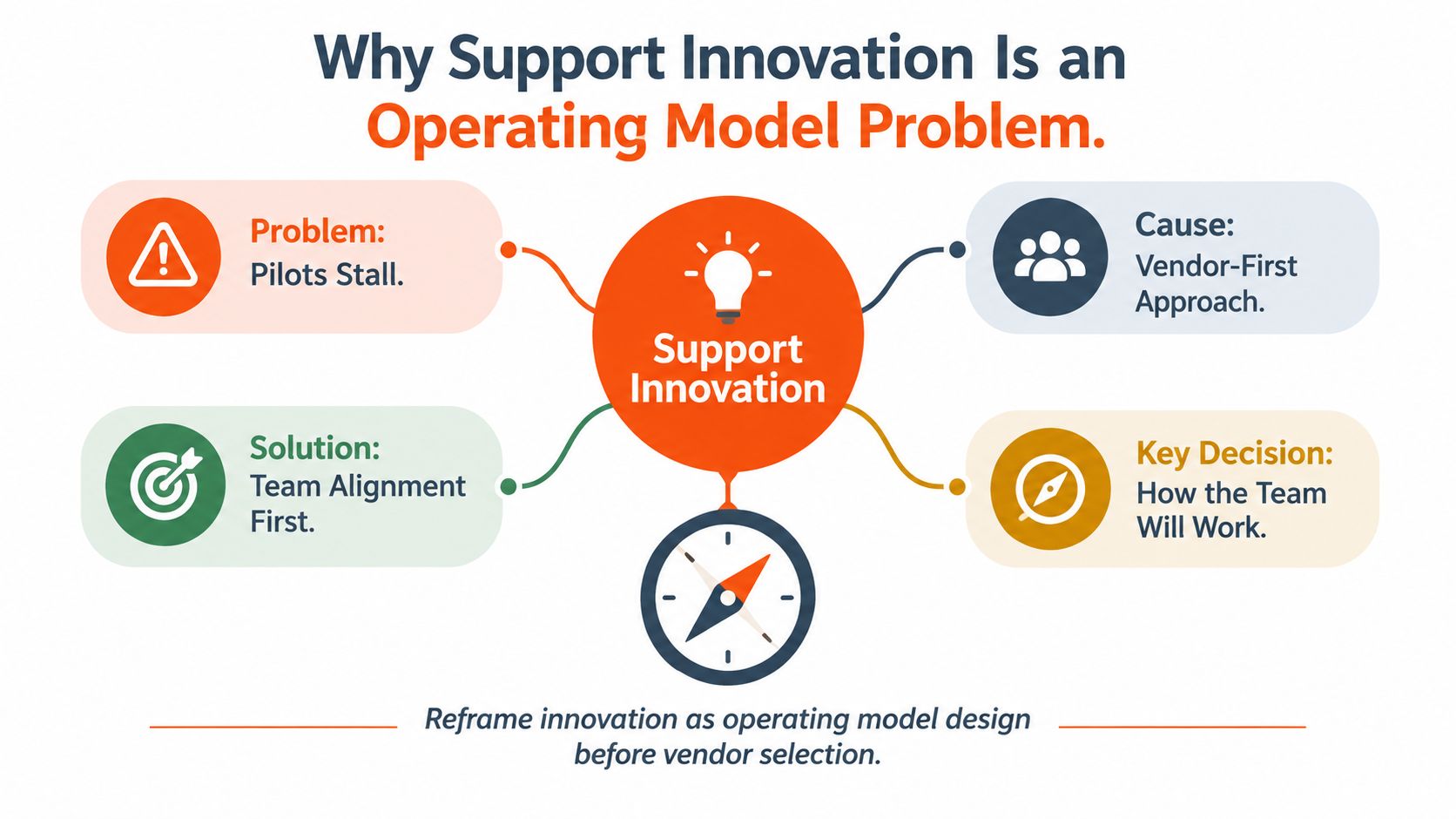
Support leaders often begin with vendor comparisons. They evaluate model quality, widget design, integrations, and pricing before asking whether the team can maintain the knowledge, review the decisions, and handle the escalations. That order is backwards.
The more important question is, how will this team work after automation enters the queue? Agents may move from answering repetitive questions to supervising exceptions. Knowledge managers may need to maintain retrieval-ready content instead of publishing documents only for human reading. Support operations may own model evaluations, escalation policies, and data-quality reviews. If nobody owns those changes, the pilot becomes shelfware.
The maturity gap matters more than the demo
Recent research highlights the gap between investment and operational maturity. 82% of senior leaders said they had invested in AI for customer service in the previous 12 months, yet only 10% described deployment as mature and fully integrated (Intercom Customer Transformation Report). The finding points to a practical problem: buying capability is easier than embedding it into daily work.
A stalled pilot usually has one or more of these weaknesses:
- Unprepared data: Important answers sit across tickets, documents, conversations, and internal systems, with conflicting versions.
- Unclear accountability: No single owner decides whether an answer is safe, accurate, current, or ready for release.
- Poor workflow design: Automation is added to an existing process instead of changing triage, review, and escalation around it.
- Weak change absorption: Agents aren't trained to supervise AI, challenge it, or improve the underlying knowledge.
Practical rule: Don't approve a support AI pilot until you can name the owner of the data, the owner of the customer experience, and the owner of the human handoff.
Support innovation therefore resembles transformation work more than a software purchase. Teams need a shared operating model that connects data readiness, workflow design, governance, measurement, and people. A useful companion perspective is this guide to support digital transformation, particularly for leaders mapping technology changes to broader service operations.
What Support Innovation Actually Means
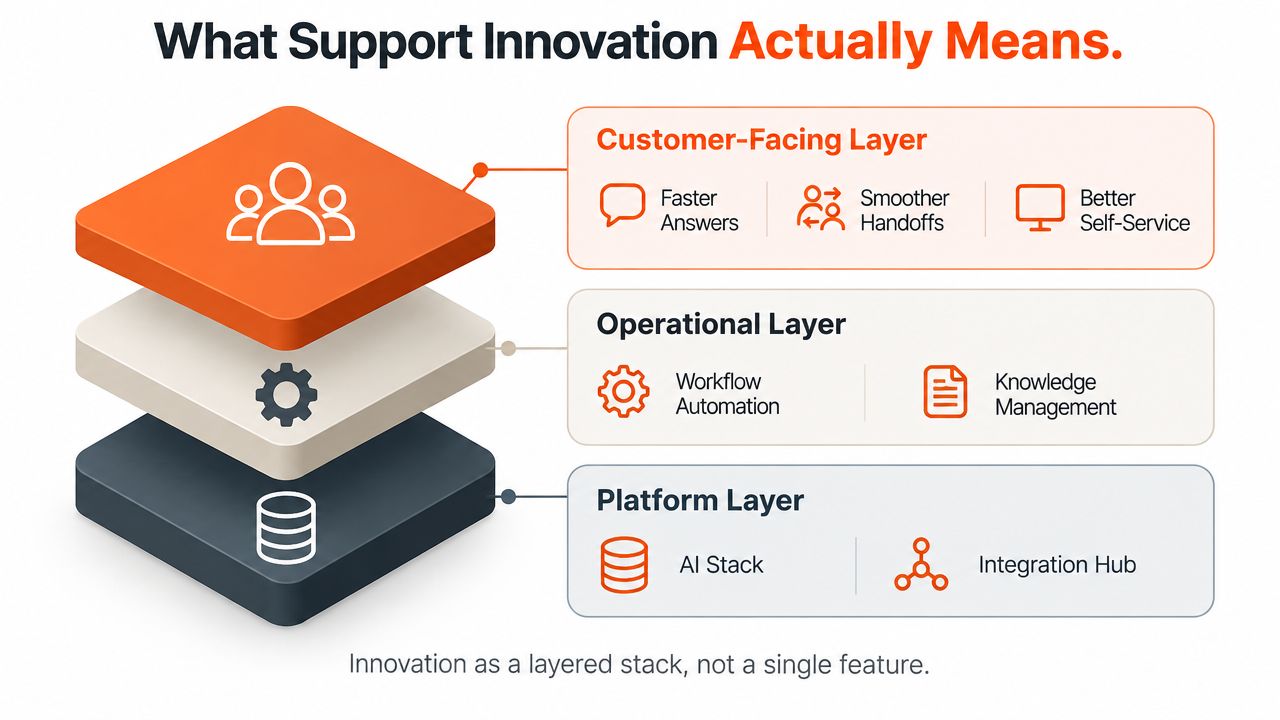
Support innovation is a stack with four connected layers. The visible layer is the customer experience, but the invisible layers determine whether that experience remains accurate, consistent, and safe.
Start with the customer-facing layer
Customers notice faster answers, smoother handoffs, and better self-service. They don't care whether a response came from retrieval, classification, a language model, or a rules engine. They care whether the answer addresses the actual question, respects the context of the conversation, and gets them to a resolution without forcing repetition.
This layer includes conversational interfaces, email replies, in-app assistance, voice experiences, and proactive guidance. It also includes the quality of the transition to a person. A fast automated answer that sends a frustrated customer into a disconnected queue isn't better service. It's a faster route to dissatisfaction.
Re-engineer the operational layer
The operational layer changes how the support team handles work. It covers workflow automation, routing, summarization, knowledge management, quality assurance, and escalation.
Routing can classify intent and urgency before a person opens the case. Summarization can give an agent the relevant history without forcing them to read every message. Knowledge management can turn unanswered questions into content updates, product feedback, or configuration changes. These capabilities matter because they improve the system around the conversation, not just the wording of a reply.
A practical overview of AI customer support agents is useful here, but leaders should evaluate agents as workflow participants rather than independent chat windows.
Build the platform layer underneath
The platform layer provides the machinery: the AI stack, integrations, retrieval systems, identity controls, audit trails, and analytics. It ingests source material, connects to business systems, applies model and policy decisions, and records what happened.
Innovation fails when the top layer advances faster than the bottom two. A polished customer interface can't compensate for fragmented source content or missing escalation rules. The strongest programs treat the layers as one design: experience on top, operations in the middle, platform underneath.
Strategic Drivers Behind Support Innovation
A support leader defending investment has four arguments available. Each one points to a different operational outcome, and the strongest business cases connect them rather than presenting automation as a standalone cost-cutting project.
Cost pressure is the most obvious driver. A 2026 industry summary estimated automated support interactions at roughly $0.25 to $0.50 each, compared with about $6 to $12 for human-handled tickets (customer support automation research). That gap creates room to automate repetitive work, but the correct goal isn't merely cheaper conversations. The goal is a lower cost per resolved issue without shifting difficult work onto agents or increasing recontacts.
Coverage pressure follows from global customers, multiple channels, and demand outside staffed hours. Automation can provide a first response when the team is offline, collect context before escalation, and support customers in the channel where they already work. The same industry summary reported that automation handles 40% to 70% of tier-one support volume, depending on sector and tooling maturity. Coverage becomes valuable when it improves access without leaving customers at a dead end.
Consistency pressure appears when regions, tiers, or individual agents deliver materially different answers. Centralized knowledge, structured workflows, and controlled response policies can reduce avoidable variation. Leaders should track the spread in customer satisfaction and resolution outcomes, not just the average, because an acceptable average can conceal weak service for a specific segment.
Insight pressure turns conversations into product intelligence. Intent trends, unanswered questions, recurring failure points, and feature requests can inform documentation, onboarding, and the roadmap. Support innovation should create a feedback loop, not just a faster queue.
| Driver | Operational outcome | Example target |
|---|---|---|
| Cost | Lower cost per resolved issue | Reduce repetitive handling without increasing recontacts |
| Coverage | Better access across channels and hours | Offer useful first responses beyond staffed periods |
| Consistency | Smaller quality variance | Standardize policy-critical answers and escalation |
| Insight | More actionable product feedback | Convert recurring intents into owned improvement work |
Use a customer service KPI framework to connect these drivers to an executive scorecard. The mistake is to fund only the cost argument. Coverage, consistency, and insight are where support innovation compounds its value.
A Four-Dimension Framework and KPI Set
A support dashboard becomes useful when each metric answers a management question. Four dimensions cover the core trade-offs: deflection, resolution time, customer experience, and cost. Each needs one primary KPI and at least one guardrail.
Measure the system, not isolated wins
For deflection, use automated resolution rate, defined as cases resolved without human intervention and without a subsequent contact for the same issue. A high number isn't automatically positive. If customers return because the bot gave an incomplete answer, apparent deflection is hiding failure.
For speed, use median first-resolution time rather than an average alone. Median performance reflects the typical customer journey and is less distorted by a small number of unusually complex cases. For customer experience, pair a sentiment-adjusted satisfaction score with qualitative review. A flat score during automation expansion can be a success if volume and complexity are changing, but it still requires sampling.
For economics, use fully loaded blended cost per contact, including platform costs, agent time, management overhead, and quality work. A cheaper automated interaction isn't a saving if the human escalation takes longer because the handoff lacks context.
The framework notes in the prompt include a worked example claiming a 22% deflection lift and a change from $6.40 to $3.90 in blended cost per ticket. Those figures aren't part of the verified data, so they shouldn't be presented as a real example. Use your own baseline and document the calculation instead.
| Dimension | Primary KPI | Formula | Target band | Guardrail |
|---|---|---|---|---|
| Deflection | Automated resolution rate | Resolved automated cases ÷ eligible automated cases | Set from your baseline and intent mix | Recontact rate |
| Resolution time | Median first-resolution time | Median elapsed time to first confirmed resolution | Improve without lowering quality | Reopen rate |
| CSAT or NPS | Sentiment-adjusted score | Customer score weighted by conversation sentiment | Hold or improve during automation | Complaint escalation |
| Cost per contact | Fully loaded blended cost | Total support cost ÷ resolved contacts | Decline by intent and channel | Escalation cost |
| Handoff quality | Escalation quality score | Context completeness and correct routing score | Maintain a defined minimum | Human transfer failure |
A useful test: If deflection rises while satisfaction falls, the system is over-automating. If satisfaction rises while blended cost keeps climbing, the team isn't using automation where it can safely help.
Treat escalation quality score as the cross-system guardrail. Review whether the human receives the conversation history, customer identity, attempted steps, detected intent, and reason for escalation. A handoff that preserves context is a feature. A handoff that makes the customer start over is a defect.
How an AI Support Stack Comes Together in Practice
A mid-market SaaS team usually shouldn't begin by automating every channel. The safer rollout starts with the work that consumes time but follows recognizable patterns, then expands only after the team can inspect outcomes.
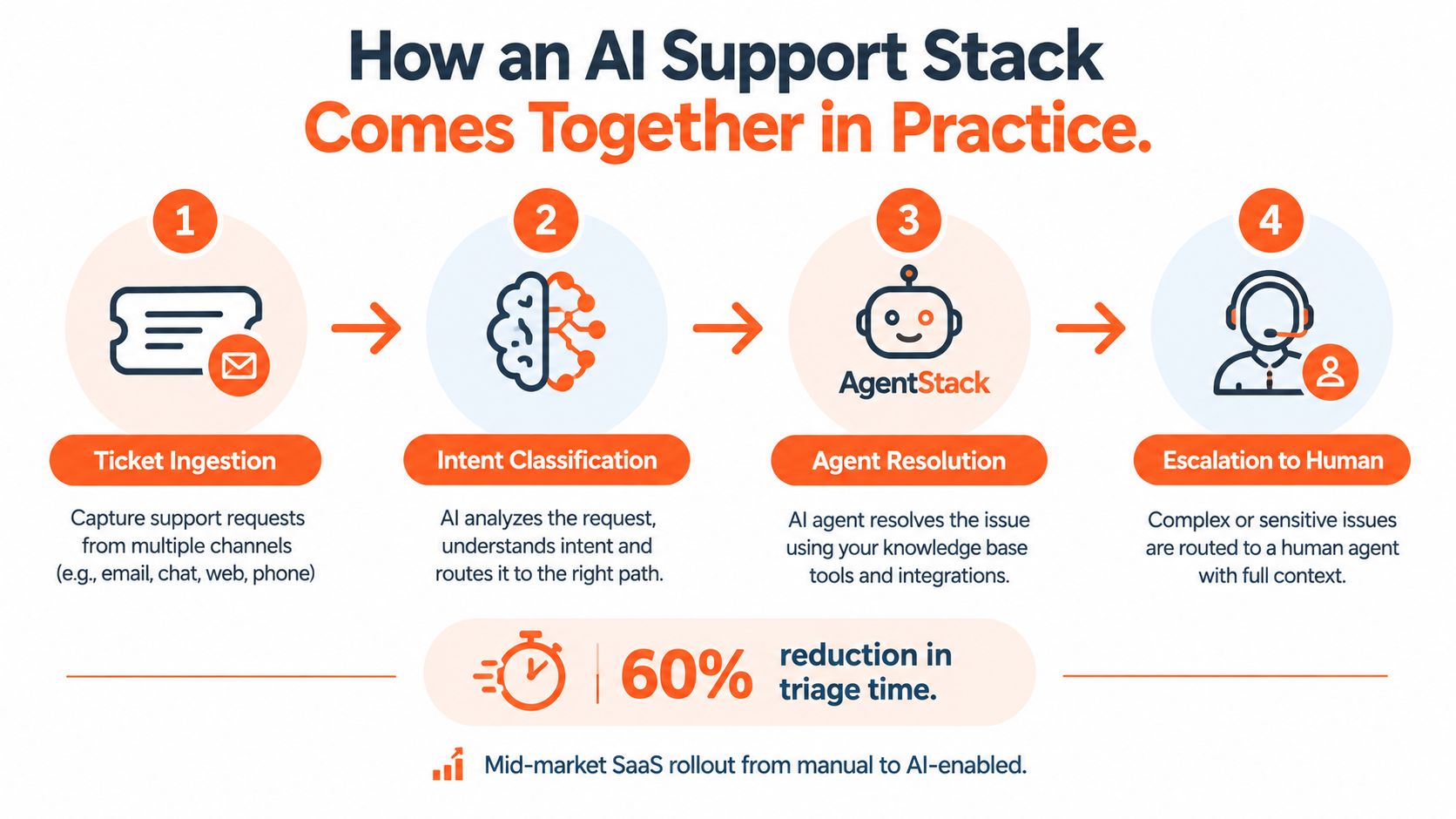
The first move is ingestion. Tickets, chats, emails, help center articles, product documentation, and internal answers flow into a unified knowledge base. The team removes duplicates, marks ownership, identifies conflicting policies, and records which content is safe for customer-facing use. Without that preparation, every downstream capability is working from uncertain material.
Sequence the rollout around decisions
Next comes orchestration. Classification determines intent, routing assigns the right workflow, and response generation produces an answer. Those jobs don't always need the same model. A fast model may handle simple classification, while a more capable model handles ambiguous policy questions or multi-step troubleshooting. Model selection should follow task requirements for accuracy, latency, and cost.
The team then adds channel-aware delivery. A web response can be conversational and detailed. An email reply may need a structured summary and links. A Slack response should fit the thread and avoid exposing information that doesn't belong in the channel. The same knowledge can support each channel, but the response format and permission rules need to change.
A platform such as AgentStack can ingest website and document content, orchestrate multiple models, deliver responses across web, email, Slack, and voice, and provide analytics plus shared-inbox escalation workflows. That makes it one reference point for evaluating an end-to-end stack, alongside other platforms and custom implementations.
Analytics should expose conversation volume, resolution outcomes, sentiment trends, and unanswered questions. Those signals tell the team what to fix next. A rising unanswered-question pattern may indicate missing documentation, a product usability problem, or an intent that shouldn't be automated yet.
Human handoff belongs in the initial design. Trigger it when confidence falls, sentiment drops, a policy boundary is reached, the customer requests a person, or the system detects risk. The human should receive the relevant context and the reason for transfer.
The verified media for this rollout includes a workflow illustration that contains a “60% reduction in triage time” callout. That figure isn't present in the verified data, so it shouldn't be treated as a measured result. The process itself remains the important lesson:
- Ingest and clean the knowledge.
- Classify intent and route work.
- Resolve routine cases with controlled automation.
- Escalate complex or sensitive cases with full context.
A Practical Roadmap Across Process, Governance, People, and Tech
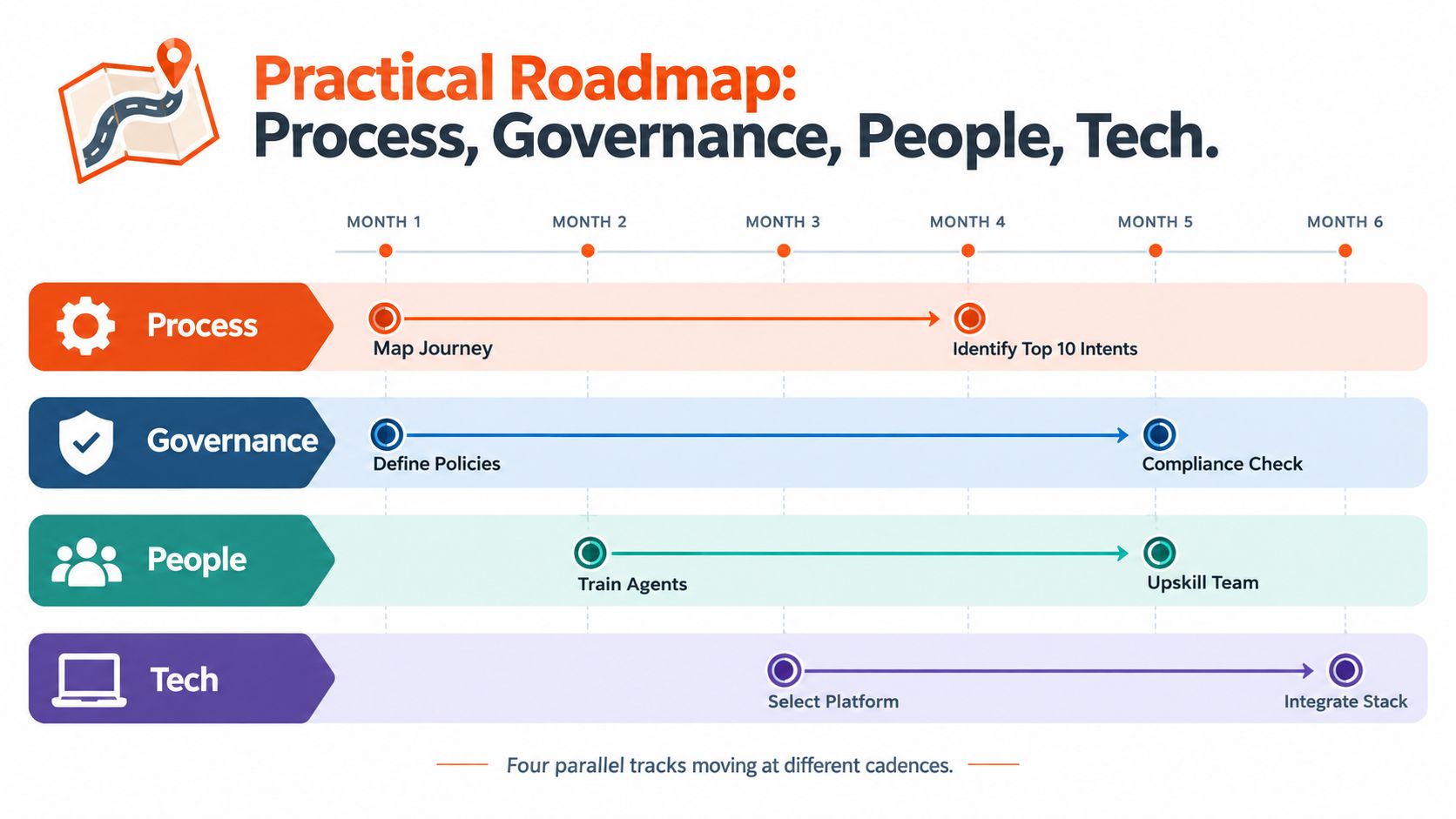
A serious rollout needs four parallel tracks. Process and governance should move first because they define what the technology is allowed to do. People and technology then mature against those decisions, with regular synchronization rather than a one-time handoff.
Process and governance
Process begins with the current customer journey. Map where a request enters, how it gets classified, which systems an agent checks, where delays occur, and how resolution is confirmed. Identify the highest-volume intents, then rewrite the standard operating procedure for each before automating it. Automation should execute a clear process, not conceal an inconsistent one.
Governance defines data handling, access, retention, escalation, review, and model-change approval. Write these rules at the start of the pilot, not after a tool is already answering customers. Include a named reviewer for policy-sensitive content and an incident path for incorrect or unsafe responses.
People and technology
People need practical training, not abstract AI awareness. Teach agents how to inspect generated answers, correct the knowledge source, tune prompts or instructions where appropriate, and take over without creating friction. Update quality assurance so reviewers score AI-assisted tickets for factual accuracy, context preservation, tone, and escalation judgment.
Technology should be assessed against ingestion depth, orchestration flexibility, integrations, analytics, permissions, auditability, and handoff design. A custom build may offer control but requires engineering ownership. A packaged platform may accelerate deployment but still needs careful configuration and governance. The right choice depends on the team's capability and risk profile, not the demo's visual polish.
The tracks don't need to move at identical speed. Process and governance should lead by four to six weeks where possible, while people and technology follow their decisions. Teams can re-sync monthly through a review that covers KPI movement, unresolved intents, policy changes, agent feedback, and customer complaints.
For a broader readiness lens beyond support tooling, teams can use the Synopsix digital transformation guide to assess organizational conditions that influence adoption. The practical principle is simple: choose the platform after defining the work, controls, and ownership it must support.
Common Pitfalls That Stall Support Innovation
The same failures recur across support programs. They aren't primarily vendor problems. They signal that the operating model hasn't been designed to sustain the change.
Pilots that never graduate usually have no exit criteria. The team launches a narrow experiment, watches a few conversations, and keeps the pilot open indefinitely. Ask: What result, quality threshold, and ownership decision would allow this workflow to expand or stop?
Over-automation happens when leaders optimize for containment before defining safe boundaries. Self-service adoption is growing, but one benchmark claims 70% of customers try self-service while 91% still fail to resolve issues without human intervention, leaving 9% of journeys fully contained (customer support KPI benchmark). Treat that benchmark cautiously, but take its operational warning seriously: customers still need people for ambiguity, risk, exceptions, and emotional situations.
Ignored handoff design creates a second queue of avoidable work. If an agent must reconstruct the conversation, identify what the system tried, and ask the customer to repeat the issue, automation has transferred effort rather than removed it. Ask: Can a new agent understand the bot-to-human transition quickly, including the reason for escalation and the next action?
Vanity metrics make weak programs look healthy. Conversation counts, bot sessions, and response volume don't prove resolution. Track recontacts, reopened cases, escalation quality, customer sentiment, and cost per resolved issue. Ask: What is happening to cost per resolved ticket and repeat contact over the latest reporting period?
The strongest teams use these questions in weekly operations reviews. They don't wait for a quarterly business review to discover that a rising containment rate is masking lower trust.
Your First 30 60 90 Days of Support Innovation
Start with a working team, not a procurement committee. Assign an executive sponsor, a support operations owner, a knowledge owner, an agent representative, and a technical owner. Each person needs a deliverable and an exit condition.
Days 1 to 30
The support operations owner runs a discovery sprint. Inventory tickets, chats, emails, documentation, permissions, and known policy constraints. Build a taxonomy of major intents, identify the first candidate workflow, and capture a KPI baseline across cost, coverage, consistency, and insight.
The exit criterion is a written current-state map, an owned knowledge inventory, and an agreed baseline. If the team can't explain how a case moves from arrival to resolution, it isn't ready to automate that case.
Days 31 to 60
The governance owner publishes data rules, review responsibilities, escalation criteria, and model-change controls. The support lead designs the human handoff and selects one high-volume, low-risk intent for a scoped pilot. A platform such as AgentStack can be evaluated here for ingestion and multi-model orchestration, but the workflow and guardrails must come first.
The exit criterion is a tested pilot with sampled conversations, documented failure modes, and a go or no-go decision. Don't expand because the demo feels good. Expand because the evidence supports the intended customer and operational outcome.
Days 61 to 90
The technical owner adds the next appropriate channel, while support operations instruments resolution, recontact, sentiment, escalation quality, and cost. The knowledge owner turns unanswered questions into content or product actions. Establish a recurring review where agents can challenge the system and owners must close identified gaps.
The exit criterion is a repeatable operating cadence, not just a live bot. You should know what the system handles, what it must escalate, who reviews changes, and which KPI determines the next investment.
AgentStack provides website and document ingestion, multi-model orchestration, omnichannel delivery across web, email, Slack, and voice, analytics, integrations, and human handoff workflows. Visit AgentStack to evaluate whether its stack fits the operating model you've defined, then test it against one measurable support workflow before expanding.