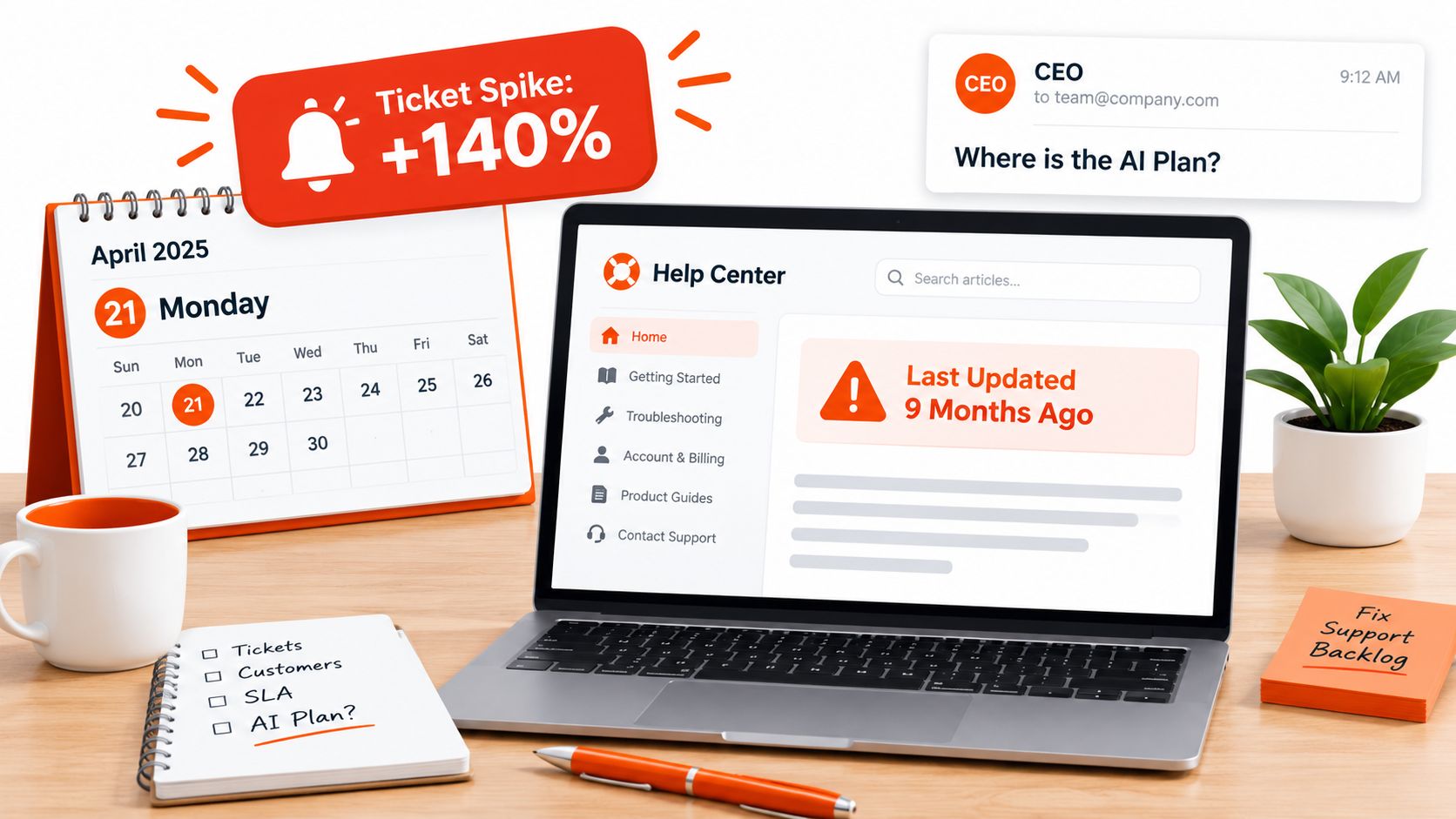
Monday morning starts with a release-related ticket spike, a help center that hasn't been updated in nine months, and an email from the CEO asking for an AI plan by Friday. The support team is still triaging manually, copying macros, and searching across product documents while customers compare every interaction with the instant answers they get from generative AI tools elsewhere.
That pressure is now normal. Leadership expects automation, customers expect continuity, and the operating model underneath often hasn't changed. The support digital transformation challenge isn't choosing an AI tool. It's building the knowledge, roles, measurement, governance, and workflows that allow automation to work reliably every day.
Table of Contents
- The Investment-to-Maturity Gap in Support Transformation
- What Support Digital Transformation Actually Means
- Setting the Right Objectives and KPIs
- Building the Implementation Roadmap
- Choosing the Technology Stack
- Managing the People Side of the Transformation
- A Real-World Transformation Story
- Your First 30 Days and What Comes Next
The Investment-to-Maturity Gap in Support Transformation
The decisive support transformation problem is not whether leadership will fund AI. It is whether the operating model can turn that investment into dependable daily performance. 82% of senior leaders invested in AI over the last 12 months, but only 10% said deployment was mature and fully integrated into support operations, according to Intercom's customer transformation report.
A support leader may have approval to buy technology while lacking a clean knowledge source, an agreed escalation policy, a success baseline, or an owner for post-launch improvement. The company has funded AI, but it has not yet redesigned support around it. That is why purchasing a chatbot rarely closes the maturity gap by itself.
The financial pressure still demands a plan. Conversational AI deployments in contact centers are projected to reduce agent labor costs by $80 billion globally by 2026, a Gartner-cited estimate reported by AmplifAI's customer service statistics. The same source reports that 73% of service organizations already run a chatbot, while 44% of support teams allocated part of their 2024 budget to chatbots. Those figures explain the buying pressure. They do not show that a chatbot will improve your operation.
Practical rule: Fund the operating model before funding broad rollout.
A durable transformation changes what support measures, how agents work, how knowledge is maintained, and how customers move between channels. It also establishes a management rhythm for reviewing quality, correcting failures, and deciding where automation should expand or stop.
Build the roadmap around that gap. The goal is mature support operations, not another impressive technology demo.
What Support Digital Transformation Actually Means
Support digital transformation is a connected operating system for customer service, not a product category. It combines objectives and KPIs, organizational design, knowledge operations, channel architecture, platform infrastructure, and change management. If one of those parts remains manual or disconnected, the new automation layer inherits the weakness.
Five connected pillars
Objectives and KPIs define the result customers and the business should experience. Deflection matters, but so do first-contact resolution, response time, customer satisfaction, escalation quality, and customer effort. A team that celebrates fewer tickets while customers open repeat contacts hasn't transformed support. It has moved work out of one queue and hidden it somewhere else.
Org design and agent roles determine who owns the new system. Agents won't answer fewer questions alone. Some will supervise AI conversations, some will handle complex cases, and others will curate the knowledge that powers automated answers. Performance reviews must recognize judgment, content quality, and useful feedback, not only tickets closed.
Knowledge operations turn solved interactions into reusable service capability. The workflow includes capturing reliable answers, removing duplicates, assigning owners, recording versions, reviewing stale articles, and feeding validated updates back into retrieval. A static help center is a document repository. A knowledge operation is a production process.
Channels and AI govern where automation appears and how customers move to people. Customers should be able to start in chat, continue through email, or reach voice support without losing intent, history, or resolution status. NICE's report on AI for an omnichannel world emphasizes the importance of unified interaction context across voice and digital channels.
Platform infrastructure provides identity, integrations, permissions, logging, retrieval, actions, and analytics. It's the layer that determines whether an assistant can safely access the right information and pass a useful handoff to an agent.
The operating model beats the chatbot
A tool-buying approach starts with a vendor shortlist. An operating-model approach starts with a customer journey, a ticket sample, and a decision about what the team is willing to automate. That distinction matters because the AI customer service market overview from TELUS Digital reports that 88% of contact centers use some form of AI, while only 25% have fully integrated automation into daily workflows.
The work is connected. Poor knowledge weakens answers. Weak handoffs create agent rework. Bad measurement rewards false deflection. Unclear roles make agents distrust the system. Transformation succeeds only when those failures are treated as operating-model defects, not isolated software bugs.
Setting the Right Objectives and KPIs
Start measurement in the first week, before the assistant answers a customer. Without a baseline, you can't distinguish genuine improvement from changes in ticket mix, seasonality, or customers giving up before reaching an agent.
Use four KPIs together. Each catches a different failure.
The four measures that matter
Deflection rate should measure the share of deflectable interactions resolved without a human, not the share of total tickets that disappear from an inbox. Exclude cases that require account access, judgment, refunds, security review, or other controlled actions. A high deflection figure can conceal bad answers if customers return through another channel.
First-contact resolution should follow the customer across channels. If a chat ends with an email follow-up, the case isn't resolved at first contact. Unified customer identifiers and resolution states make this measurement possible.
Time to answer needs two paths. Track AI-resolved interactions separately from human handoffs, and include the time required for an agent to understand the conversation and act. An instant automated reply followed by a slow, contextless escalation isn't a fast support experience.
CSAT impact from AI-handled interactions should be reported separately from overall CSAT. Otherwise, strong human interactions can mask poor automated ones. Read satisfaction alongside effort, repeat contact, fallback reason, and escalation outcome.
| KPI | What to measure | Typical baseline | 90-day target | Failure mode it exposes |
|---|---|---|---|---|
| Deflection rate | Resolved deflectable interactions without human involvement | Establish from ticket sampling | Improve only on approved use cases | Bad answers disguised as automation |
| First-contact resolution | Cases resolved without repeat contact or follow-up | Segment by channel and intent | Increase for selected intents | Repeat contacts hidden by channel silos |
| Time to answer | AI response and end-to-end human handoff time | Separate automated and assisted paths | Reduce waiting and handoff friction | Escalation cost hidden by fast replies |
| CSAT impact | Satisfaction for AI-only and AI-assisted flows | Report separately from total CSAT | Maintain or improve quality while scaling | Effort and poor answer quality masked |
The “typical baseline” and “90-day target” columns should contain your measured values, not industry averages. Use a practical customer service KPI framework to define event rules before dashboards go live.
Pick two primary KPIs for the first two quarters. I'd usually choose first-contact resolution and AI-handled CSAT, then use deflection and response time as guardrails. Trying to optimize all four at once encourages teams to chase volume instead of customer outcomes.
Building the Implementation Roadmap
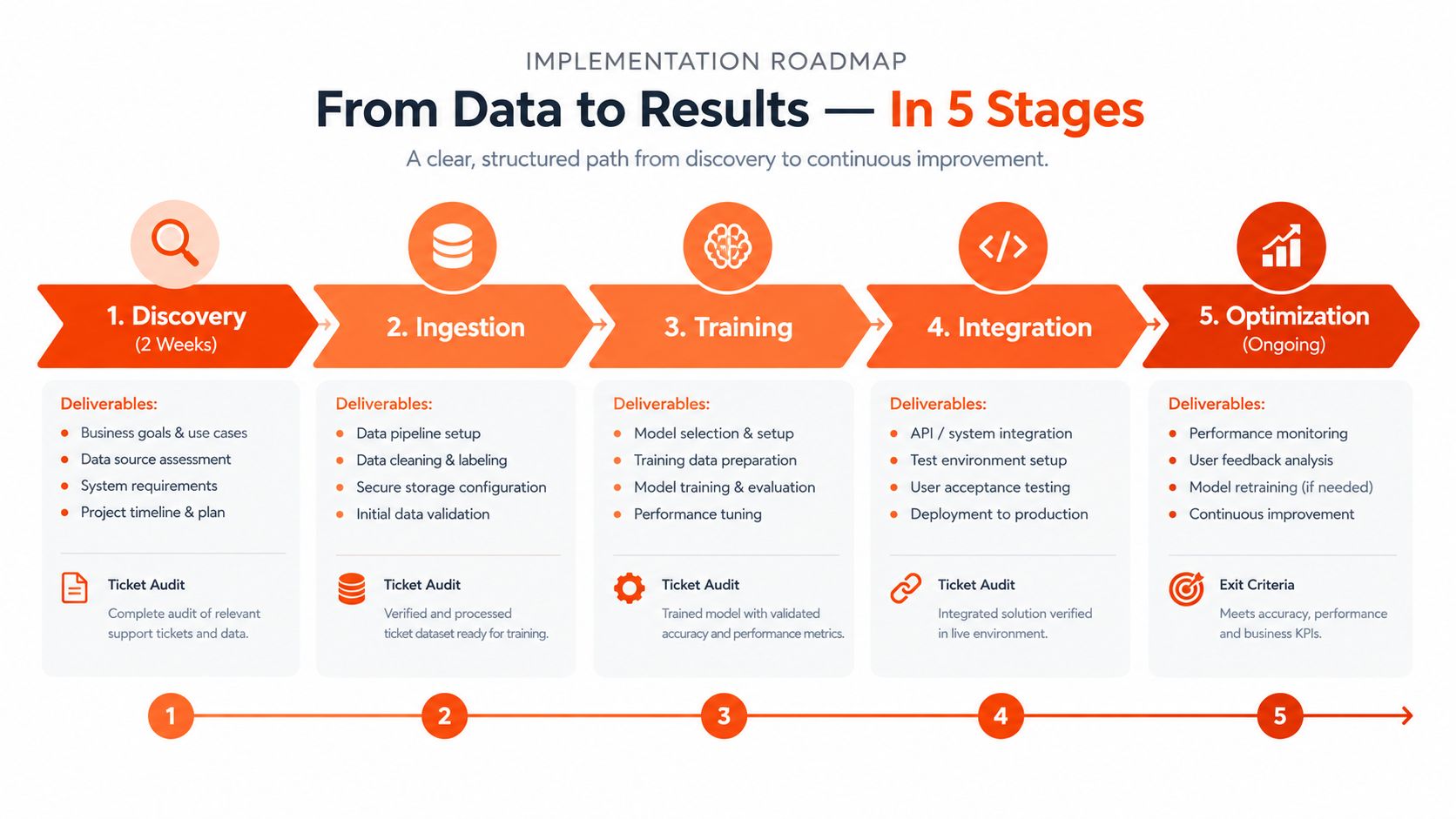
The implementation order matters. Start with discovery, then make the knowledge retrievable, then test the model, then connect channels, and only after that optimize continuously. Reversing the order creates an expensive front end on top of unreliable source material.
Stage one, discovery
Spend the opening phase sampling tickets, auditing channels, mapping intents, and identifying where agents lose time. Review help-center articles, macros, product documentation, past resolutions, and escalation patterns. Don't fill these weeks with vendor demos.
The deliverable is a written baseline and a prioritized use-case list. The exit criterion is agreement on one narrow, high-repeat workflow and the evidence needed to judge it.
Stage two, ingestion
Consolidate help-center content, macros, resolved tickets, product documents, and approved Q&A into one retrievable corpus. Remove duplicates, identify contradictions, assign content owners, and preserve version history.
Knowledge management works when teams create, organize, share, and apply information as a repeatable process. That principle is central to the research on knowledge management in omnichannel support. If ingestion quality is below 85% after six weeks, stop. Don't integrate a system that can't reliably find the right answer.
Stage three, training
Build evaluation sets from real customer questions. Test prompt behavior, retrieval quality, refusal behavior, confidence thresholds, and escalation rules. Gate deployment on a 90% answer-quality bar on a held-out set. The evaluation set must include ambiguous, outdated, adversarial, and high-risk questions, not only clean examples.
Stage four, integration
Connect the approved use case to the help widget, email, Slack, and agent desktop where relevant. Every handoff should carry the conversation, detected intent, customer identifier, retrieved sources, confidence signal, and suggested next action.
The exit criterion is a human agent receiving enough context to continue without asking the customer to repeat the problem.
Stage five, optimization
Optimization is permanent. Review deflection, first-contact resolution, escalations, fallback reasons, and low-confidence answers every week. Maintain a backlog of missing articles, conflicting policies, failed retrievals, and workflows that need a human decision.
Give every stage a named owner, deadline, and kill criterion. If nobody can stop a weak deployment, nobody owns its quality.
Choosing the Technology Stack
Technology choices should follow operating requirements. Don't begin by asking which model has the strongest benchmark performance. Ask which failure would hurt your customers most and which layer prevents it.
| Capability | When It Matters Most | Risk If Skipped | Build vs. Buy |
|---|---|---|---|
| Knowledge ingestion | Always, especially with scattered documents and changing product information | Confident answers from stale or duplicated content | Buy the ingestion and retrieval foundation unless you have a strong platform team |
| Multi-model orchestration | When tasks differ by reasoning depth, latency, cost, or specialization | One model handles every task poorly or inefficiently | Buy or use a managed routing layer; build only when routing is a core differentiator |
| Omnichannel delivery | When customers move between chat, email, Slack, in-app, or voice | Repeated explanations and fragmented resolution history | Buy channel connectors, then build only the workflows unique to your business |
| Analytics and handoff | From the first pilot onward | False deflection, invisible failures, and agent rework | Buy the core telemetry and handoff layer; build custom reporting around your KPIs |
Fund the layers in the right order
Knowledge ingestion is essential. A clean, deduplicated corpus with strong retrieval usually matters more than switching to a larger model. If your product documentation contradicts your macros, better reasoning won't repair the underlying conflict.
Multi-model orchestration is conditional. A single model can be enough for a focused support program. Add routing when you have a clear reason, such as sending routine classification to a faster model and complex troubleshooting to a model with stronger reasoning. Don't introduce orchestration just because a vendor slide makes it look impressive.
Omnichannel delivery is a data problem disguised as a channel problem. The chat widget, email system, in-app surface, Slack workflow, and voice agent must share customer identity and conversation state. Otherwise, every new channel creates another silo.
Analytics and handoff are the control system. Track confidence, fallback reasons, source usage, escalation causes, and agent actions. A customer who reaches a human after a weak automated answer hasn't been deflected. The work has been deferred.
For teams comparing platforms, an AI agent development platform overview is useful as a checklist of capabilities, but your decision should still follow your data model and handoff policy. AgentStack is one option that combines website and document ingestion, multi-model routing, web, email, Slack, and voice delivery, analytics, shared-inbox handoff, and developer integrations.
Managing the People Side of the Transformation
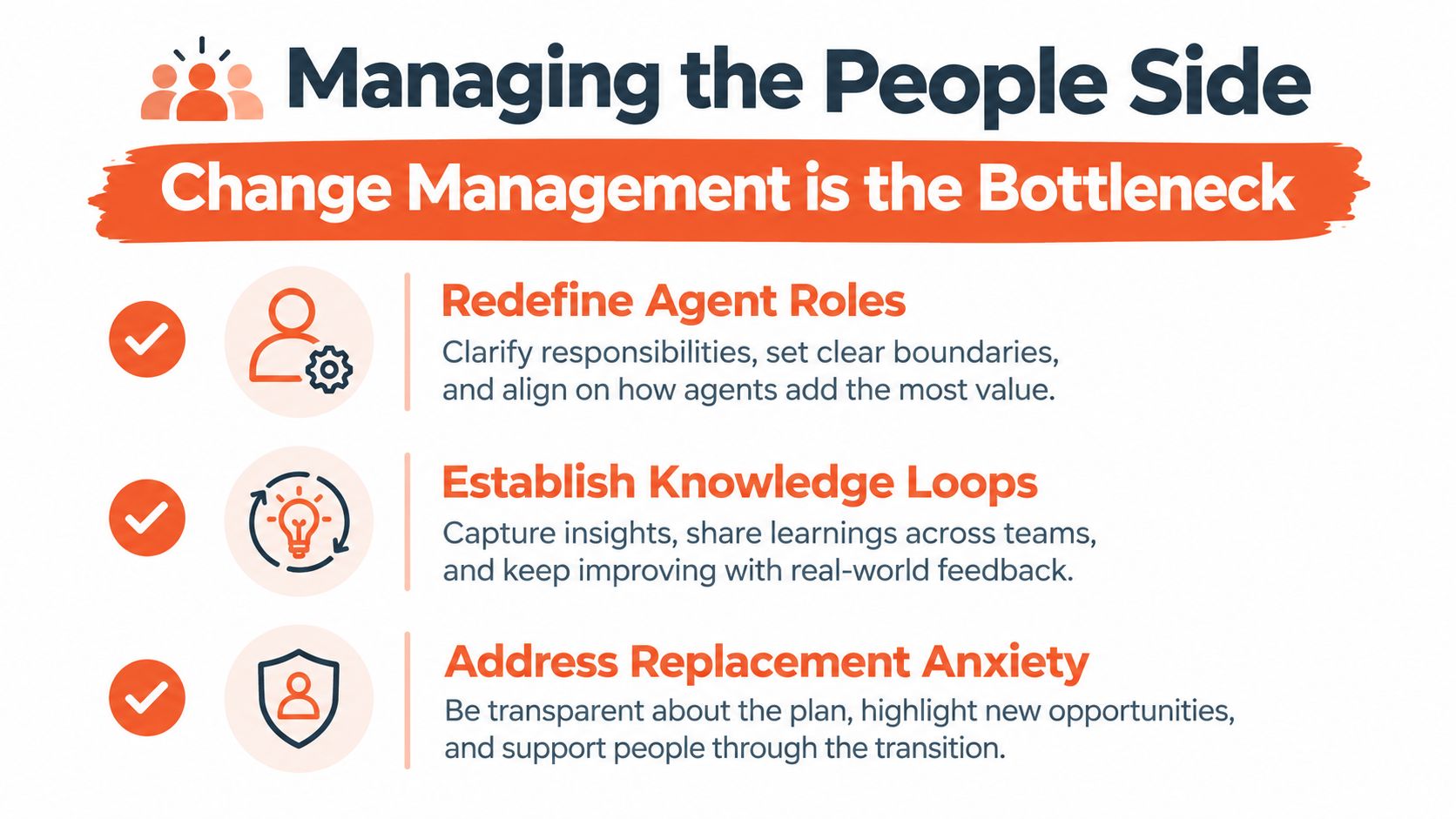
A support team facing an AI rollout will ask one question first: does this program remove our jobs? Answer it before rumors answer it for you. The intended shift is from repetitive replies to higher-value conversations, complex-case ownership, AI supervision, and knowledge improvement. If leadership cannot explain the new work, agents will assume the work being removed is theirs.
Model quality is rarely the bottleneck; roles, incentives, and protected improvement time are. Fund those operating changes before adding another tool.
A 90-day people plan
Days 1 to 30, appoint ownership. Name a knowledge owner and document responsibilities for content freshness, approvals, duplicate removal, and policy conflicts. Give that person protected time. “Everyone owns the knowledge base” means nobody does.
Days 31 to 60, redesign roles. Assign responsibility for AI supervision, complex-case ownership, and content curation. Update scorecards so agents receive credit for identifying poor answers, improving articles, reviewing low-confidence conversations, and resolving difficult cases. Ticket volume alone misrepresents performance once agents maintain and improve an automated system.
Days 61 to 90, close the loop. Hold weekly knowledge-gap reviews. Agents should triage low-confidence answers, classify the cause, and publish approved fixes to the knowledge corpus. QA should score answer accuracy, source grounding, escalation judgment, and handoff completeness.
The new support unit of work isn't the ticket. It's the answer system that prevents the next ticket.
Tie part of the support OKR to knowledge health. Keep the framework practical: check whether owners review stale content, recurring gaps receive fixes, and known failure patterns decline. The weighting can fit your team, but knowledge contribution must affect priorities and performance conversations.
AI creates maintenance work. Staff for it explicitly, including time for reviewing conversations, correcting content, and improving workflows. Treating that work as volunteer effort guarantees that it will be postponed during busy periods.
Without a weekly improvement loop, the system decays. Product changes make answers stale, customers expose edge cases, and agents stop trusting automation when nobody fixes its errors. Protect the loop in team schedules, assign an owner for every corrective action, and review completion with the same discipline as queue performance.
A Real-World Transformation Story
A mid-market SaaS company began its AI support transformation with an audit, not a company-wide launch. The example is a fictional composite, built to show the operating decisions that determine whether automation works. Its support operation had a 430-seat B2B platform and an 11-person support team, but the useful lesson is not the company's size. It is the sequence: establish measurement, repair the knowledge system, then expand automation.
Illustrative figures for a composite example, not a measured customer result.
In month one, the team established a baseline of 38% deflection, 11.4-hour first response, and CSAT of 4.1. They also defined how each metric was calculated and separated self-service outcomes from human resolutions. Months two through five are not reported here because the source notes do not support trend claims.
The team refused to manufacture improvement. A dashboard filled with positive movement creates false confidence and weakens operating decisions. Treat unreported results as unreported, then fix the measurement process before making performance claims.
What broke first
Month two exposed duplicate articles and conflicting macros. The ingestion process found several versions of order-management instructions, each written for a different product release. Deployment stopped while a senior agent took ownership as knowledge curator.
Month three introduced a narrow order-management use case. The assistant handled high-intent questions first, but the pilot exposed handoff latency. Agents received conversations without the relevant account context and had to reconstruct what the customer had already told the system.
Month four added email and in-app channels. Routing conflicts appeared because one customer could enter through multiple surfaces with different identifiers. The team corrected identity matching and escalation rules before expanding the pilot.
The human moments changed the outcome
The senior agent stopped treating documentation as administrative cleanup. The QA lead rebuilt scoring around grounded answers, useful escalation, and complete handoffs. Agents reviewed low-confidence conversations and classified the failures instead of dismissing them as model problems.
By month five, the team was retraining from resolved tickets and running a feedback loop. The available figures do not support claims about broad performance lifts or a 22% reduction in escalations. The operational result is clearer: source quality, handoff design, and ownership had to work before wider automation could be trusted. That is the transformation gap. Funding AI is easy. Building the operating model that keeps it accurate is the work.
Your First 30 Days and What Comes Next
Treat support digital transformation as a quarterly operating program with a named owner, a knowledge curator, and a funding line for retraining and review. The first month should produce decisions and evidence, not a polished AI announcement.
The first 30 days
- Baseline the four KPIs. Define event rules for deflection, first-contact resolution, time to answer, and AI-handled CSAT before deployment.
- Audit help-center decay. Find outdated articles, duplicates, contradictory macros, missing product workflows, and content with no owner.
- Choose one repeatable use case. Start with a narrow intent where customers ask similar questions and the business can tolerate controlled automation.
- Choose orchestration before vendor demos. Decide whether one model is sufficient, where routing may help, and which tasks require deterministic workflows or human review.
- Draft the handoff policy. Define confidence thresholds, prohibited actions, escalation triggers, required context, and agent ownership.
- Appoint the knowledge owner. Give that person authority, time, review responsibilities, and a clear path to product or policy owners.
Skip custom model building unless your support problem genuinely requires it. Don't replace the phone channel because a chatbot looks impressive. Don't replatform the CRM to compensate for unclear workflow ownership. Don't chase omnichannel parity before one use case proves that the knowledge and handoff economics work.
The next year is a maturity ladder, not a finish line. Move from baseline measurement to trusted retrieval, from narrow automation to controlled workflows, and from isolated channels to shared customer context. Maintain a continuous improvement cycle that turns every unresolved question into either a better article, a clearer workflow, or a deliberate human escalation.
The operating-model shift is simple to state and difficult to fake: support leaders must fund the people and processes that make automation dependable, not just the software that makes automation visible.
AgentStack helps support teams ingest website and document content, configure and deploy AI agents across web, email, Slack, and voice, and review conversations through analytics and human handoff workflows. If you're building a measured support digital transformation program, visit AgentStack to evaluate whether its ingestion, routing, channel, and review capabilities fit your roadmap.