You're heading into a leadership review with two numbers that seem impossible to reconcile. Since deploying an AI support agent, CSAT is climbing after individual conversations, yet NPS is flat or falling. The support team believes the rollout is working, product leaders see unresolved loyalty concerns, and nobody can agree which metric deserves attention.
This isn't a reporting problem. It's a measurement problem. NPS and CSAT capture different layers of the customer experience, so treating either one as a complete verdict can turn useful data into false confidence. The practical answer isn't choosing a winner. It's building a system that uses each signal for the decision it can actually support.
Table of Contents
- The Support Leader's Dilemma
- Understanding NPS and CSAT Fundamentals
- Key Differences Between NPS and CSAT
- Interpreting Your Scores Accurately
- Overcoming Survey Fatigue in Practice
- Leveraging AgentStack for Unified Analytics
- Building a Combined Measurement Strategy
- Your Action Plan for Metric Mastery
The Support Leader's Dilemma
A head of support at a growing SaaS company often sees the contradiction first. After an AI rollout, customers get faster answers, more consistent troubleshooting, and fewer handoffs for routine questions. The post-interaction survey looks healthy. Agents can point to resolved tickets and positive comments.
Then the quarterly relationship survey arrives. Customers still complain about product gaps, difficult onboarding, confusing billing, or a roadmap that doesn't match their priorities. NPS remains weak even though the latest support interaction went well.

The mistake is asking one score to answer two different questions:
- CSAT asks whether a specific experience met expectations.
- NPS asks whether the broader relationship is strong enough for a customer to recommend the company.
A customer can be satisfied with a helpful answer and still feel frustrated by the product. Another customer can rate a support conversation poorly because the requested outcome wasn't possible, while still valuing the platform and intending to stay.
Practical rule: A strong CSAT result proves that a touchpoint worked. It doesn't prove that the customer relationship is healthy.
That distinction matters even more in AI support environments. Automation can improve response quality, tone, and availability while leaving pricing, reliability, integrations, and product usability untouched. If leaders look only at the immediate interaction, they may expand automation without addressing the reasons customers remain reluctant to recommend the business.
Use CSAT to manage the work your support operation controls directly. Use NPS to test whether repeated experiences, product decisions, and relationship moments are strengthening loyalty. The apparent contradiction becomes useful once each metric has a defined job.
Understanding NPS and CSAT Fundamentals
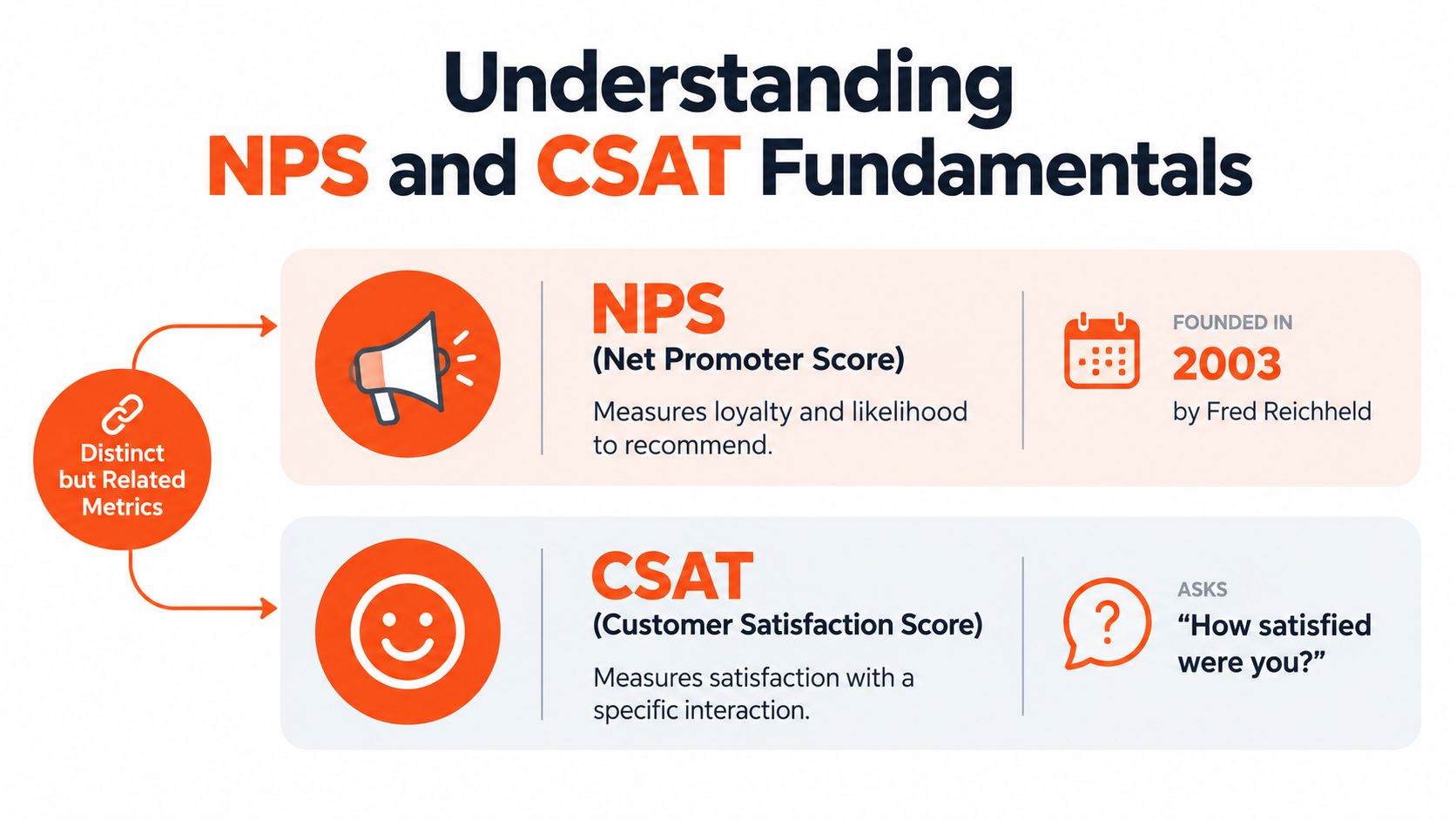
Net Promoter Score, or NPS, is a relationship metric. Fred Reichheld introduced it at Bain & Company in 2003, and the Harvard Business Review article “The One Number You Need to Grow” helped popularize the recommendation question as a simpler alternative to traditional satisfaction measures. Bain describes NPS as a score calculated by subtracting the share of detractors from the share of promoters, using a standardized range from -100 to +100 (Bain's overview of NPS).
The question asks customers how likely they are to recommend the company or product on a 0–10 scale. Promoters are the strongest advocates, passives sit in the middle, and detractors express the greatest risk of negative sentiment. The score is useful because it compresses a broad loyalty signal into a trend leadership can monitor across segments and time periods.
Customer Satisfaction Score, or CSAT, is a transactional metric. It asks how satisfied a customer was with a particular product, service, or interaction, usually immediately after the experience. Teams commonly report the share of respondents selecting the highest satisfaction options, which makes CSAT practical for monitoring ticket handling, chat resolution, onboarding steps, or purchase experiences. IBM's explanation of NPS and its relationship with satisfaction metrics provides useful context on why immediate satisfaction and longer-term loyalty shouldn't be treated as interchangeable (IBM's guide to Net Promoter Score).
A simple mental model
Think of CSAT as a temperature check after an event. It tells you how the customer felt about what just happened. That makes it close to the workflow, agent, channel, and resolution.
Think of NPS as a broader health check. It reflects the accumulated relationship, including support, product value, trust, reliability, and the customer's willingness to put their reputation behind a recommendation.
The two measures are related because support experiences contribute to the relationship. They aren't duplicates, and there isn't a reliable conversion that turns one score into the other. Teams exploring how customer sentiment can be connected to public reviews may also find Bragly social proof analytics useful for comparing recommendation signals with external customer feedback.
The distinction should shape both survey design and ownership. Support leaders can act on a poor CSAT response by reviewing the interaction, improving a knowledge article, or changing an escalation rule. A weak NPS result usually requires broader investigation, because the cause may sit outside the support queue.
Key Differences Between NPS and CSAT
The operational choice is straightforward once the question is clear. If you need to know whether this interaction worked, use CSAT. If you need to know whether the customer relationship is generating loyalty and advocacy, use NPS.
| Dimension | NPS | CSAT |
|---|---|---|
| Primary signal | Relationship loyalty and likelihood to recommend | Satisfaction with a specific experience |
| Typical timing | Periodic relationship check-ins or milestones | Immediately after a ticket, call, chat, or other touchpoint |
| Core question | Likelihood to recommend on a 0–10 scale | Satisfaction with the recent interaction or service |
| Calculation | Percentage of promoters minus percentage of detractors | Usually the percentage selecting the top satisfaction options |
| Scale | Standardized from -100 to +100 | Commonly reported as a percentage |
| Best operational use | Track relationship direction and advocacy | Find friction in a workflow and improve service recovery |
| Sensitivity | More stable across repeated interactions | Highly sensitive to response time, tone, and resolution completeness |
| Main limitation | Too broad for diagnosing one support failure | Too narrow to represent overall loyalty |
The timing difference drives much of the interpretation. A CSAT survey sent after a ticket is still tied to the customer's memory of that ticket. A customer may reward a courteous explanation even if the underlying product defect remains unresolved. NPS asks the customer to assess the relationship with more distance, so it can reveal accumulated frustration that a single successful interaction temporarily hides.
CSAT is therefore valuable for coaching and process management. Segment it by channel, issue type, resolution status, or handoff path. NPS is more useful for strategic review. Segment it by customer maturity, plan, product area, or relationship milestone, then investigate the comments behind material changes.
Neither metric predicts everything. NPS shouldn't replace retention analysis, and CSAT shouldn't become a proxy for product quality. The strongest programs connect the two without collapsing them into one blended score.
Interpreting Your Scores Accurately
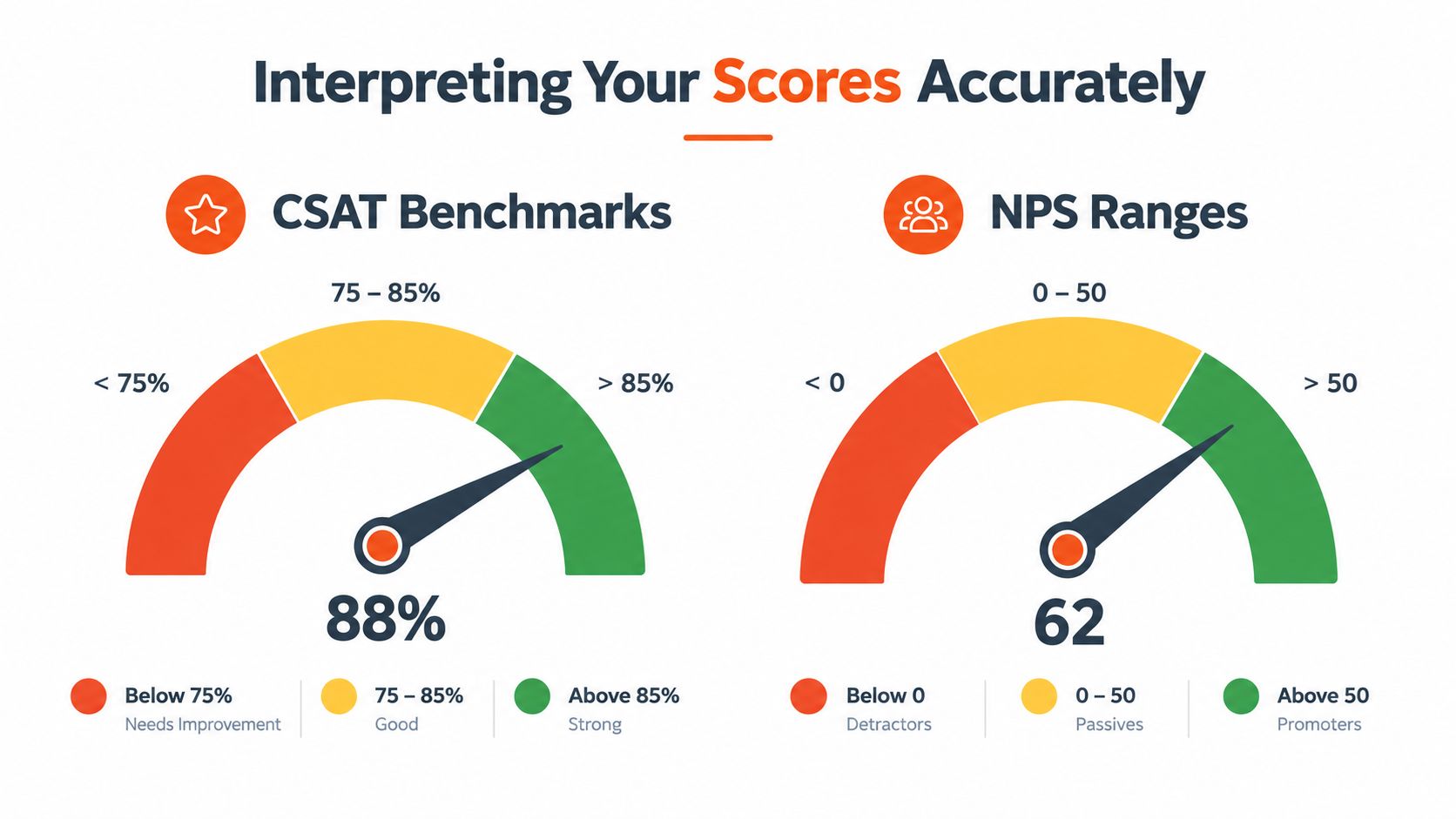
A score only becomes useful after you define what action it should trigger. For CSAT, independent CX guidance commonly interprets above 75% as good, above 85% as strong, and above 90% as excellent, while retail and e-commerce teams often target 75–85% and B2B software teams often aim for 80% or higher (SmartSurvey's customer satisfaction metrics guidance). These are directional thresholds, not universal laws. A score without channel, segment, response volume, and question context can mislead.
NPS needs a different reading model. Because it ranges from -100 to +100, a negative score means detractors outweigh promoters, zero reflects balance, and a positive score means promoters outnumber detractors. Industry context matters, so leadership should focus on movement within comparable segments rather than treating a single cross-industry benchmark as a target.
When the scores disagree
The most useful cases are often the uncomfortable ones:
- High CSAT and low NPS: Support interactions are working, but customers may dislike pricing, onboarding, product limitations, reliability, or the overall value proposition.
- Low CSAT and stable NPS: A difficult interaction may be isolated, or customers may trust the product enough to tolerate occasional service failures.
- High scores on both: Preserve the operating conditions that produced the result, then verify that response bias isn't hiding dissatisfied customers.
- Low scores on both: Prioritize immediate service recovery while investigating broader relationship drivers.
Recent CX coverage illustrates why divergence deserves attention. In a reported Q1 2026 example, Banking and Credit Unions showed 72% CSAT while NPS was 19, and NPS had fallen 22 points from Q1 2025 to Q1 2026 (GreenBook's analysis of misleading CX metrics). The lesson isn't that those values define every industry. It's that a satisfactory interaction score can coexist with a weaker relationship signal.
When you see a gap, don't average the scores. Join the underlying records where possible. Compare the customer's recent CSAT history with their NPS comment, unresolved issue categories, escalation history, product usage, renewal status, and account segment. That investigation turns a dashboard anomaly into a decision about product, policy, staffing, or automation.
For a practical framework on interpreting satisfaction signals alongside operational context, see this guide to customer satisfaction metrics.
Overcoming Survey Fatigue in Practice
Survey fatigue can damage both metrics before a support leader notices. Recent guidance reports that email response rates for NPS and CSAT programs fell from about 20–25% in 2019 to 10–15% in 2025, while customers receive roughly 3–5 feedback requests per week across channels (User Intuition's analysis of declining survey response rates). When response becomes voluntary and repetitive, the people who answer may be unusually happy, unusually frustrated, or simply more willing to complete surveys.
AI support makes this easier to get wrong. An automated agent can close many conversations quickly, and a naive trigger can send a CSAT request after every one. Customers then experience the measurement system as another source of interruption.
Put frequency controls before automation
Start with a contact policy, not a survey tool.
- Cap invitations: Decide how often one customer can receive a feedback request across email, chat, and in-product channels.
- Create a recontact window: Recent guidance recommends waiting 30–60 days before recontacting a customer for another survey, especially when multiple channels are involved.
- Match the question to the event: Send transactional CSAT after a meaningful resolution, not every automated message or status update.
- Keep the form short: A one- or two-question CSAT form reduces effort while preserving room for an optional explanation.
- Suppress duplicates: If a customer has already responded about the same issue, don't ask again because another workflow fired.
Protect the signal
Segment invitations by customer lifecycle, issue type, and channel. A new customer completing onboarding needs a different measurement opportunity from an established account that just received a billing correction. Keep NPS for relationship moments and use CSAT where the team can act on the response quickly.
Review response rates and respondent mix alongside the scores. A rising CSAT with a shrinking or increasingly polarized respondent group isn't automatically an improvement. It may indicate that the most engaged customers are answering while everyone else has stopped participating.

The operating principle is simple: collect fewer, better-timed responses and add context to every trend. A quiet customer base isn't necessarily a satisfied customer base.
Leveraging AgentStack for Unified Analytics
The operational challenge isn't collecting NPS and CSAT separately. Most support teams can launch two survey forms. The harder problem is connecting each response to the conversation, channel, issue, resolution path, and subsequent action without forcing analysts to reconcile disconnected exports.
AgentStack can serve as one option for teams that want support delivery and analytics in the same operating environment. Its platform ingests website and document content, supports responses across web chat, email, Slack, and voice, and provides analytics for conversation volumes, resolution outcomes, sentiment trends, and unanswered questions. Those views don't replace a dedicated survey platform, but they can supply the operational context that raw scores lack.
Connect the score to the work
A useful dashboard should let a support leader move from signal to investigation:
- Start with the trend. View CSAT by channel, issue category, automation path, and handoff status.
- Locate the exception. Find conversations with poor sentiment, incomplete resolution, repeated contact, or a mismatch between a positive rating and unresolved intent.
- Review the evidence. Use conversation history and exportable audit logs to understand what the customer asked, what the agent answered, and where the workflow failed.
- Close the loop. Update the knowledge source, routing rule, escalation policy, or human training process.
- Compare relationship outcomes. Examine whether operational improvements coincide with healthier NPS trends in the relevant customer segments.
The shared inbox matters because score analysis shouldn't end in a spreadsheet. Human agents need a clear handoff path when automation can't resolve the issue, and managers need to see whether those escalations create recurring dissatisfaction. Real-time sentiment tracking can help prioritize conversations for review, while unanswered-question analysis can expose knowledge gaps that low CSAT alone won't explain.
The platform's analytics dashboard examples show the kind of operational visibility teams should expect from a measurement layer. The key design principle is tool neutrality: survey data can remain in the system that owns it, while support analytics supplies the conversation context needed for interpretation.
A unified workflow also clarifies what the metrics cannot prove. High CSAT after an automated interaction doesn't demonstrate that automation caused stronger loyalty. Low NPS doesn't prove that support failed. Teams need linked evidence, consistent sampling, and a review process that distinguishes interaction quality from relationship health.
Building a Combined Measurement Strategy
Choosing between NPS and CSAT creates a false constraint. The better question is where each metric earns the right to be asked.
Place CSAT close to the event. After a resolved chat, ticket, voice interaction, or onboarding step, ask whether the customer was satisfied with that experience. Route low responses into service recovery, conversation review, or workflow analysis while the context is still available.
Place NPS at a relationship milestone. An onboarding review, recurring account conversation, renewal discussion, or broader customer check-in gives the respondent enough context to evaluate the relationship rather than a single exchange. Keep the wording and scoring method consistent so changes remain interpretable.
Build the calendar around decisions
A practical measurement calendar has three layers:
- Transactional layer: CSAT after selected support outcomes where the team can make a direct improvement.
- Relationship layer: NPS at deliberate customer milestones, with suppression rules that prevent overlapping invitations.
- Diagnostic layer: Open-text feedback, conversation analysis, and account context used to explain movement in either score.
Each layer needs an owner. Support operations should review CSAT patterns and assign workflow actions. Customer success or account leadership should investigate NPS themes with product and commercial teams. Someone must also own the survey policy, including frequency caps, exclusions, and recontact windows.
This approach avoids a common failure mode: collecting every possible response and acting on none of them. Teams designing the automation layer can also review customer feedback automation software for ideas on routing responses, triggering follow-up, and reducing manual processing.
The success test is not a larger dashboard. It's a traceable chain from customer feedback to a change in service, product, or policy, followed by a review of whether the relevant signal improved.
Your Action Plan for Metric Mastery
Start with an audit of the program you already have. List every NPS and CSAT invitation, identify the event that triggers it, record the owning team, and check whether customers can receive overlapping requests. Remove surveys that don't lead to a decision.
Then define the job of each metric:
- Use CSAT to diagnose immediate service quality and workflow friction.
- Use NPS to monitor relationship loyalty and advocacy direction.
- Use qualitative feedback to explain why either score moved.
- Use operational data to test whether the suspected cause appears in conversations, escalations, or unresolved issues.
Create a review rhythm that makes action visible. Support leaders can inspect CSAT themes and low-score conversations regularly, while cross-functional leaders review NPS trends at relationship milestones. Keep a decision log showing the change made, the customer segment affected, and the signal that should move if the intervention works.
Finally, validate the infrastructure. Your system should preserve survey source, timestamp, channel, customer segment, conversation ID, resolution outcome, and follow-up status. It should also support frequency controls, human handoff, auditability, and exports for deeper analysis.
The best NPS and CSAT programs don't maximize responses. They maximize useful decisions. When the metrics have separate jobs and shared context, support teams can improve today's interaction without losing sight of tomorrow's relationship.
AgentStack helps teams deploy AI support across web chat, email, Slack, and voice while analyzing conversation volumes, resolution outcomes, sentiment trends, and unanswered questions in one workspace. Visit AgentStack to connect operational support data with a more disciplined NPS and CSAT measurement process.