92% of contact centers run a formal QA program, yet manual reviews still cover only 2% to 5% of interactions. AI can expand coverage, but without the right scorecard and governance, it can widen blind spots instead of closing them.
That gap changes the job. Support quality assurance is no longer mainly about listening to a few calls, marking coaching opportunities, and reporting an average score. It's a control system for customer trust across human conversations, AI-assisted replies, and fully automated resolutions.
A mature program must show whether the customer received a correct and complete answer, whether the interaction stayed within policy and brand standards, and whether the result can be explained and reproduced. Coverage is necessary, but coverage alone isn't quality.
Table of Contents
- What Support Quality Assurance Actually Means Now
- How Support QA Got From Spot Checks to 100% Coverage
- The Core QA Process From Ticket to Coaching
- KPIs That Matter Beyond Average Handle Time
- Choosing the Right Mix of Humans, AI, and Analytics
- Why AI Coverage Without Governance Makes QA Worse
- A 90 Day Plan to Rebuild Support QA From Scratch
- What a Mature Support QA Function Looks Like Next
What Support Quality Assurance Actually Means Now
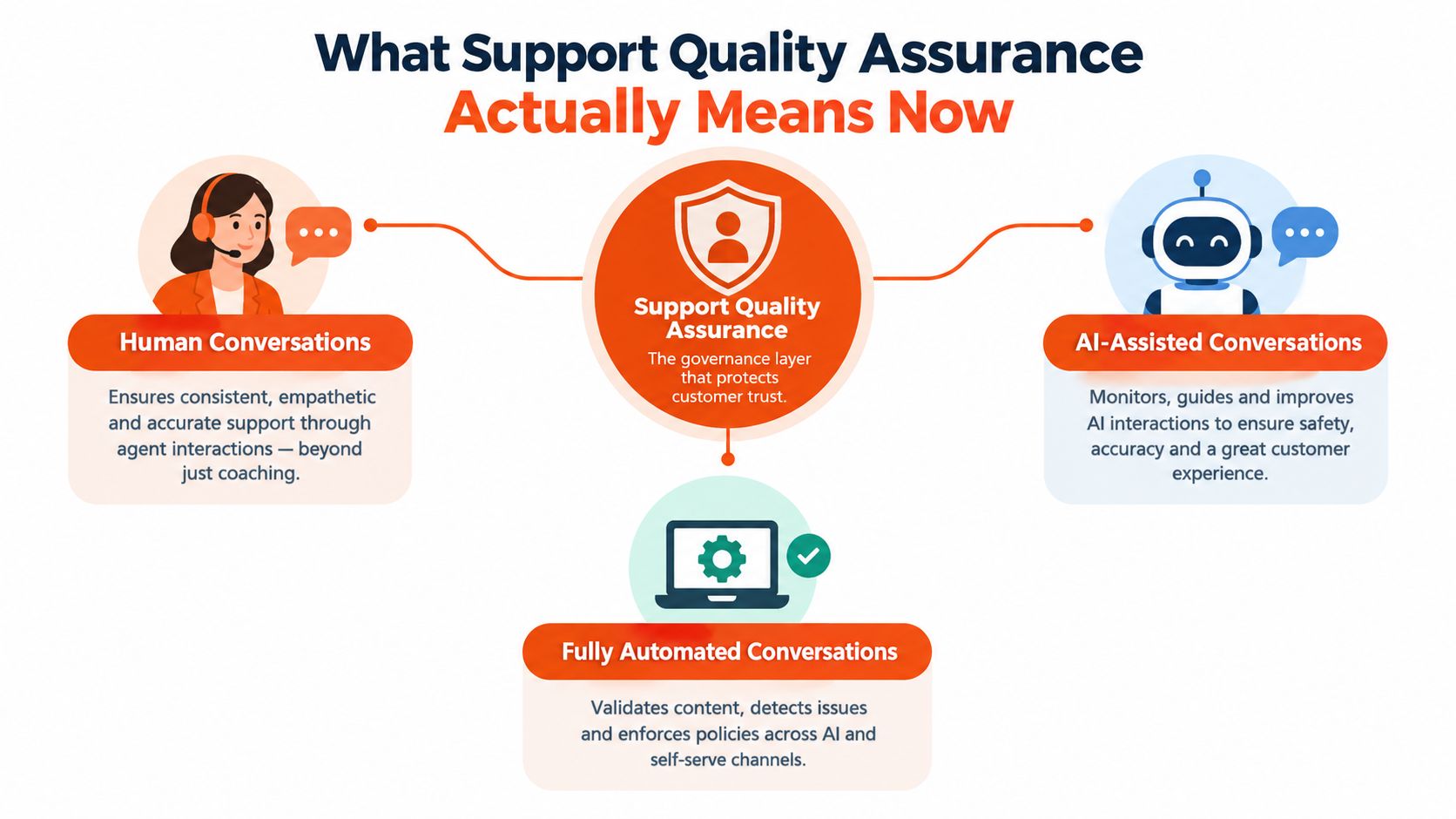
Support quality assurance is the governance layer that defines acceptable service, tests every channel against that standard, identifies risk, and feeds evidence back into the operation. That operation may include human agents, AI copilots, autonomous agents, knowledge-base content, routing rules, macros, and escalation workflows.
This is broader than agent coaching. Coaching remains important, but it's an output of QA rather than its entire purpose. A support QA function should answer three practical questions:
- Was the resolution correct? The answer must address the customer's actual issue, not merely sound fluent.
- Was the interaction safe and compliant? The response must respect policy, privacy, approval boundaries, and escalation rules.
- Can the team explain the result? Reviewers need evidence showing what source, instruction, action, or failure produced the outcome.
That definition brings several disciplines together. Call calibration aligns reviewers on how to apply a scorecard. Ticket auditing tests individual interactions against process and policy. Conversation intelligence identifies themes, sentiment changes, and recurring friction. Outcome analytics connects support activity to resolution quality and customer results. Treating these as separate silos makes it harder to see whether a weak answer came from an agent, a prompt, a knowledge gap, or a broken workflow.
The quality signal must travel upstream
A failed interaction shouldn't end as an agent score. It should create an actionable record for the person who can fix the cause:
- A missing policy belongs with the knowledge manager.
- A poor handoff belongs with the conversation designer or routing owner.
- An unsafe automated answer belongs with the AI product owner.
- A repeated human error belongs in targeted coaching.
- A misleading scorecard item belongs with the QA program owner.
Teams building this operating model should also connect QA to knowledge-centered support practices, because reliable answers depend on how well customer knowledge is captured, maintained, and reused.
Practical rule: Score the interaction, then investigate the system that made the interaction likely.
How Support QA Got From Spot Checks to 100% Coverage
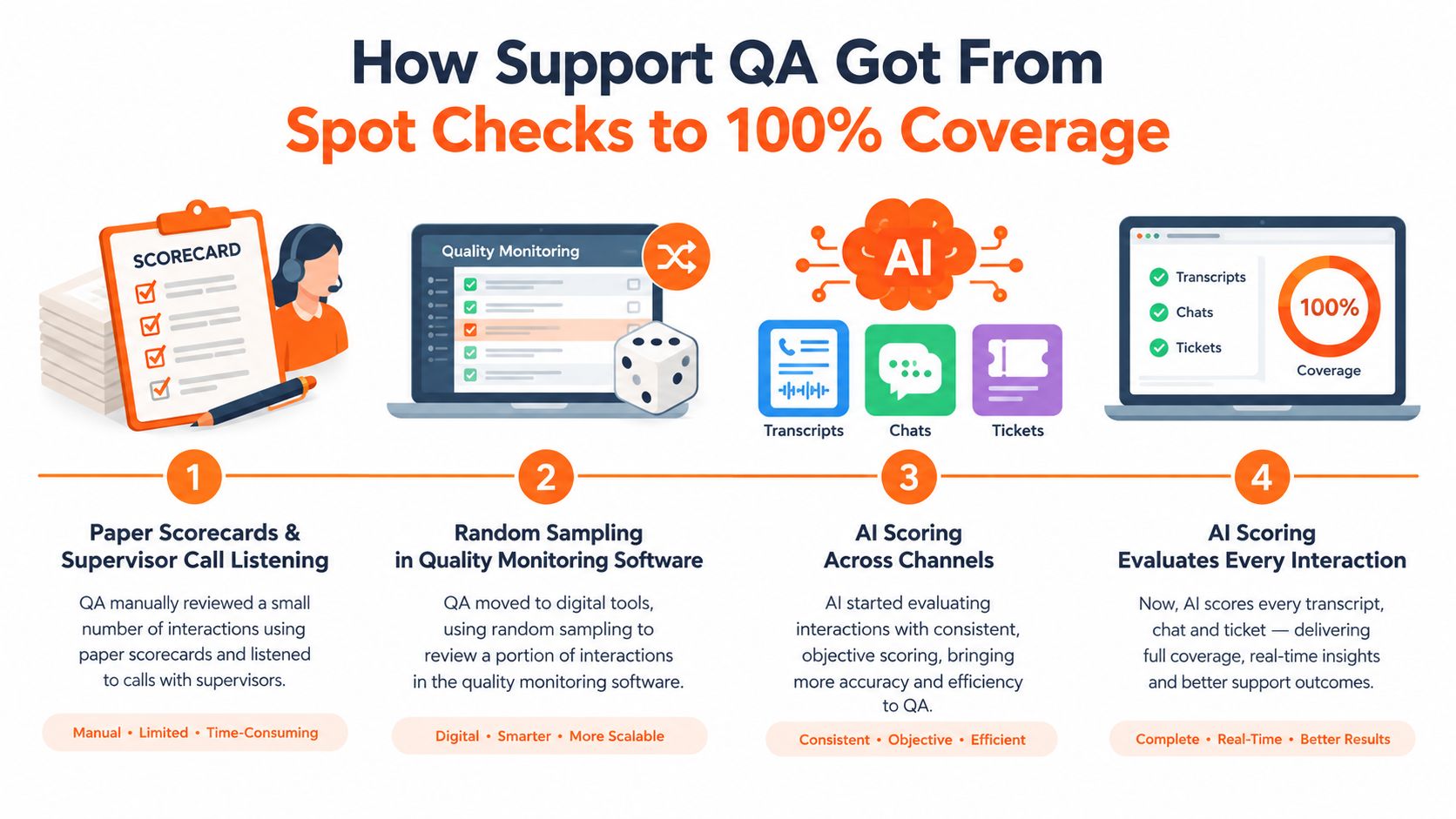
Early support QA depended on supervisors listening to recorded calls, reading tickets, and completing paper or spreadsheet scorecards. As contact centers adopted quality-monitoring software, random sampling made the process more consistent, but it preserved the basic limitation: reviewers still assessed a small subset and inferred what the wider operation looked like.
That inference became less reliable as support spread across voice, chat, email, social messaging, and asynchronous ticket threads. A sampled call might show excellent compliance while an unreviewed email workflow routinely produced incomplete answers. A team could celebrate a healthy average score while missing a concentrated failure in one language, channel, product area, or automation path.
The scale problem is visible in the historical data. One industry compilation reported that manual review covers only 2% to 5% of customer interactions, leaving 95% to 98% unreviewed, while 85% of teams struggle to find time for QA. These figures come from the 2026 customer support QA statistics compilation. The issue isn't that sampling has no value. It's that a sample can't reliably expose every high-risk pattern in an omnichannel operation.
Standardization came before automation
Formal QA frameworks matured before AI scoring became practical. A 2018 global survey summary classified call-center QA processes as 11% basic, 16% somewhat basic, 34% somewhat optimized, and 39% optimized. The distribution, reported in Amplifai's customer service statistics overview, shows a field moving beyond ad hoc review, but not uniformly reaching optimization.
Speech analytics, transcription, and language models changed the economics of review. Systems can now evaluate transcripts and tickets against repeatable criteria, identify exceptions, and direct human attention toward ambiguous or high-risk cases. Supervisors no longer need to decide which handful of calls deserves attention before they know where the risks are. They can triage exceptions, inspect evidence, and use human judgment where it adds the most value.
The cultural shift matters as much as the technical one. Sampling positioned QA as inspection. Broad coverage positions QA as operational feedback, where every failure can inform coaching, product fixes, knowledge updates, and safer automation.
The Core QA Process From Ticket to Coaching
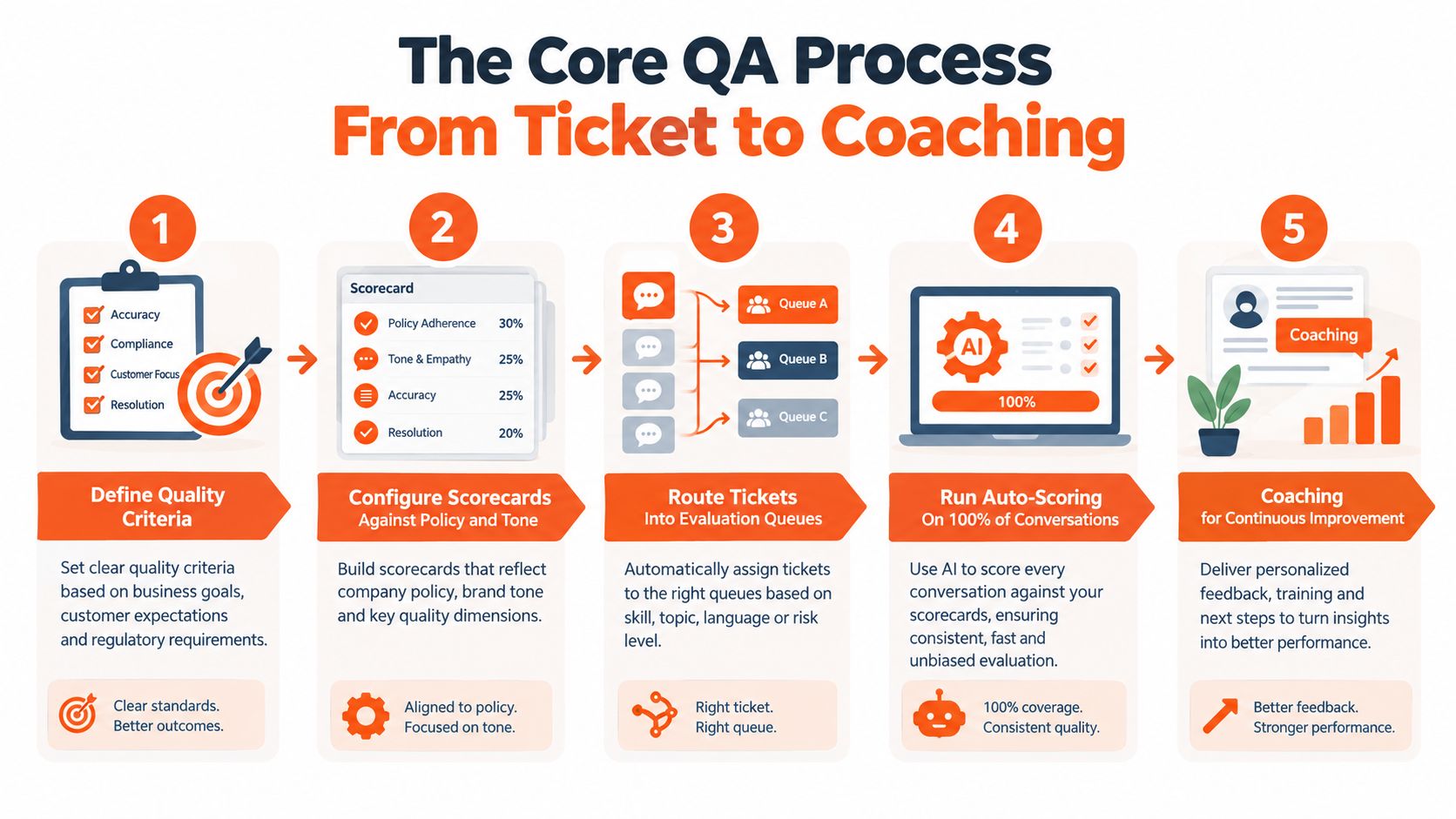
A dependable QA program runs as a closed loop. It begins with a definition of quality and ends only when the team has changed the behavior, content, or system that caused the failure.
1. Define the standard before scoring
Start with the customer outcome and the risk boundary. A useful scorecard might evaluate resolution correctness, completeness, policy adherence, tone, escalation judgment, and evidence quality. Avoid vague items such as “communicated well.” Write observable criteria that two reviewers can apply to the same conversation and reach a defensible conclusion.
Create scorecard variants where interaction types differ. A billing dispute, technical incident, account-access request, and automated password workflow don't carry identical risks. Keep shared principles consistent, but adapt the evidence requirements and critical-failure rules.
2. Configure evaluation and evidence
The QA analyst turns policy into scoring logic. Every material score should point to supporting text, an action record, or a clearly identified omission. Low-confidence evaluations should enter a human review queue rather than being incorporated into performance data without review.
Route interactions by channel, language, customer segment, automation path, issue type, and risk. Analytics can help identify unusual patterns, while the scorecard supplies the formal judgment.
3. Review, calibrate, and resolve disputes
Run a weekly calibration ritual with QA analysts, team leads, and the owners of conversation or knowledge design. Each reviewer scores the same difficult interactions independently, compares decisions, and records the rule that resolves disagreement. Track score variance, disputed evaluations, and the time needed to settle them.
Run a monthly audit cycle on score explanations, critical-error handling, routing accuracy, and appeal outcomes. Hold a quarterly scorecard review with compliance, operations, product, and knowledge stakeholders. Policies change, and a frozen rubric eventually measures yesterday's service.
4. Turn findings into coaching and system changes
Team leads use interaction evidence in coaching conversations. Knowledge managers update missing or confusing documentation. Conversation designers revise prompts, instructions, and fallback language. Product owners investigate recurring defects that agents and AI systems can't solve through better wording.
For teams that need a practical reference for inspecting transcripts and identifying failure patterns, customer service chat transcript guidance can support the review workflow.
A score without a follow-up owner is only a label. Assign every recurring failure to a person, a deadline, and a verification step.
KPIs That Matter Beyond Average Handle Time
Average handle time is useful for capacity planning, but it can reward rushed answers. A shorter interaction isn't a quality success if the customer returns, receives contradictory information elsewhere, or gets an unsafe automated response.
A balanced QA dashboard should combine three KPI families. Operational analytics describe workload and service mechanics, including volume, response time, resolution time, SLA performance, and agent productivity. Support intelligence explains what the conversations reveal, including quality scores, calibration drift, coaching completion, sentiment movement, recurring topics, and resolution quality. Trust and AI metrics test whether automation behaves responsibly, including containment quality, confidence calibration, escalation accuracy, groundedness, and policy-violation flags.
ICMI's measurement snapshot shows how strongly traditional metrics still shape contact-center reporting: abandonment rate is measured by 85% of centers, average handle time by 84%, quality by 77%, average speed of answer by 76%, and agent productivity by 74%, as reported in ICMI's contact-center measurement overview. Those measures remain useful, but they shouldn't stand in for outcome quality across modern channels.
| KPI Family | Example Metrics | What It Tells You | Risk If Used Alone |
|---|---|---|---|
| Operational analytics | Volume, response time, resolution time, SLA performance | Whether the operation can absorb demand and meet service commitments | Speed can hide incomplete or repeated resolutions |
| Support intelligence | Quality score, score variance, coaching completion, sentiment shift, resolution quality | Whether conversations meet standards and where customers experience friction | Internal scores can drift away from customer outcomes |
| Trust and AI metrics | Containment quality, confidence calibration, escalation accuracy, groundedness, policy flags | Whether AI-assisted service is accurate, safe, explainable, and appropriately routed | Automation can appear efficient while increasing hidden risk |
Make the weekly review actionable
Choose one metric from each family and give the combination to one owner. For example, an operations lead can review response-time movement, a QA lead can review resolution-quality exceptions, and an AI owner can review escalation accuracy. The meeting should examine the same interaction set, not three unrelated dashboards.
Avoid treating raw CSAT as a verdict. It can signal dissatisfaction, but it won't always explain whether the issue was product friction, policy restriction, agent behavior, or an AI failure. A useful QA program joins customer feedback to conversation evidence and then assigns the fix.
Teams developing a broader service measurement model can use customer service KPI guidance as a starting point, then adapt the measures to their channel mix and risk profile.
Choosing the Right Mix of Humans, AI, and Analytics
Human review, AI auto-scoring, and conversation analytics solve different problems. The mistake is asking one of them to perform all three jobs.
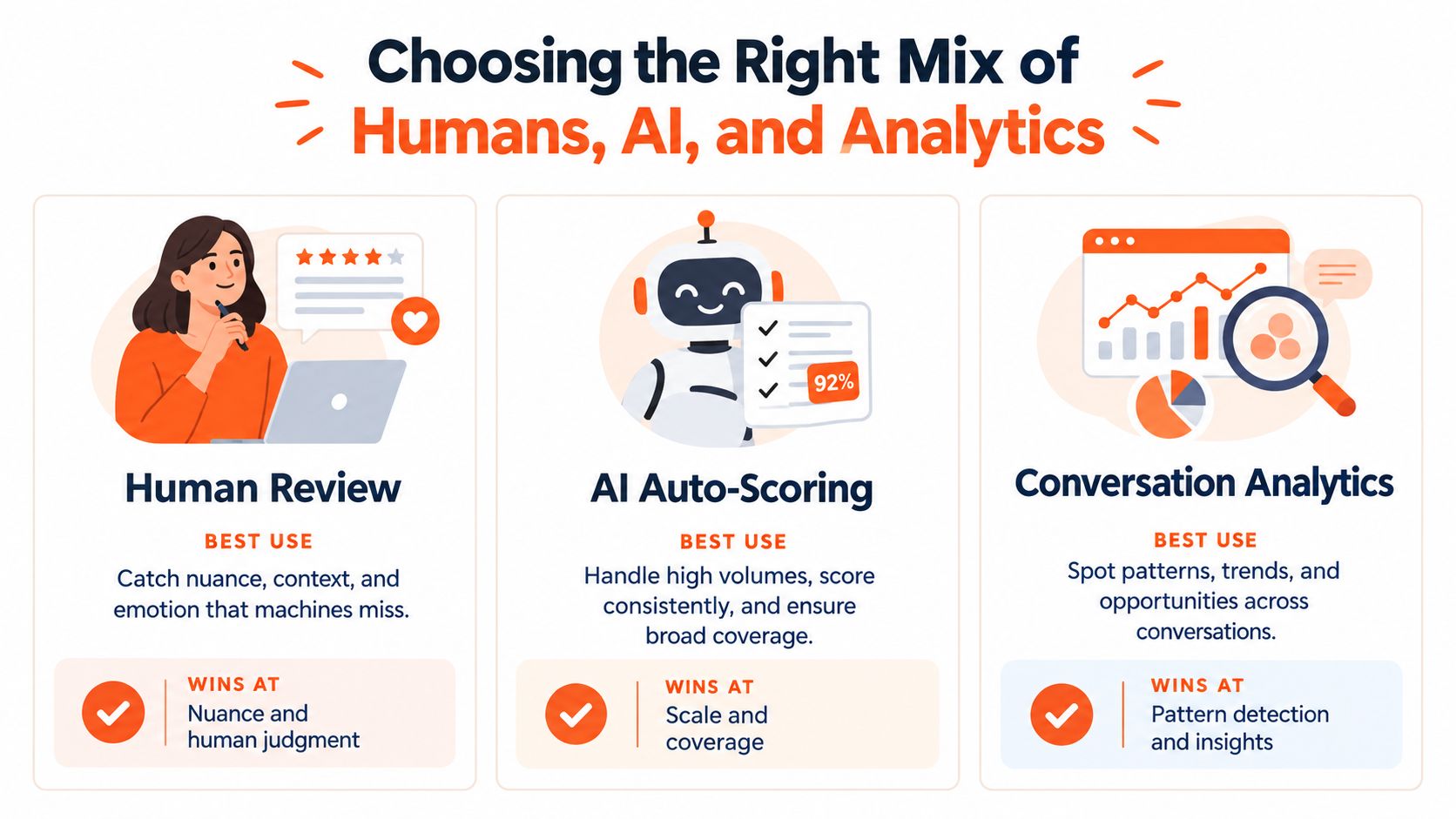
Human reviewers are strongest where context matters. They can interpret policy edge cases, detect a subtle escalation cue, assess empathy in a tense exchange, and turn evidence into a productive coaching conversation. Their limitation is capacity. Without AI assistance, manual reviewers remain constrained to a small portion of the interaction volume, as the coverage figures discussed earlier demonstrate.
AI auto-scoring is strongest on scale and repeatability. It can apply explicit criteria across conversations, flag possible compliance failures, and provide a first-pass explanation. It can also drift when the rubric changes, overvalue surface language, miss sarcasm, or mistake confident phrasing for correctness. Human calibration remains essential.
Conversation analytics looks across interactions rather than judging one scorecard at a time. It can expose emerging topics, repeated transfer patterns, sentiment changes, deflection failures, and differences between channels. Analytics won't replace a policy decision, but it can tell you where to investigate.
Assign the next QA investment deliberately
Use AI as the first review layer, analytics to shape investigation priorities, and humans for calibration, exceptions, appeals, and coaching. Preserve a deliberately selected human sample even after automated coverage expands. Reviewers should include low-confidence cases, high-risk topics, unusual outcomes, customer complaints, and interactions where the model's explanation doesn't match the transcript.
Spend the next QA dollar where uncertainty and customer risk overlap, not where the dashboard already looks green.
Human reviewers also benefit from consistent evaluation criteria. Resources such as CSR interview answers with examples can help hiring and enablement teams assess how candidates reason through empathy, escalation, and difficult customer situations. That's separate from scoring production conversations, but it strengthens the human judgment layer that AI can't safely replace.
Why AI Coverage Without Governance Makes QA Worse
Turning on automated evaluation doesn't repair a weak QA program. It industrializes it.
If the scorecard is stale, the system scores outdated behavior at scale. If the rubric rewards short replies, agents and automated systems may optimize brevity while customers receive incomplete resolutions. If leadership sees a large volume of green scores without checking evidence, confidence rises faster than reliability.
The most serious failure modes are operational, not theoretical:
- Unsupported scores: An evaluator assigns a failing or passing result without citing the text, policy, or event that justifies it.
- Calibration drift: Human reviewers and AI evaluators gradually apply different interpretations to the same criterion.
- Unsafe containment: An automated interaction avoids escalation even though the customer needed a human, creating a reassuring containment metric and a poor outcome.
- Untraceable decisions: The team can't reconstruct which model, prompt, knowledge source, or policy version produced the answer.
- Unfair coaching: Agents are coached on model mistakes or ambiguous criteria without a clear appeal process.
AI adoption is conditional on trust. Gartner reported that 51% of customers would be willing to use a GenAI assistant for customer-service interactions on their behalf, while Zendesk notes that 68% of people are more likely to trust AI when it has human-like traits. These findings appear in Gartner's customer-service trends release and the Zendesk discussion of AI and trust. Trust depends on perceived empathy, but governance must also verify correctness and accountability.
The minimum governance layer
Version every scorecard, prompt, policy, and evaluator configuration. Record the evidence behind each material decision. Review model drift and bias, require human sign-off for flagged high-risk interactions, and give agents and customers a defined route to challenge an evaluation or outcome.
Coverage is an input, not a score. The score becomes trustworthy only when the team can explain how it was produced and what changed because of it.
A 90 Day Plan to Rebuild Support QA From Scratch
A rebuild works best when each phase produces evidence for the next one. Don't launch automation before you know whether the rubric measures the behavior customers need.
Days 1 to 30, establish the baseline
- Audit the current scorecard: Remove vague criteria, separate critical failures from style preferences, and map each item to a policy or desired customer outcome.
- Blind-review historical interactions: Have two reviewers independently tag 500 historical interactions across representative channels and issue types. Compare disagreements before writing automated rules.
- Set the north star: Track coverage, evaluation accuracy, and CSAT impact as the program's primary tests. Supporting measures can inform operations, but they shouldn't replace these outcomes.
- Document ownership: Name the QA lead, calibration owner, knowledge owner, AI owner, and escalation owner.
The first month is deliberately manual. The aim is to validate what “good” means before asking an evaluator to reproduce it.
Days 31 to 60, introduce assisted scoring
- Launch AI scoring against the validated rubric: Start with explicit criteria and preserve the transcript evidence behind each result.
- Calibrate twice each week: Compare human and AI decisions on difficult interactions, then adjust criteria, instructions, or routing when the disagreement reveals a real ambiguity.
- Require evidence before coaching: No low score should trigger a performance conversation until the reviewer can cite the customer statement, agent response, policy, or missing step that supports it.
- Separate model defects from agent defects: Route unsupported answers and knowledge gaps to system owners instead of treating every failure as an individual coaching issue.
Days 61 to 90, operationalize the loop
- Turn on continuous sampling: Keep broad automated evaluation while deliberately selecting high-risk, low-confidence, disputed, and unusual interactions for human review.
- Publish a weekly QA brief: Link score movement to resolution outcomes, customer feedback, and system changes.
- Review appeals and drift: Track where agents challenge scores and where human reviewers repeatedly disagree with automation.
- Refresh the rubric: Retire criteria that don't predict useful outcomes and add newly observed risks.
By day ninety, leadership should see not only scores, but also explanations, owners, corrective actions, and evidence that the changes affected customer outcomes.
What a Mature Support QA Function Looks Like Next
A mature support QA function in 2026 will treat every interaction as a traceable event, whether a human handled it, an AI assistant drafted it, or an autonomous agent completed it. That doesn't mean humans manually inspect everything. It means the system produces a calibrated quality signal, records the evidence, and sends only the right risks to human reviewers.
The function also monitors the evaluator itself. A model that once applied a rubric reliably may behave differently after a prompt, policy, model, or knowledge change. Drift detection, version control, reviewable explanations, and periodic external calibration keep the QA system from becoming an unchallenged authority.
The operating model has a visible feedback loop
Product teams receive recurring defect themes. Documentation teams receive unanswered questions and confusing source content. Conversation designers receive escalation and instruction failures. Support leaders receive a report card that connects quality, safety, coverage, and customer outcomes.
| Capability | Legacy QA | Mature AI-Augmented QA |
|---|---|---|
| Coverage | Small manual sample | Traceable evaluation across the interaction estate |
| Review strategy | Supervisors choose calls in advance | Analytics and risk signals prioritize human review |
| Scoring | Single scorecard with limited context | Channel-aware, versioned criteria with evidence |
| Calibration | Occasional reviewer discussion | Scheduled human and AI calibration with drift tracking |
| Coaching | Agent-level feedback | Agent coaching plus prompt, policy, product, and knowledge fixes |
| Governance | Scores stored as performance records | Decisions, evidence, versions, appeals, and escalation paths retained |
| Reporting | Average quality and efficiency metrics | Outcome quality, safety, consistency, and operational performance together |
If a team is starting today, instrument one metric first: the percentage of interactions that have both an outcome score and an explanation. A score tells you what the system decided. An explanation gives people a way to test, challenge, and improve that decision.
AgentStack provides a practical option for AI-supported service operations, with source ingestion, multi-model routing, omnichannel delivery, shared human handoff, analytics, and exportable audit logs. To connect response quality with review and improvement workflows, visit AgentStack and evaluate how its controls fit your support QA program.