73% of consumers use multiple channels during a single support interaction, yet only 13% of businesses fully carry customer context across those channels. Freshworks' customer-service channel overview captures the uncomfortable reality: customers aren't asking for more ways to contact a company. They're asking not to start over every time they switch from chat to email, social messaging, or phone.
That distinction defines modern omnichannel support software. A platform that merely collects messages in separate queues is still multichannel, regardless of how polished its dashboard looks. The operational test is continuity, whether the next person or AI agent can see what happened, understand what's already been promised, and take the right next action.
Table of Contents
- The Reality of Modern Omnichannel Expectations
- Core Architecture and Unified Context Management
- AI Orchestration and Intelligent Routing
- Knowledge Governance and Operational Trust
- Measuring Success with Operational KPIs
- Vendor Selection and Integration Checklist
- Building a Future-Proof Support Strategy
The Reality of Modern Omnichannel Expectations
86% of consumers expect consistent communication with support agents across multiple channels, while 70% of customers globally prefer brands that provide service across multiple channels, according to industry reports summarized in Freshworks' analysis of customer-service channels. Those figures describe a clear operating requirement. Customers want several ways to contact a company, but they expect the service relationship to remain intact when they move between them.
Customer journeys rarely follow the boundaries of a support platform. Someone may ask a question in web chat, attach evidence by email, follow up through social messaging, and call when the issue remains unresolved. The channels change. The underlying case does not.
That makes channel availability an incomplete definition of omnichannel service. A business can offer email, chat, voice, and messaging while forcing agents to search separate systems for the same customer. Customers experience that fragmentation as repeated explanations, delayed answers, and unclear ownership. Support leaders experience it as manual reconciliation and inconsistent decisions.
Availability isn't continuity
Salesmate reports that 73% of consumers use multiple channels in a single interaction, and 56% say they have to repeat themselves when channels are disconnected. The same source reports that only 13% of businesses fully carry customer context across channels. These figures indicate an operational gap. Companies have expanded contact options faster than they have connected identity, history, routing, and ownership.
Practical rule: Don't approve a channel until you can explain how its conversation record connects to the existing customer state.
Test a vendor with a real customer journey rather than a feature tour. Start a request in chat, add information by email, then escalate it to voice. Ask the vendor to show the receiving agent the original transcript, attachments, identity match, internal notes, promised follow-up, and current owner. If any of those disappear during handoff, the system is collecting channels, not coordinating support.
Teams designing their service model can use this digital customer care guide for broader channel and customer-experience context. For a focused explanation of connected and disconnected journeys, see AgentStack's guide to omnichannel customer service.
Why the distinction matters commercially
The global omnichannel customer service market was estimated at about USD 14.2 billion in 2023 and projected to reach USD 35.6 billion by 2032, with a projected 10.8% compound annual growth rate over that period, according to Plivo's 2025 statistics summary. That forecast does not make every platform a sound investment. It does explain why disconnected queues are increasingly treated as technical debt.
The buying question for support leaders is direct: does the software preserve a trusted customer narrative as an interaction moves between channels, automation, and people? If the answer depends on manual ticket merging or an agent's memory, the omnichannel promise is not supported by the operating model.
Core Architecture and Unified Context Management
A dependable omnichannel stack starts with a unified customer state model, not a shared inbox. The inbox is where agents work. The state model is what lets every channel understand the same person, issue, and resolution status.
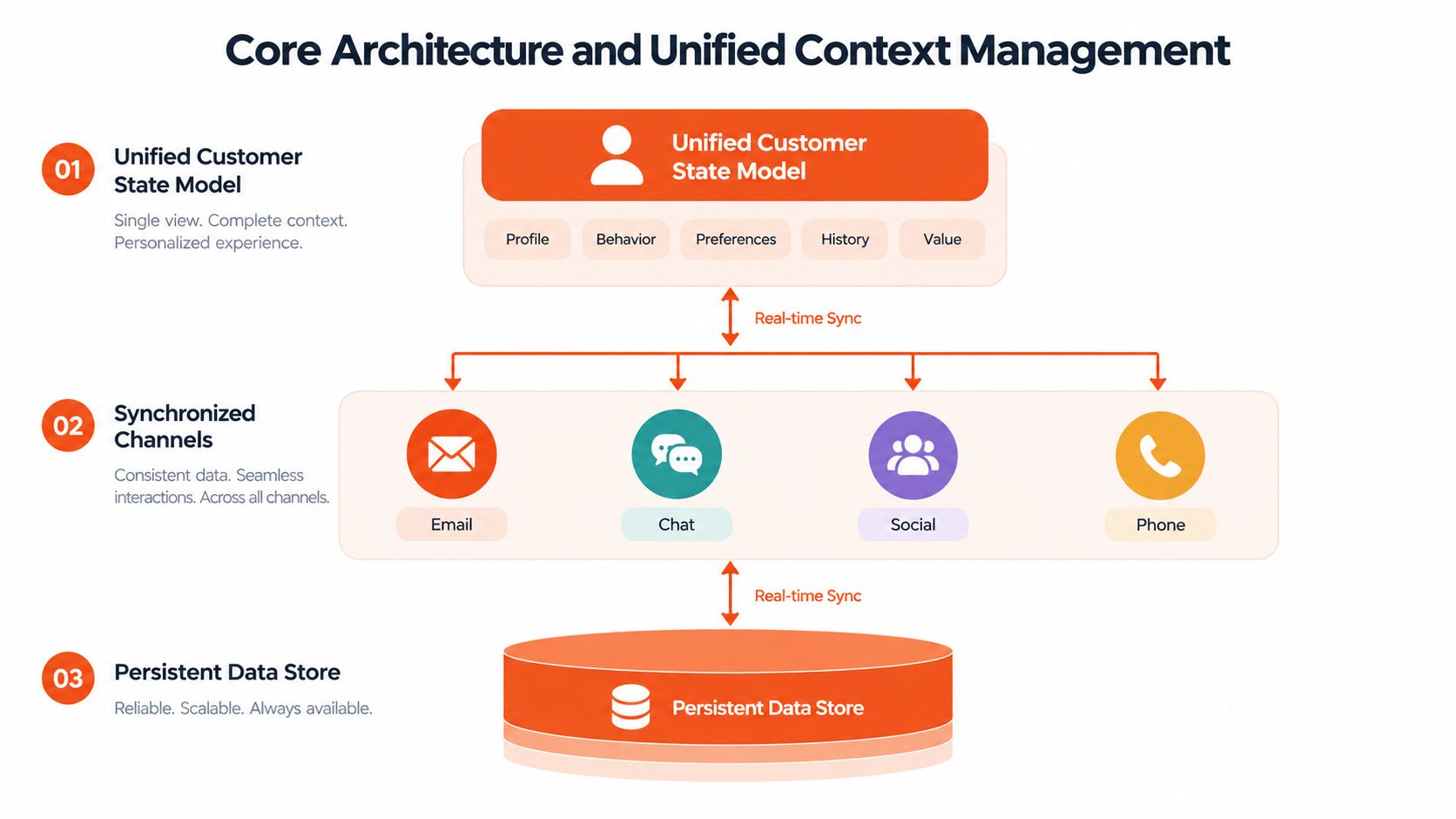
At minimum, that model should persist four related records:
- Identity: Match authenticated users, known email addresses, phone numbers, and carefully governed anonymous sessions to one customer profile.
- Case history: Store the issue, status, priority, ownership, tags, actions, and business-system references independently of the channel.
- Transcript continuity: Keep messages, attachments, bot responses, agent replies, and timestamps available to the next participant.
- Handoff metadata: Record why a case escalated, what the customer has already been told, what remains unresolved, and who owns the next step.
Build the shared data layer first
Each channel should read from and write to the same operational record in real time. Email shouldn't create a detached ticket just because the customer used a different address. Voice shouldn't reset the case because the agent works in a separate telephony console. Social messages need a controlled identity-resolution process, especially when a public comment becomes a private support conversation.
A shared inbox helps with visibility, but it doesn't solve bad data. If two systems maintain separate customer identities, agents can still see duplicate histories in one interface. During implementation, define the system of record for customer identity, orders, subscriptions, entitlements, and case ownership. Then map the synchronization direction and failure behavior for each integration.
An API integration platform becomes relevant here. Evaluate whether the platform supports the actions your agents need, such as checking an order, updating a subscription, booking a meeting, or creating an escalation. A read-only integration can display context, but it won't remove the handoff work that creates delays.
Protect context as it moves
Customer history often contains personal, financial, or operational information. Security controls should cover data in transit, data at rest, access rights, retention, deletion, export, and auditability. AgentStack, for example, documents AES-256-GCM encryption, role-based access control, exportable audit logs, and GDPR features including data residency, deletion, and export. Treat those capabilities as evaluation criteria, not as a substitute for your own access policies.
A platform should also make permissions understandable at the object level. Agents may need conversation access without access to every CRM field. Supervisors may need audit visibility without permission to alter transcripts. AI actions should have explicit scopes, approval requirements where appropriate, and logs that show which system supplied each answer or triggered each change.
The architecture works when a customer can change channels without changing the truth of the case. Everything else is interface design around that principle.
AI Orchestration and Intelligent Routing
AI turns omnichannel support software from a message-collection layer into a resolution decision system. The operational test is whether it can identify intent, retrieve approved information, select the right model or workflow, and transfer the case without losing the reasoning already completed. Channel choice matters less than whether the system preserves a trustworthy case state.
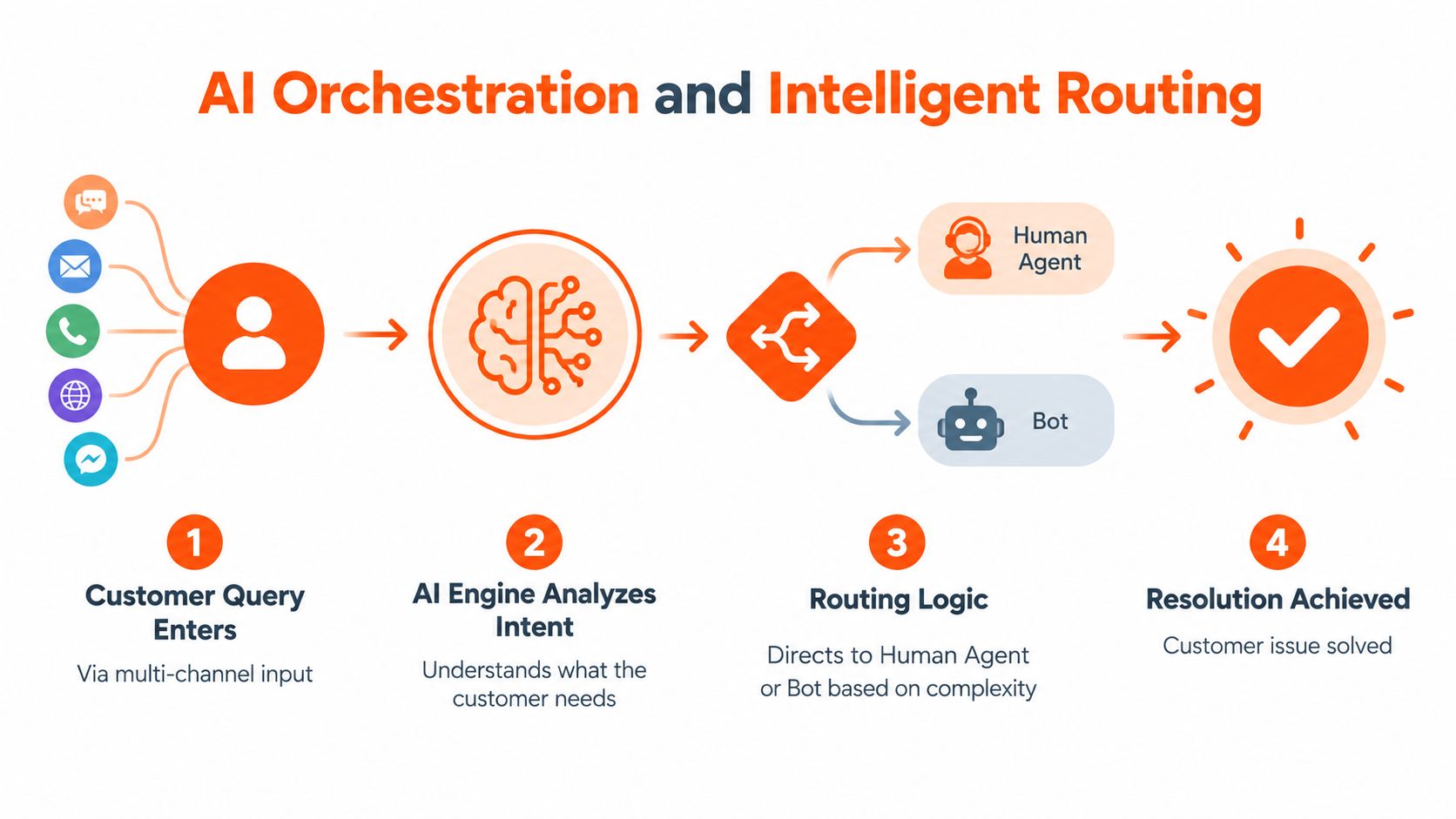
A practical orchestration layer separates routine requests from consequential work. A fast model can classify a password question, find an approved article, or summarize a known policy. A stronger reasoning model fits technical diagnosis, multi-step account problems, or conflicting records. Routing should consider intent, customer context, confidence, risk, and required actions, rather than the channel alone.
Route by complexity and consequence
Use a decision matrix before setting automation rules:
| Request profile | Model or route | Required control |
|---|---|---|
| High confidence, low risk, narrow action | Fast model and approved self-service | Grounded source and automated logging |
| Moderate confidence or broader account context | Stronger model with limited tool access | Source display, validation, and retry limits |
| Low confidence, sensitive policy, or high-impact action | Human escalation | Full context, retrieved sources, and approval record |
A reliable workflow follows five steps:
- Normalize the request. Convert chat, email, voice transcripts, and messaging events into a common case format.
- Identify intent and risk. Detect the customer's goal, urgency, sentiment, account state, and policy or compliance sensitivity.
- Retrieve grounded knowledge. Search approved website content, documents, product records, and internal sources.
- Select the response path. Automate well-supported, low-risk requests and escalate uncertainty or consequential actions.
- Preserve the work. Pass the transcript, sources, decisions, and unresolved questions to the human agent.
The operating benefit comes from matching automation to the work, not from maximizing containment. Average chatbot resolution remains far below best-in-class performance, as benchmarked in the KPI table below. That gap can reflect routing, knowledge quality, staffing, queue design, and escalation discipline. Treat the benchmark as a prompt to inspect the operating system, not as proof that adding a chatbot will solve the problem.
Ingest knowledge before adding autonomy
An AI agent cannot answer consistently when source material is scattered, stale, or restricted by unclear permissions. Ingest the systems teams already maintain, including websites, PDFs, office documents, Notion workspaces, and structured Q&A. Attach an owner, review status, audience, effective date, and source priority to every item.
For model selection, delegation, and supervision, use this complete guide to AI orchestration. The model should be replaceable, while the customer state, governance rules, and escalation record remain stable.
AgentStack provides one example of this architecture, with website and document ingestion, Notion synchronization, multi-model routing, shared inbox handoff, and delivery across web, email, Slack, and voice. Its approach can be considered alongside broader multi-agent orchestration patterns. Evaluate the platform by asking whether operators can inspect why a case was automated, why it was escalated, and which source shaped the answer.
Knowledge Governance and Operational Trust
More channels can produce less trustworthy support when the knowledge pipeline remains fragmented. A bot may cite an outdated web page, an agent may use a superseded macro, and a voice specialist may follow a policy stored in an internal document. The customer experiences those differences as broken promises, even when every participant is acting in good faith.
AI adoption makes the issue more urgent. Recent consumer research reports that chatbot adoption reached 88% in 2025 from 69% in 2024, while emotional trust touchpoints declined, according to the 2025 customer support and service research. The operational lesson is not to remove automation. It's to make the transition between automation and human care legible, accountable, and consistent.
Create one narrative with explicit ownership
Every customer-facing answer should have a traceable source and a responsible owner. That doesn't mean exposing internal retrieval details to customers. It means support leaders can answer basic questions after an incident: Which source did the system use? Was it current? Which policy permitted the action? Who reviewed the answer? What happened when the customer disagreed?
A workable governance process includes:
- Source ownership: Assign each policy, product explanation, and workflow to a named team.
- Change control: Retire or replace obsolete content instead of allowing conflicting versions to remain searchable.
- Permission boundaries: Prevent an AI system from retrieving documents that the requesting agent or customer shouldn't see.
- Escalation triggers: Route low-confidence, high-risk, or emotionally sensitive conversations to trained people.
- Answer review: Sample automated resolutions and inspect unanswered questions, corrections, recontacts, and negative sentiment.
Test for blind spots, not just accuracy
A response can sound fluent and still be operationally wrong. Test edge cases involving missing records, conflicting documents, ambiguous identity, unusual account states, and customers who reject the first answer. Then test the handoff itself. The human agent should receive enough context to continue the conversation naturally, not a generic message that says the bot failed.
Data residency and auditability also belong in the design phase. Regulated or high-stakes teams need clear retention rules, deletion workflows, export controls, access logs, and a way to separate training or retrieval data by tenant, region, role, or purpose.
A trusted fallback isn't an apology after automation fails. It's a designed path with context, ownership, and authority to resolve the issue.
The right governance question is therefore not “How many channels can we activate?” It's “Can every channel produce the same defensible answer, and can a person take over without making the customer reconstruct the case?”
Measuring Success with Operational KPIs
A unified interface can hide weak operations. Support leaders need metrics that connect customer outcomes with the systems behind them, including routing, self-service, queue management, handoffs, and knowledge maintenance. The goal is to measure whether AI and human teams resolve the right issue with reliable context, rather than just whether they respond quickly.
The benchmark below compares average and best-in-class values reported in a 2026 summary from Wonderchat's customer support KPI analysis. Use these figures as external reference points, not as promises from a software vendor.
Omnichannel Support KPI Benchmarks
| Metric | Average Performance | Best-in-Class Performance |
|---|---|---|
| First response time | 5.7 hours | 0.1 hours |
| Full resolution time | 27.8 hours | 0.7 hours |
| First contact resolution | 74.7% | 94.8% |
| AI chatbot resolution rate | 35% | 95% |
| Human live-chat wait time | 2.3 minutes | 0.3 minutes |
| Phone abandonment | 5.7% | 0.4% |
These averages need context. A fast first response can still produce poor resolution if automation sends an irrelevant answer. A high chatbot resolution rate can also hide customer effort when bots close cases prematurely or make escalation difficult. Pair speed metrics with evidence that the customer reached a correct outcome.
Measure continuity alongside speed
Track first contact resolution by intent and channel, then monitor whether resolved cases return through another channel. Calculate cross-channel recontact rate as:
Recontact rate = cases reopened on a different channel within 7 days / total resolved cases
Set stricter expectations for simple, repeatable intents such as order status or password access. Allow more recontact for complex technical, billing, or account cases, but review sudden increases by intent. A customer who receives an immediate chat response and later calls about the same issue has not experienced a successful resolution.
Separate automated and human performance. Monitor bot containment, escalation acceptance, agent rework, transfer counts, and the time between handoff and meaningful human action. If agents must verify information that the bot already collected, automation is shifting effort rather than reducing it.
Add quality and trust indicators
Include answer-correctness reviews, source freshness, unanswered-question categories, sentiment changes after escalation, and feedback by resolution path. Record which knowledge version supported an automated answer, who approved it, and whether later corrections or recontacts followed. These controls connect KPI movement to knowledge governance.
A shared inbox earns its place when it makes ownership visible and exposes stalled cases. Build dashboards around customer journeys, not isolated channel totals, then use the findings to adjust routing, staffing, content, permissions, and escalation rules.
Vendor Selection and Integration Checklist
Feature lists make vendors look similar. A controlled trial reveals the differences. Give every shortlisted platform the same customer journeys, data conditions, escalation rules, and security questions, then compare the work required to reach a reliable resolution.
Start with the workflow, not the channel list
Choose representative cases that cross channels and systems. For example, a software customer can begin in web chat, attach diagnostic information by email, and request a phone call. An e-commerce customer can ask about an order in social messaging, require a back-office lookup, and receive a written update later.
Ask each vendor to demonstrate:
- Identity matching: What happens when the customer uses a different address, an unsigned session, or a social account?
- Ownership changes: How does the case move when an agent is unavailable or a specialist is required?
- Action execution: Can the agent or AI safely complete work in the CRM, commerce platform, or scheduling system?
- Context preservation: Which transcript, attachments, promises, and internal notes arrive at the next channel?
- Failure handling: What happens when an integration is unavailable or the model lacks a grounded answer?
A platform that requires extensive manual reconciliation may carry a higher operating cost than its license suggests. Include configuration, training, integration maintenance, content review, AI usage, and vendor support in the total-cost assessment.
Inspect extensibility and security
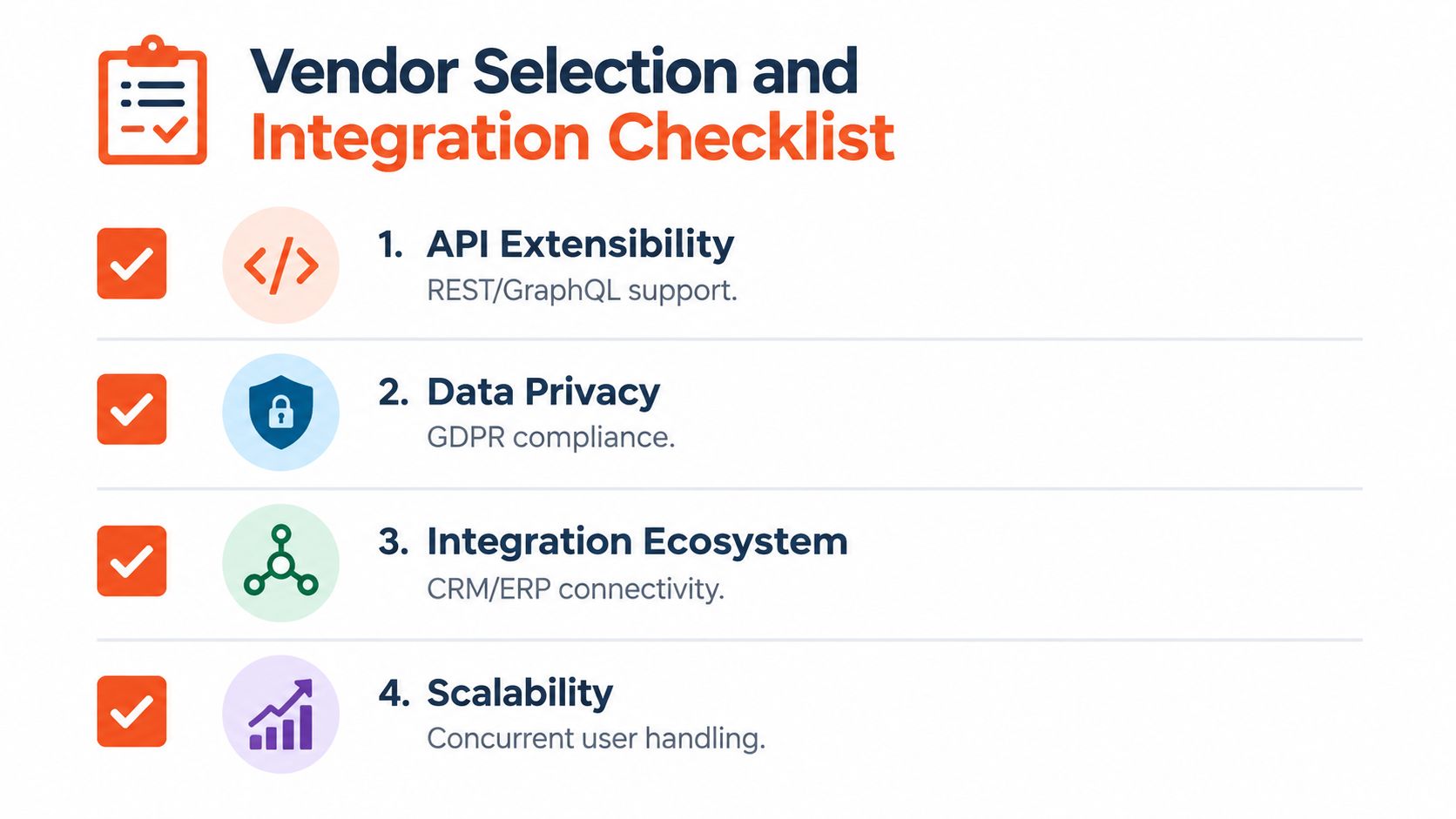
Developers should verify REST or GraphQL access, webhooks, custom API actions, event schemas, rate limits, environment separation, and programmatic export. A vendor's integration catalog doesn't tell you whether your unusual workflow is maintainable. Ask to see documentation and implement one meaningful action during the trial.
Security evaluation should cover:
- Data residency: Identify where conversations, documents, transcripts, and backups are processed and stored.
- Auditability: Confirm that administrators can export logs for access, configuration changes, model actions, and handoffs.
- Access control: Test role-based permissions for agents, supervisors, administrators, contractors, and automated systems.
- Privacy operations: Verify deletion, export, retention, consent, and tenant-isolation workflows.
- Knowledge governance: Check versioning, source attribution, permissions, review ownership, and stale-content detection.
Model choice deserves its own test. A model-agnostic platform may let you balance reasoning quality, latency, and cost, but only if routing rules are transparent and measurable. Usage-based pricing can align spend with demand, yet it can also make costs unpredictable when long transcripts, voice processing, or repeated retrieval calls expand usage. Request a scenario-based estimate rather than relying on a headline plan.
Building a Future-Proof Support Strategy
Omnichannel support software should become the operational memory of the customer relationship, not another destination where agents read messages. That requires a connected state model, governed knowledge, deliberate AI routing, and human escalation designed as part of the main journey.
Start with an audit of your highest-effort customer paths. Record where customers change channels, where agents copy information manually, where answers conflict, and where ownership becomes unclear. Fix the shared data and knowledge foundations before adding another channel, because automation amplifies both reliable processes and unreliable ones.
Then introduce AI in controlled stages. Begin with retrieval and summarization, add low-risk actions, and expand autonomy only when review data shows that the system handles the relevant intents consistently. Keep a visible human path for cases involving uncertainty, emotional distress, sensitive data, policy exceptions, or material business consequences.
The strategic shift is straightforward: support isn't only a cost center. It's a product-intelligence layer that reveals confusing documentation, broken workflows, recurring defects, and unmet customer needs. A governed omnichannel stack turns those signals into improvements, while an ungoverned one spreads inconsistency across every available touchpoint.
AgentStack provides website and document ingestion, multi-model orchestration, shared-inbox handoffs, custom API actions, and support delivery across web, email, Slack, and voice. Audit your highest-friction customer journey, then visit AgentStack to evaluate whether its AI-driven workflow fits your continuity, governance, and integration requirements.