
Your CSAT report is improving. Resolution looks healthy, and the support team is closing tickets without an obvious backlog. Then customer success brings a renewal forecast into the weekly meeting, and the accounts at risk include customers your dashboard says you served well.
Table of Contents
- The Dashboard That Looked Healthy but Was Not
- What Customer Experience and Analytics Actually Mean
- The Metrics That Matter and What They Miss
- Where the Data Comes From and How to Unify It
- Tooling, Dashboards, and the Decisions They Enable
- Where AI Support Changes the Analytics Game
- Turning Insights Into Better Workflows and Content
- A 90-Day Plan for Building a Honest CX Analytics Function
The Dashboard That Looked Healthy but Was Not
Consider a hypothetical software company whose support team gets praise for fast, friendly answers. Customers appreciate the agents, so survey responses look positive. Yet account owners keep hearing the same complaint: getting anything done requires too much coordination.
A billing question gets answered, but the customer must contact another team to apply the correction. An administrator receives accurate setup instructions, then discovers that completing them requires permissions nobody mentioned. Support marks both issues resolved.
The dashboard isn't necessarily wrong. The team has defined success too narrowly.
A closed ticket isn't a completed customer task
In this scenario, each department measures its own contribution. Support measures replies and closures, customer success tracks account health, and finance records renewals. Nobody checks whether a customer who received an answer completed the underlying task.
That creates uncomfortable possibilities:
- Better scores, worse coverage. Positive feedback from straightforward questions can obscure unresolved work for customers with complicated needs.
- Faster handling, more customer work. An agent can reduce handling time by sending instructions that leave the customer to coordinate the fix.
- Lower contact volume, uncertain outcomes. Fewer conversations could mean customers found answers, abandoned the task, or stopped trying.
A healthy support dashboard should help explain account risk, not merely contradict the account team.
Start with the decision
A useful customer experience and analytics program starts with a business question: which service experiences should we change to improve retention, protect expansion, or reduce cost-to-serve?
That question requires a connection between conversation events and later account behavior. It also requires restraint. A customer who contacts support and later cancels hasn't necessarily canceled because of support.
The practical job is to identify a plausible problem, inspect the experience, test a change, and check the result. If a dashboard can't support that sequence, adding another executive chart won't fix it.
What Customer Experience and Analytics Actually Mean
Customer experience analytics is the practice of connecting what customers report, what happens during their interactions, and what they subsequently do. For support leaders, the useful unit isn't just a conversation. It's a customer trying to complete a task within an ongoing relationship.
A workable measurement hierarchy separates signals by the question they answer.
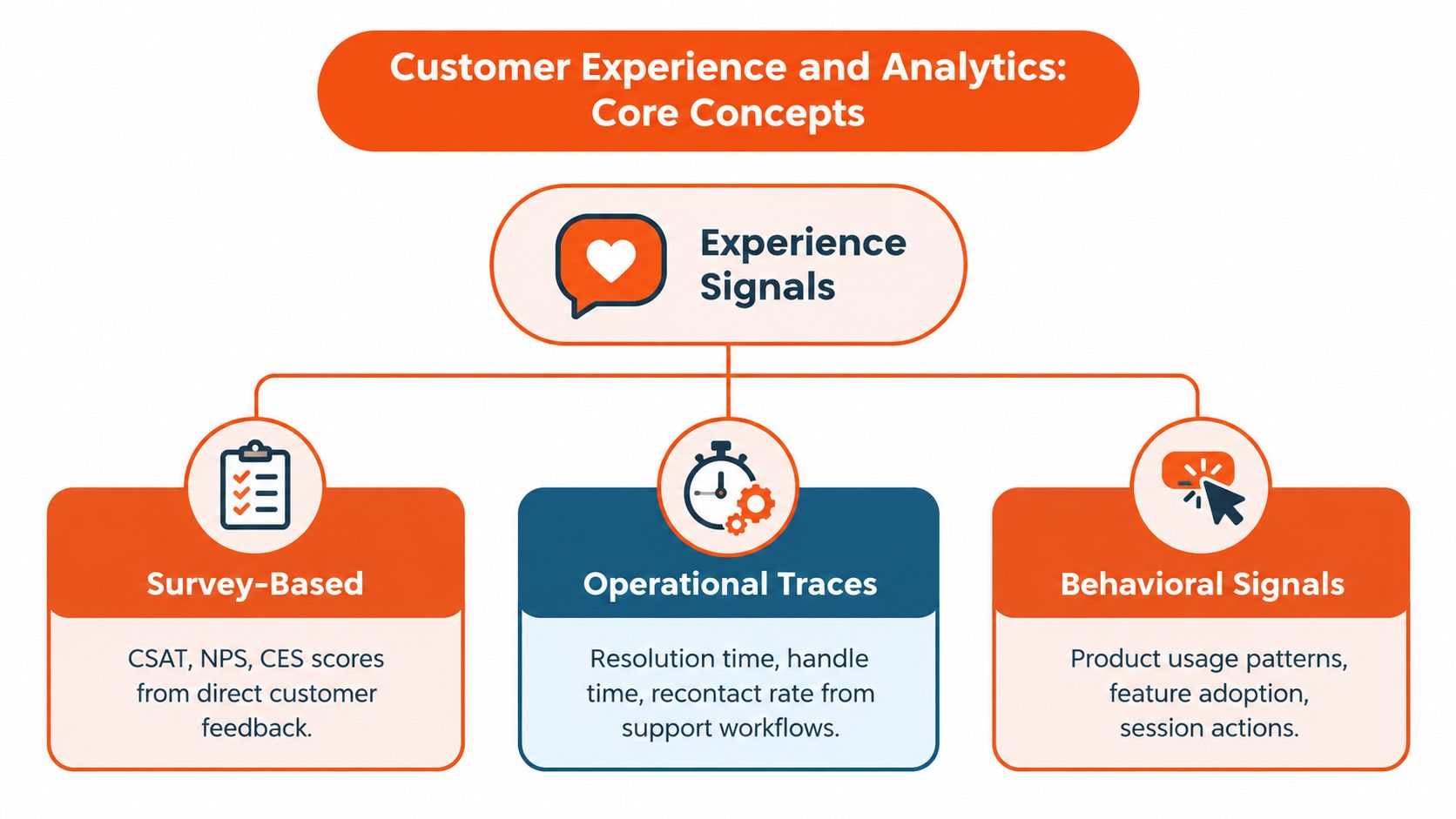
Separate feedback from observed events
Survey-based signals capture a customer's assessment. CSAT asks about satisfaction, NPS concerns willingness to recommend, and CES asks about effort. Treat these as reported perceptions, not substitutes for examining what happened.
Operational traces describe the service process: transfers, response timing, resolution status, authentication requests, and repeat contacts. They help locate friction, but an event log alone can't establish how a customer experienced it.
Behavioral signals show subsequent actions, such as completing setup, purchasing again, reducing product usage, or renewing. Sentiment inferred from a transcript belongs alongside these signals as an interpretation of language, not as equivalent evidence to an observed purchase.
For a repair business, BenchKey's customer repair portal provides a useful context for thinking about these distinctions. When evaluating such a workflow, separate whether a customer checked their repair status, whether that check answered their question, and whether they still needed to contact support. Those are different questions requiring different evidence.
Use the hierarchy without oversimplifying it
A weather analogy helps: customer feedback describes how conditions feel, operational traces are the instruments, and longer-term behavior provides the climate record. None makes the others unnecessary.
Use the hierarchy to build an investigation:
- Perception. Did the customer describe the task as difficult?
- Process. Where did they encounter repeated steps or failed actions?
- Outcome. Did they complete the task and continue the relationship?
Don't turn those layers into a single blended experience score. A weighted average can hide the exact contradiction you need to investigate. Keep the measures distinct, connect their records, and let analysts move between them.
The Metrics That Matter and What They Miss
Metrics need different jobs, not equal billing. A satisfaction measure shouldn't approve a workflow change by itself, and a resolution label shouldn't overrule evidence that the customer is still struggling.
CX metrics at a glance
| Metric | What it measures | Where it fails | Layer |
|---|---|---|---|
| CSAT | Reported satisfaction with an interaction | Respondents may not represent every customer or issue | Survey |
| NPS | Stated willingness to recommend | Doesn't isolate the service event responsible | Survey |
| CES | Reported ease or difficulty | Requires behavioral validation beyond stated intent | Survey |
| Resolution rate | Issues classified as resolved | Depends on the closure definition and ignores hidden work | Operational |
| Recontact | Return contact about an issue | Needs reliable issue matching | Operational |
| Sentiment | Interpreted emotional tone | Can misread context, sarcasm, or terse language | Inferred experience |
CSAT is useful for reviewing a recent interaction. Its weakness is interpretation: an agent can be helpful even when the underlying process remains frustrating. When deciding how to measure customer satisfaction, specify the touchpoint, survey eligibility, and respondent population before comparing results.
Use NPS as relationship feedback rather than a verdict on an individual agent. If the surveyed customer mix changes, investigate that change before crediting a new support policy.
Give effort a diagnostic role
Effort deserves particular attention. In a support-interaction study of 176,158 customers, first-contact resolution with low effort corresponded to an 87% loyalty rating, compared with 69% for first-contact resolution with high effort, an 18-percentage-point difference, according to the customer-effort research published by Oracle. Resolution and ease weren't interchangeable.
Research summarized from 75,000 interactions also found that 94% of customers reporting low-effort service expressed an intention to repurchase, while 88% intended to increase spending, as described in Stop Delighting the Customer. Those are stated intentions, not proof of subsequent purchasing or a guaranteed effect from lowering effort.
An e-commerce sizing question illustrates the distinction. A resource such as Robosize clothing size comparison belongs in a content review when shoppers struggle to interpret sizing. Evaluate whether the answer removes uncertainty, not whether the support team supplied a chart.
Use CES and observable effort as investigation triggers, resolution and recontact as operational checks, and relationship feedback plus account behavior as confirmation. Review sentiment across comparable conversations, then inspect examples before acting. Don't use an automated emotional label as the sole reason to classify an interaction as successful or harmful.
Where the Data Comes From and How to Unify It
Before building charts, decide how records will connect. A chat identifier can't tell you whether a later email concerns the same unresolved issue unless your data model preserves that relationship.
Start with the sources your team uses: chat transcripts, email tickets, voice calls and transcripts, knowledge-base interactions, and product or account events.
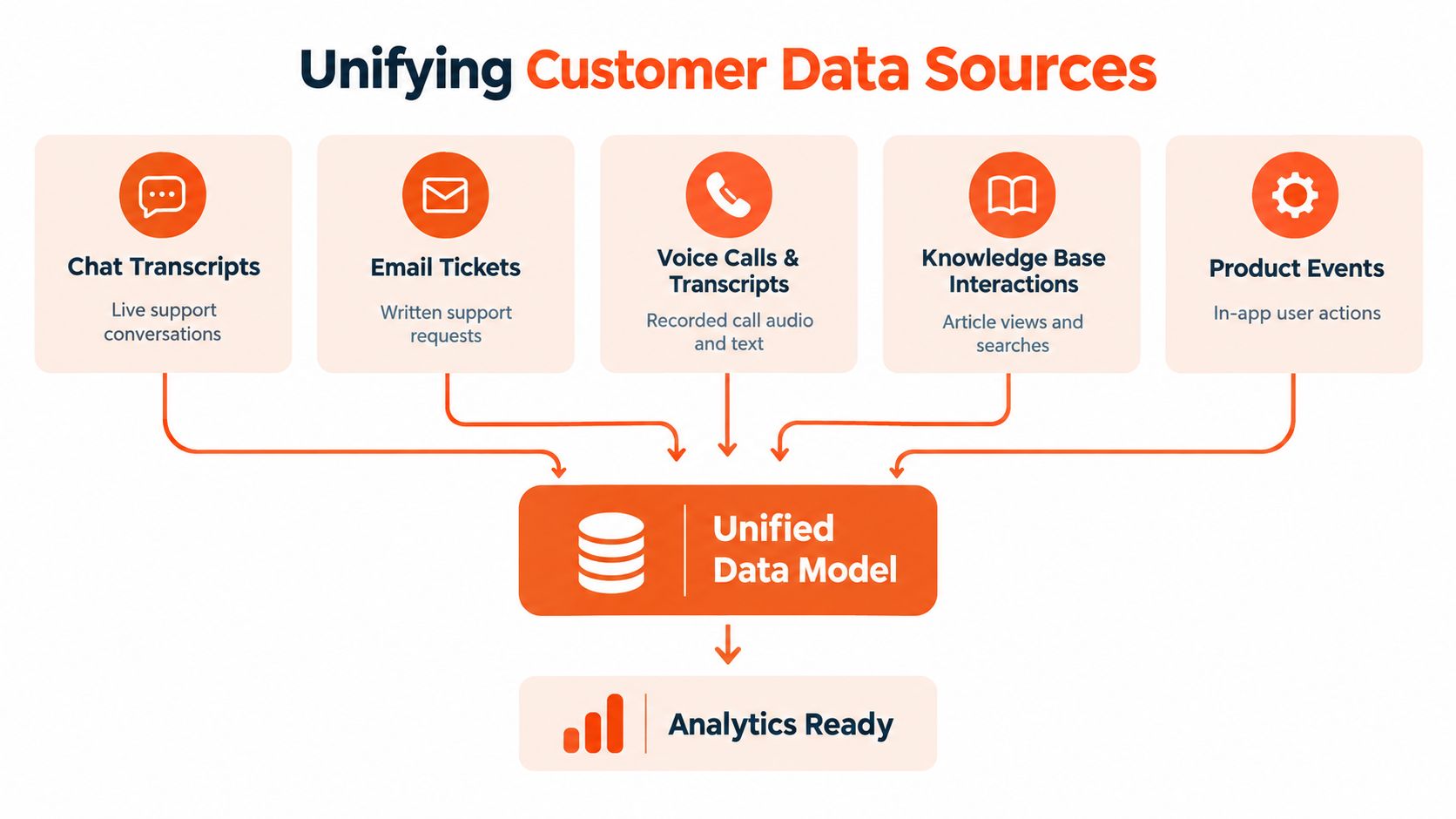
Build an issue-level event model
Give each interaction a conversation ID, then connect related interactions through an issue ID. Keep customer and account identifiers separate so an account's administrator and end user don't become indistinguishable.
The event schema should include:
- Context fields. Timestamp, channel, issue intent, customer tier, and account identifier.
- Execution fields. Assigned team or model route, action attempted, tool result, and escalation reason.
- Evidence fields. Resolution basis, linked survey response, source-document version, and issue-reopening status.
Standardize intent labels before comparing channels. If chat calls an issue “payment failure” while email calls it “billing,” analysts need a shared category rather than a dashboard filter that excludes relevant records.
Practical rule: If you can't slice a metric by intent, channel, customer tier, and outcome, treat it as a summary, not a diagnosis.
Join carefully and preserve uncertainty
Distinguish confirmed matches from inferred ones. Don't merge conversations just because their wording looks similar, and don't pretend anonymous article readers are identified account users.
The business-outcome join deserves equal care. PwC's 2025 customer-experience survey argues for connecting emotional engagement and longitudinal loyalty with conversion attribution, customer lifetime value, behavioral analytics, and purchase patterns rather than reporting satisfaction alone.
Translate that into explicit observation windows and documented definitions. Record when the interaction occurred relative to a renewal decision, which users were exposed to the change, and which outcomes remain pending.
Limit access to sensitive conversation content, redact unnecessary personal details, and define retention rules. An analytics-ready dataset should be explainable and appropriately governed, not complete.
Tooling, Dashboards, and the Decisions They Enable
A vendor demo I sat through ran smoothly until I asked one question: show me every customer who hit the unresolved "duplicate charge" intent last month, pull two of their actual conversations, and tell me which help article the bot quoted at the time. The demo stalled. The reporting worked. The investigation did not.
That gap is the buying criterion. A tool that counts intents produces reporting. A tool that connects a spike to the conversations, the routing rule, and the document version behind it supports a closed improvement loop.
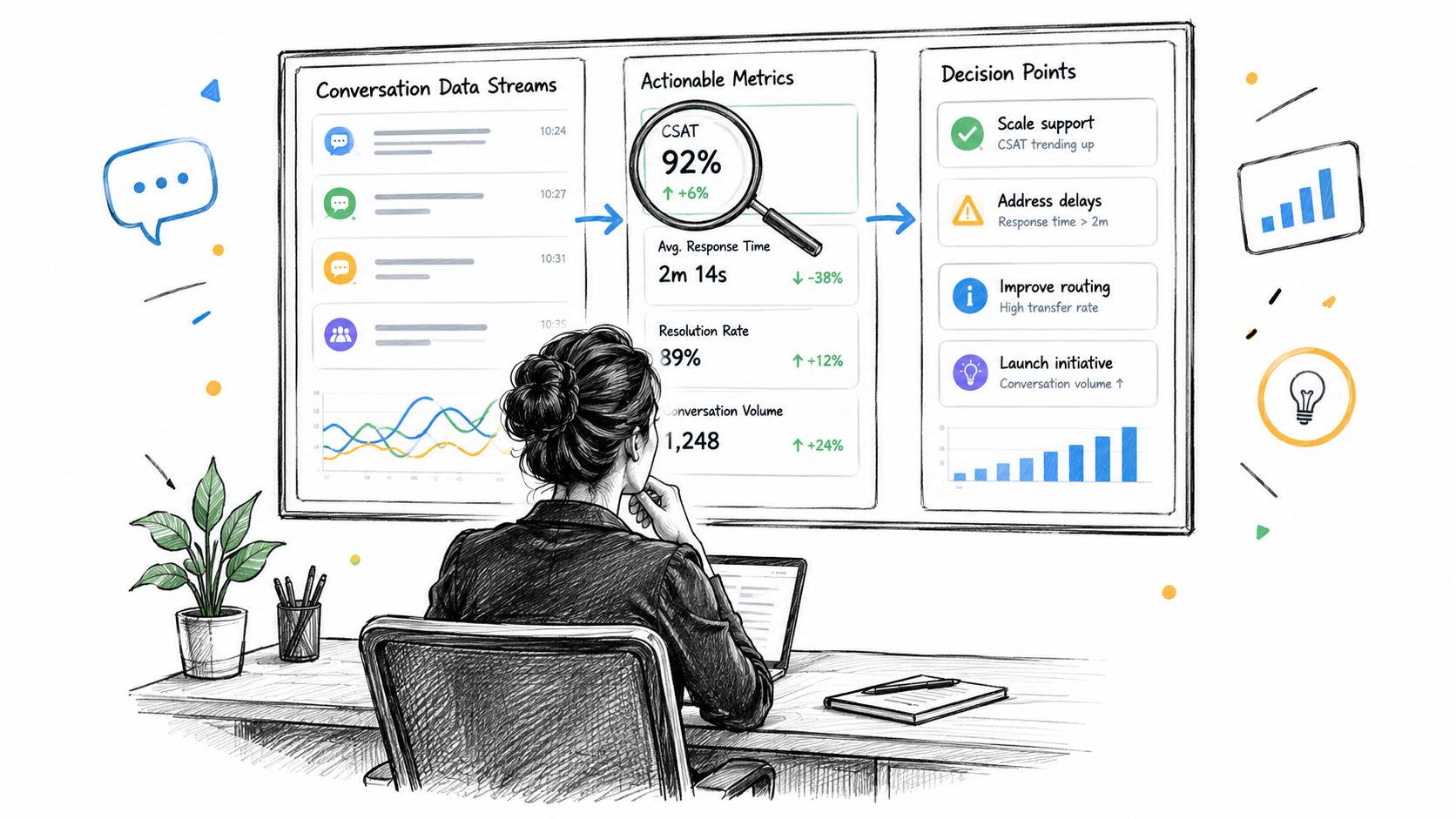
Where each system earns its place
Ticketing, product analytics, and the warehouse answer different questions. Keep conversation review inside the support workflow, where reviewers already work. Push account-outcome joins to the warehouse or business-intelligence layer, because the support interface cannot carry them.
E-commerce teams defining the commercial side of that join can use ServeApps' guide to understand Shopify data for decisions as context. The discipline is the same everywhere: relate service experiences to purchasing behavior without crediting support for every later purchase.
Before building panels, pull analytics dashboard examples for layout ideas, then test each proposed view against a decision someone owns.
| Dashboard view | Decision it should support |
|---|---|
| Intent and effort | Which customer task needs investigation? |
| Unanswered questions | Which knowledge gap needs an owner? |
| Escalation path | Where should routing rules change? |
| Account outcomes | Which interventions merit further validation? |
What procurement should actually ask
A usable stack lets a team move from a cohort to representative conversations, inspect the source material behind each, and see what changed between then and now. Without version history, analysts review today's documentation while investigating yesterday's answer.
Four questions separate real tooling from demo tooling. Can analysts combine intent, model route, channel, and customer tier? Can reviewers inspect failures and successes, not just curated examples? Can the system distinguish a document revision from a routing change? Can the team export records for independent analysis and controlled tests?
Governance belongs in that conversation too. Limit who can open full transcripts, redact what analysts do not need, and set retention rules before rollout. An analytics-ready dataset should be explainable and appropriately governed, not exhaustive.
Resist putting every measure on the executive overview. The temptation is to lead with containment because the number moves; the defensible view leads with the problem, the intervention, and the downstream cost. Operational owners need investigation depth. Executives need that defensible account. They should not share a screen.
Where AI Support Changes the Analytics Game
On one team I worked with, containment climbed quarter after quarter while repeat contacts climbed right alongside it. The automation was keeping conversations. Whether it was resolving them was a different question, and the dashboard could not distinguish a customer who left satisfied from one who gave up or never found the human option.
Those outcomes must not share the same success label.
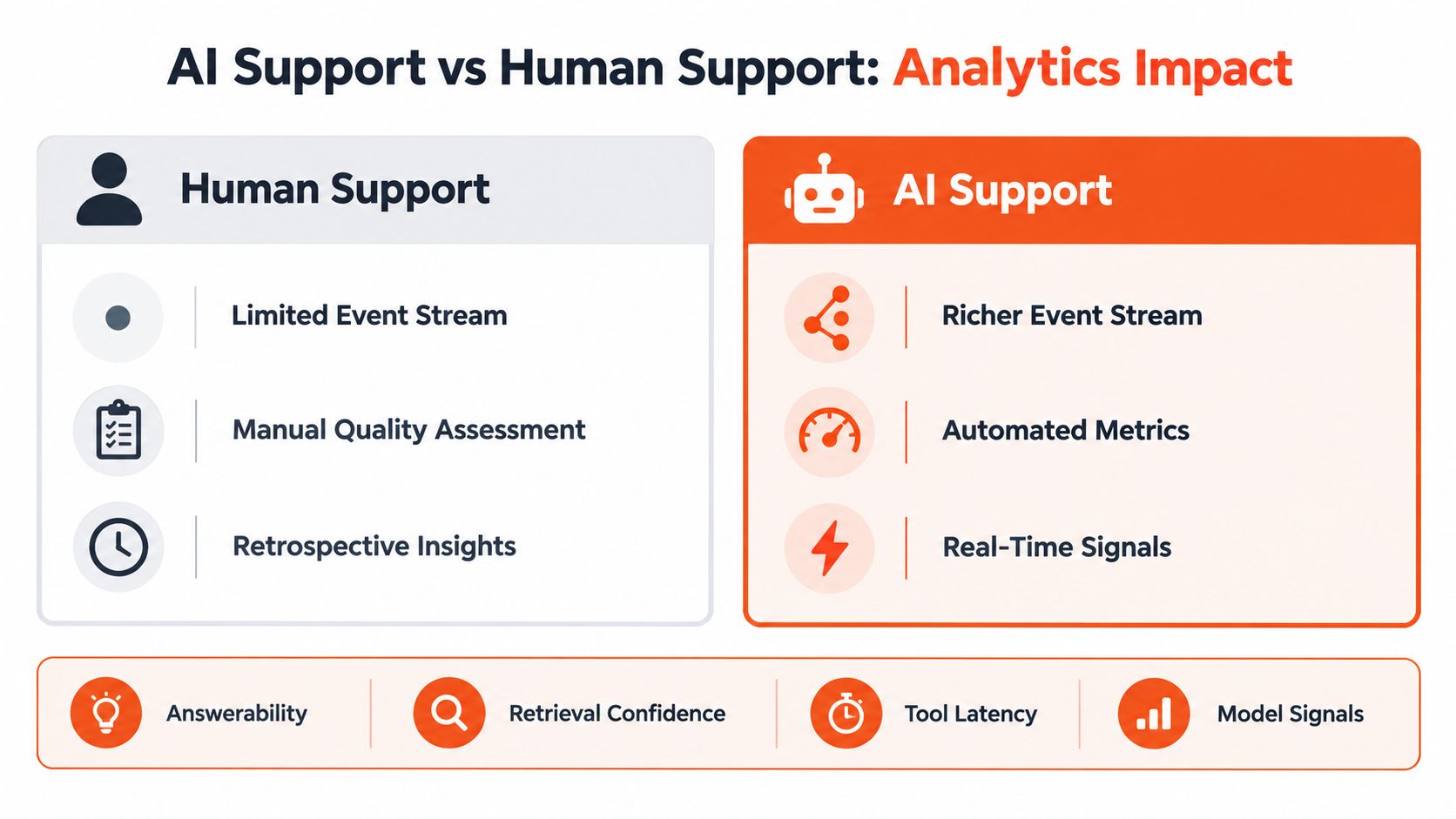
An AI support deployment can expose retrieval results, tool execution, routing decisions, and answer-generation events. Human support operations can capture detailed events too, so richer instrumentation alone says little about experience quality.
For AI interactions, log answerability assessments, retrieved document identifiers, tool latency, failed actions, and escalation reasons. Treat retrieval confidence as a system signal that needs calibration rather than evidence the answer was right. These fields explain why an interaction failed. They cannot tell you whether the customer understood their options or finished their task.
The controls worth measuring
A 2026 consumer study found that trust in AI rose from 26% to 55% when a human option was visible, and 71% of respondents said it was very or extremely important to know when they were interacting with AI, according to Salesforce's report on AI service agents and customer satisfaction.
Four checks turn that into operations. Track human-access attempts, including explicit requests that never produced a transfer. Review exits that follow AI disclosure, while staying careful about assuming the disclosure caused them. Measure handoff burden by checking whether customers repeat information they already gave. And audit escalation appropriateness: whether sensitive, ambiguous, or high-risk requests reached someone equipped to handle them.
Successful automation should preserve the customer's ability to understand the process and choose appropriate help.
A broader agent performance monitoring review should include these controls alongside execution metrics. An appropriate escalation that lowers containment counts as the system working.
The trade-off is real: easier human access adds staffed workload. Weigh that cost against completed tasks, repeat contacts, and the needs of the affected customers. When the alternative is customers trapped in a process they cannot follow, a lower automation rate is the honest number.
Turning Insights Into Better Workflows and Content
A SaaS support team keeps logging repeat contacts about cancellation. This is a constructed example, but the pattern shows up in real queues constantly. The automated answer accurately describes where to cancel. Transcript review surfaces the actual problem: only the billing owner can complete the action. Everyone else follows the instructions, hits a permissions wall, and comes back.
The answer is right and the workflow is broken. Warmer phrasing cannot fix a prerequisite the customer has no way to satisfy.
Fixes split along two lines. The knowledge-content loop covers what the system can explain: rewrite the source document to state the required role, show customers how to check whether they hold it, and describe what a non-owner can do instead. Then verify retrieval against the phrasing customers use, since "cancel my subscription" and "stop billing" need to reach the same material. The workflow loop covers what customers and agents can do: whether an authorized user gets a direct cancel action, whether a non-owner gets routed to request the billing owner, and where support steps in. Keep authentication and permission checks intact. Stripping safeguards to make the journey look easier trades a support metric for a security problem.
Track each intervention in a compact change record so the reasoning survives the person who proposed it:
| Field | Cancellation-flow example |
|---|---|
| Observed problem | Customers return after encountering a role restriction |
| Hypothesis | Missing prerequisite information causes avoidable work |
| Intervention | Explain eligibility before presenting the action |
| Primary check | Reported effort for the affected intent |
| Guardrails | Task completion, repeat contact, and unauthorized actions |
| Owner | Named content or workflow maintainer |
Before shipping, narrow the blast radius. Route eligible traffic to the new experience, hold a comparison group on the old one, and change one thing at a time. Editing the article, rerouting the model, and loosening escalation policy in the same release makes the result impossible to attribute. A plain pre/post comparison still works for a small team, but label its limits clearly: shifts in customer mix, billing policy, or product behavior can explain part of the gap.
The review itself has three outcomes. Keep the change when effort drops and guardrails hold. Revise it when customers understand the instructions yet still cannot act. Escalate past support when the friction lives in product or permissions design itself, since no amount of content editing fixes a role model.
One discipline closes the loop: name an owner and set a review date before anything deploys. Changes shipped without both tend to accumulate while the original problem persists, and the dashboard keeps reporting a solved issue that was never resolved.
A 90-Day Plan for Building a Honest CX Analytics Function
Treat this as a proposed operating schedule, not a promise of measurable retention impact within the quarter. Start with a bounded set of support intents and expand only after the team can trust the records and act on findings.
Instrument and measure
Weeks 1 through 3 should establish the evidence trail. Choose the initial intents, agree on event definitions, and connect conversations to issues and accounts. Manually audit representative records across chat, email, and voice before approving the joins.
Weeks 4 through 6 should establish the baseline. Introduce post-interaction effort feedback and build investigation views for resolution-with-effort and recontact. Have frontline agents inspect apparent failures and successes so the dashboard reflects actual work rather than classification quirks.
Don't wait for perfect coverage. Document gaps prominently, especially missing survey responses, uncertain issue matches, and account outcomes that haven't matured.
Act and review
Weeks 7 through 10 should produce bounded interventions. A manageable proposed workload is two knowledge-content changes and one routing change, each with a hypothesis, owner, comparison method, and rollback condition. Choose problems the team can fix rather than whichever chart looks most dramatic.
Weeks 11 through 13 should test business relevance. Review exposed accounts with customer success and finance, examining retention, expansion, and support effort where the observation window permits. If renewal outcomes aren't available yet, schedule the follow-up instead of substituting early sentiment for proven retention.
Hand the team a short acceptance checklist:
- Trustworthy records. Can reviewers reconstruct the customer's task?
- Clear ownership. Does each flagged problem have someone responsible for action?
- Testable interventions. Is the expected change explicit?
- Honest conclusions. Are associations distinguished from demonstrated effects?
The useful outcome is a repeatable operating habit: find a consequential problem, change the experience, and verify what happened. Better-looking numbers are optional. Better-supported decisions aren't.
AgentStack offers AI-support agents grounded in website and document content, with analytics for reviewing resolution outcomes, sentiment trends, and unanswered questions. Visit AgentStack to explore how conversation review, knowledge updates, and human handoff can fit into your CX improvement workflow.