Compliance support is the guidance, systems, monitoring and assistance that help people and businesses understand, meet and keep meeting laws, regulations and internal standards.
If your team can explain a requirement but can't show who followed it, what record would prove compliance? That's the gap between knowing the rules and running a defensible operation.
For customer support teams, the distinction matters whenever an agent handles personal information, quotes a policy or takes an action. A useful way to understand compliance support meaning is to connect each obligation to a task, an owner and evidence that someone can retrieve.
Table of Contents
- What Compliance Support Means in Practice
- Why Compliance Support Matters Now
- Core Compliance Requirements and the Controls That Prove Them
- How GDPR Shapes Compliance Support
- Who Owns Which Compliance Tasks
- Where Human Review Stays and Your Gap Check
What Compliance Support Means in Practice
Think of a building's fire-safety arrangements. The fire inspector checks compliance, but the alarms, evacuation signs, drills, maintenance records and people responsible for repairs help keep the building safe between inspections.
Compliance support plays that supporting role inside a business. It helps employees find the right instructions, apply them consistently and raise concerns before an exception becomes an unmanaged problem.
The OECD's analysis of corporate compliance systems13/en/pdf) describes mechanisms intended to prevent, identify and respond to breaches while promoting a culture of compliance. That framing is broader than enforcement or legal advice: support includes interpretation, documented procedures, training, reporting, monitoring, escalation and corrective action.
The components work together rather than as separate purchases.
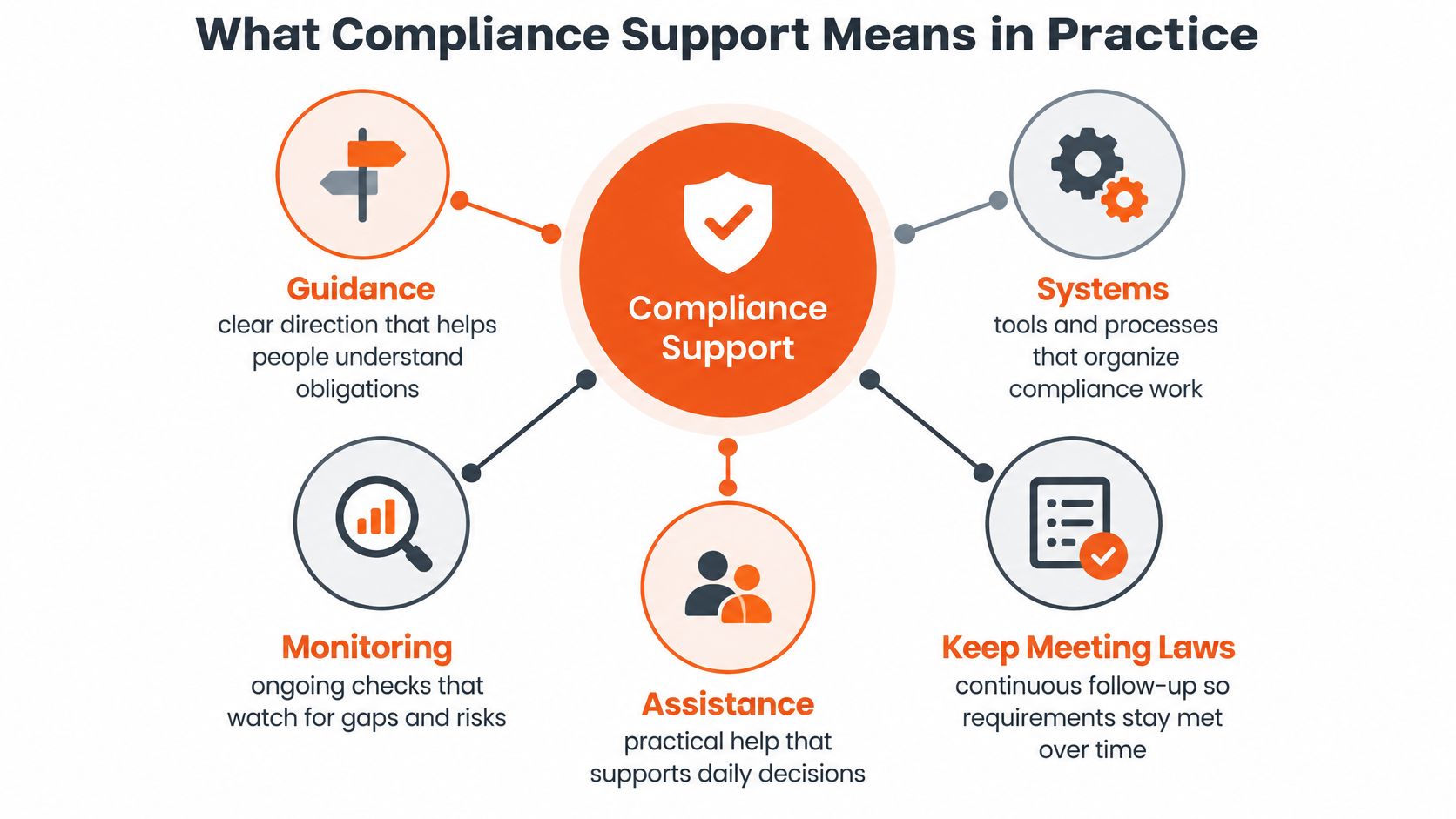
From advice to an operating process
Say an e-commerce support employee receives a request to erase a customer's information. Advice explains the relevant obligation. Operational support tells the employee how to verify the requester, identify affected systems, assign the request and document the outcome.
The difference is important. A policy document can describe the right process while employees still lack permission to carry it out or somewhere to record completion.
For an organizational perspective on coordinating those activities, the enterprise compliance insights from Freeform Company provide an additional resource on compliance management services. Use that perspective to examine how responsibilities connect across departments, rather than treating compliance as a legal-team inbox.
Practical rule: A compliance procedure should tell someone what to do next and what to save afterward.
Support continues after implementation
Structured compliance management replaces reliance on individual memory with repeatable work. Teams establish procedures, evaluate their operation, investigate exceptions and improve what isn't working.
A certificate, policy approval or completed training session may contribute evidence, but none replaces the ongoing work. Support must remain usable when a requirement changes, a source becomes outdated or an employee leaves.
Keep these takeaways distinct:
- Working definition: Support helps people understand and carry out applicable obligations.
- Continuous operation: Teams maintain and improve controls instead of treating compliance as a completed project.
- Concrete outputs: The process produces consistent answers, preserved evidence and records of decisions.
Why Compliance Support Matters Now
Regulatory complexity creates work beyond reading rules. Someone must decide which requirements apply, reconcile conflicting instructions, coordinate departments and maintain records as operations change.
For a small support team, that work competes with customer conversations. Outsourcing advice may help with interpretation, but employees still need to translate the advice into assignments, system settings and documented outcomes.
Compliance burden indicators
| Indicator | Figure | Source |
|---|---|---|
| Business organisations ranking regulation and compliance among their top three challenges | More than 80% of surveyed countries | OECD international survey |
| Businesses saying full compliance is too costly | 81% of countries, compared with 49% for government respondents | OECD international survey |
| Business organisations reporting rising administrative costs over the previous three years | 77% | OECD international survey |
| UK businesses using external support to comply with regulation | 93% in 2024 | UK Department for Business and Trade |
| US small businesses saying they spent too much time fulfilling compliance requirements | 47% in 2024 | MetLife and U.S. Chamber of Commerce Small Business Index |
| US small businesses outsourcing compliance tasks | 44% in 2024 | MetLife and U.S. Chamber of Commerce Small Business Index |
Reduce coordination work, not just reading time
These indicators describe different populations, not a single global business average. Their practical relevance is the workload they identify: understanding obligations and carrying them through everyday operations.
A useful support process turns an instruction such as “retain information only as needed” into a defined decision. The responsible person identifies the information, documents the retention rule, arranges deletion and saves confirmation.
- Interpretation: Identify the obligation that applies to the actual workflow.
- Execution: Give the task to someone with the authority and tools to complete it.
- Verification: Preserve the result and schedule review when the process changes.
Buying faster answers without assigning that work leaves the coordination burden with the same people. Effective support should make completion visible, including unresolved cases that need specialist attention.
Core Compliance Requirements and the Controls That Prove Them
A requirement is an obligation. A control is the measure used to address it. Evidence is the retrievable record that helps demonstrate what happened.
These aren't interchangeable. A screenshot of a retention setting shows a configuration, but it doesn't necessarily demonstrate that a particular deletion completed. Match the record to the question you're trying to answer.
The following table is an operational checklist, not a claim that every business has identical legal duties. Applicable requirements, exceptions and deadlines need assessment for your circumstances.
Compliance requirements, support tasks and evidence
| Requirement | What Support Must Do | Evidence to Keep | Platform Control |
|---|---|---|---|
| Lawful, documented personal-data processing under GDPR | Explain where customer data is used and why | Processing records, lawful basis, retention periods | Data inventory and retention settings |
| Data residency | State where data is stored and processed | Region settings and transfer records | Residency controls |
| Deletion and access requests | Respond to erasure and export requests within applicable deadlines | Deletion records and export files | Deletion and export controls |
| Audit trail of changes | Show who changed a prompt, source or permission, and when | Versioned change history and exported logs | Exportable audit logs |
| Access restriction | Limit who can view transcripts and edit answers | Role assignments and access reviews | Role-based access control |
| Data protection in transit and at rest | Show that encryption is applied to stored and transferred data | Encryption configuration records | Encryption in transit and at rest |
| Escalation of uncertain answers | Route sensitive or unresolved cases to a qualified person | Handoff records and resolution notes | Shared inbox and escalation workflows |
Start with the data lifecycle
For documented processing, an auditor might ask why customer transcripts enter the support system. Keep a processing record that identifies the purpose, relevant information and approved retention rule. A chatbot's explanation of that purpose isn't a substitute for the record.
For residency, preserve region settings alongside documentation of processing locations and transfers. Don't equate a selected storage region with proof that every connected service processes information there. Trace integrations and subprocessors as well.
For deletion and access, retain the request, identity-verification outcome, systems checked, completion status and any reviewed exception. An export file proves that something was exported, not that every relevant system was searched. Our guidance on data retention policies can help you turn retention decisions into explicit operating rules.
Make configuration changes inspectable
Exportable audit logs should let reviewers investigate configuration, source, permission and handoff changes. Before relying on them, inspect an actual export: check which events it contains, whether actors are identifiable and whether you can connect a change to its approval.
Role-based access control addresses a different question: who is allowed to view or change something? Keep role assignments, approval records and review outcomes. Customers remain responsible for setting permissions appropriately, even when the platform supplies the controls.
Encryption protects stored and transferred information, but it doesn't determine whether an employee should open a transcript. Keep configuration or assurance records for encryption separately from access approvals.
When evaluating the operational cost of ticketing and handoff tooling, the HaloITSM subscription pricing guide from DataLunix offers procurement context. Compare the workflow you need before comparing subscriptions, particularly how staff will retrieve approvals and resolution records.
A correct answer helps someone act. A retrievable record helps someone verify the action.
Check the source before judging the answer
A submitted crawl or upload isn't evidence that its material is retrievable. An asynchronous source must finish before answers are graded; otherwise, a failed answer may reflect incomplete ingestion rather than a defective prompt.
Record source readiness as part of the test setup. Preserve the document identity, relevant version and ingestion outcome so another reviewer can understand what information was available.
Say an auditor asks why an agent quoted a refund policy on a particular date. A useful evidence package contains:
- Source provenance: The policy version available to the agent.
- Change approval: The record identifying who approved or published that version.
- Conversation trace: The answer and the material used to support it.
- Security evidence: The relevant storage-protection configuration.
- Handoff history: Any escalation, reviewer decision and final resolution.
No single item proves the whole workflow. Together, they let a reviewer reconstruct the event without relying on someone's memory.
Apply this three-question test to every row: Can we answer it? Can we prove it with a record? Can we show who reviewed it? If the last answers are missing, you have an evidence gap even when the explanation sounds convincing.
How GDPR Shapes Compliance Support
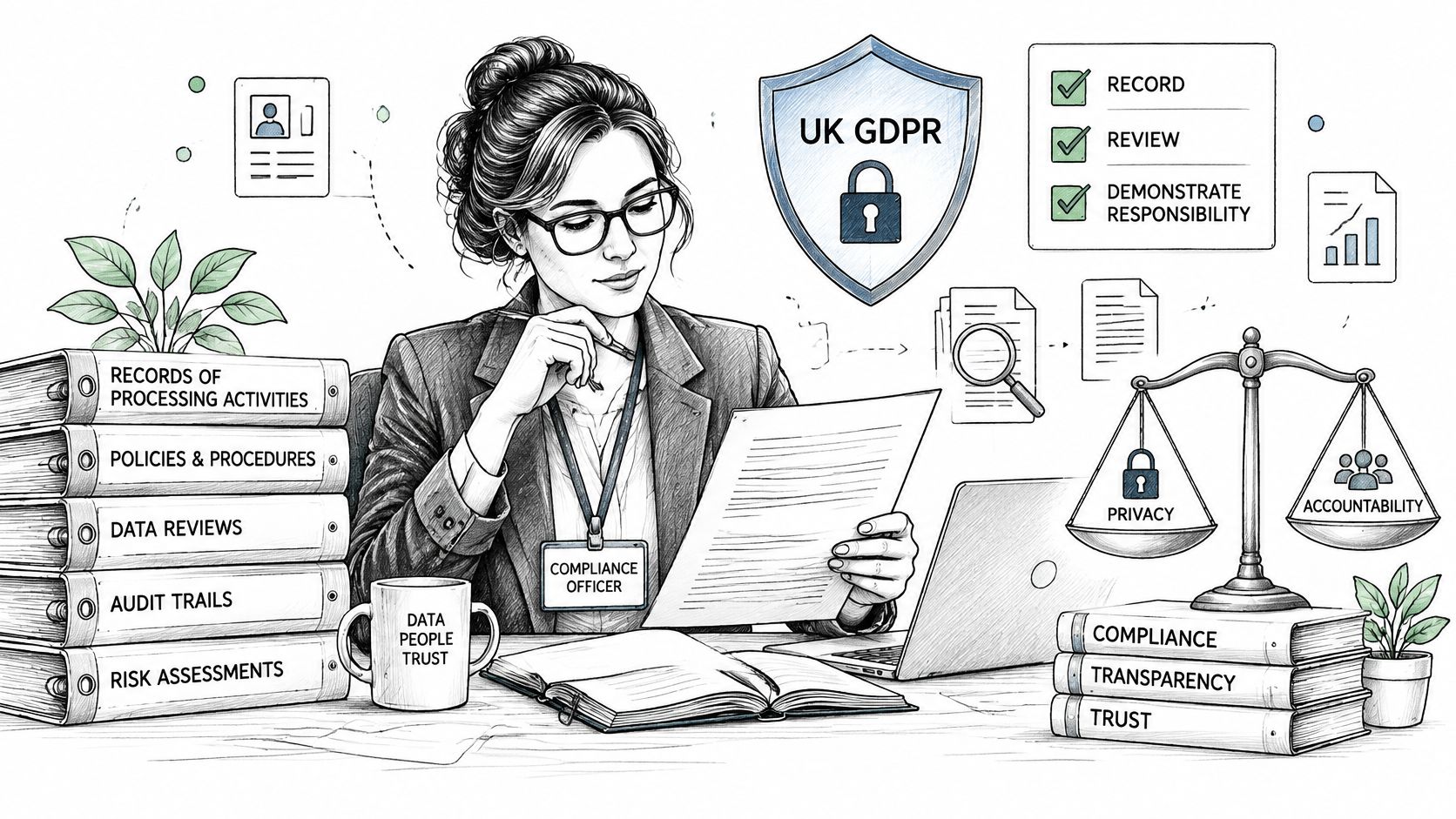
In privacy-regulated workflows, compliance support must help the organization demonstrate accountability for personal information. The ICO's accountability and governance guidance describes processing records covering purposes, data categories, recipients, international transfers and safeguards, retention schedules, and security measures, alongside DPIAs before processing likely to create high risk to individuals.
Privacy review belongs in the working environment, not just in policy documents.
Trace information through the workflow
Start with website crawls. Record whether the pages contain staff details, customer stories or other personal information, and why those pages belong in the knowledge base.
For uploaded documents, identify the document owner and remove unnecessary personal information before ingestion. Matil's guide to GDPR compliance for document processing provides additional context for examining that document workflow.
Then inspect conversation transcripts, email content and voice recordings separately. They may support related customer-service purposes, but their contents, access needs and retention decisions can differ.
- Analytics: Record whether reporting uses identifiable conversations or aggregated information, and who can access the underlying material.
- External API actions: Document what information leaves the support environment, its recipient and the reason for the transfer.
- Each processing flow: Record its assessed lawful basis, retention period, permitted roles and relevant subprocessors. Don't copy the same answers across unrelated activities.
Review risk before expanding automation
Sensitive information, extensive monitoring, profiling and consequential automated decisions should trigger a privacy-risk assessment and a decision about whether a DPIA is required. Record the reasoning, including a decision not to proceed until safeguards are in place.
Use this video as an additional discussion aid during privacy review.
Our GDPR security controls guidance can support the technical review. AgentStack is GDPR compliant, but that doesn't replace your organization's processing records or its assessment of a particular use case.
Set a practical benchmark: every material processing activity should have an owner, documented lawful basis, retention period, security measure and review evidence.
Before introducing another data source, complete this checklist:
- Inventory: List the new flow and the information involved.
- Ownership: Name the person responsible for its purpose and review.
- Retention: Set and document the deletion rule.
- Recipients: Record subprocessors and relevant transfers.
- Risk: Decide whether the proposed processing needs a DPIA.
Who Owns Which Compliance Tasks
Customers are solely responsible for the User Submissions they contribute to our service and represent and warrant that those submissions comply with applicable laws, rules and regulations. The practical starting point is therefore upload approval: someone in your organization must decide what material belongs in the system.
Responsibility then splits across operational, legal and technical work. The NIST AI Risk Management Framework recommends lifecycle risk management with transparent policies, assigned responsibilities, documented controls covering third-party AI technologies and ongoing monitoring.
Assign execution and review separately
Use this as a starting allocation, then replace team labels with named people. Where someone holds multiple roles, keep the approval and execution records distinguishable.
Compliance support tasks by owner
| Task | Support Team | Compliance or Legal | Platform Administrator |
|---|---|---|---|
| Answer accuracy and source refresh | Owns | Reviews high-risk topics | Keeps sources synced |
| Escalation rules | Owns | Approves triggers | Configures handoff routes |
| Retention and deletion periods | Informed | Owns | Applies deletion controls |
| Role assignments | Requests changes | Approves | Owns |
| Audit log review | Samples conversations | Reviews exports | Exports logs |
| DPIA trigger review | Flags new use cases | Owns | Provides configuration details |
Our role-based access control guidance helps translate these responsibilities into permissions. A job title alone shouldn't grant access to every transcript or configuration.
Give every deployment a review date
Connect each deployed agent, model, retrieval source and tool action to an owner, risk classification, control requirement and next review date. Include escalation paths and policy exceptions, since those can otherwise remain outside routine checks.
The support lead should sample unanswered or sensitive conversations. The compliance owner reviews policy concerns, while the administrator supplies configuration details, model-routing records and change history.
Ownership check: If everyone can identify the implementer but nobody can name the next reviewer, the task isn't fully assigned.
Disabling an action removes the agent's capability, but its saved configuration stays. Record the disablement and its reason, and distinguish an inactive configuration from an action the agent can currently perform.
Close reviews with an outcome: approved, changed, disabled or escalated. A meeting invitation demonstrates scheduling; a signed-off finding and corrective-action record demonstrate what reviewers decided.
Where Human Review Stays and Your Gap Check
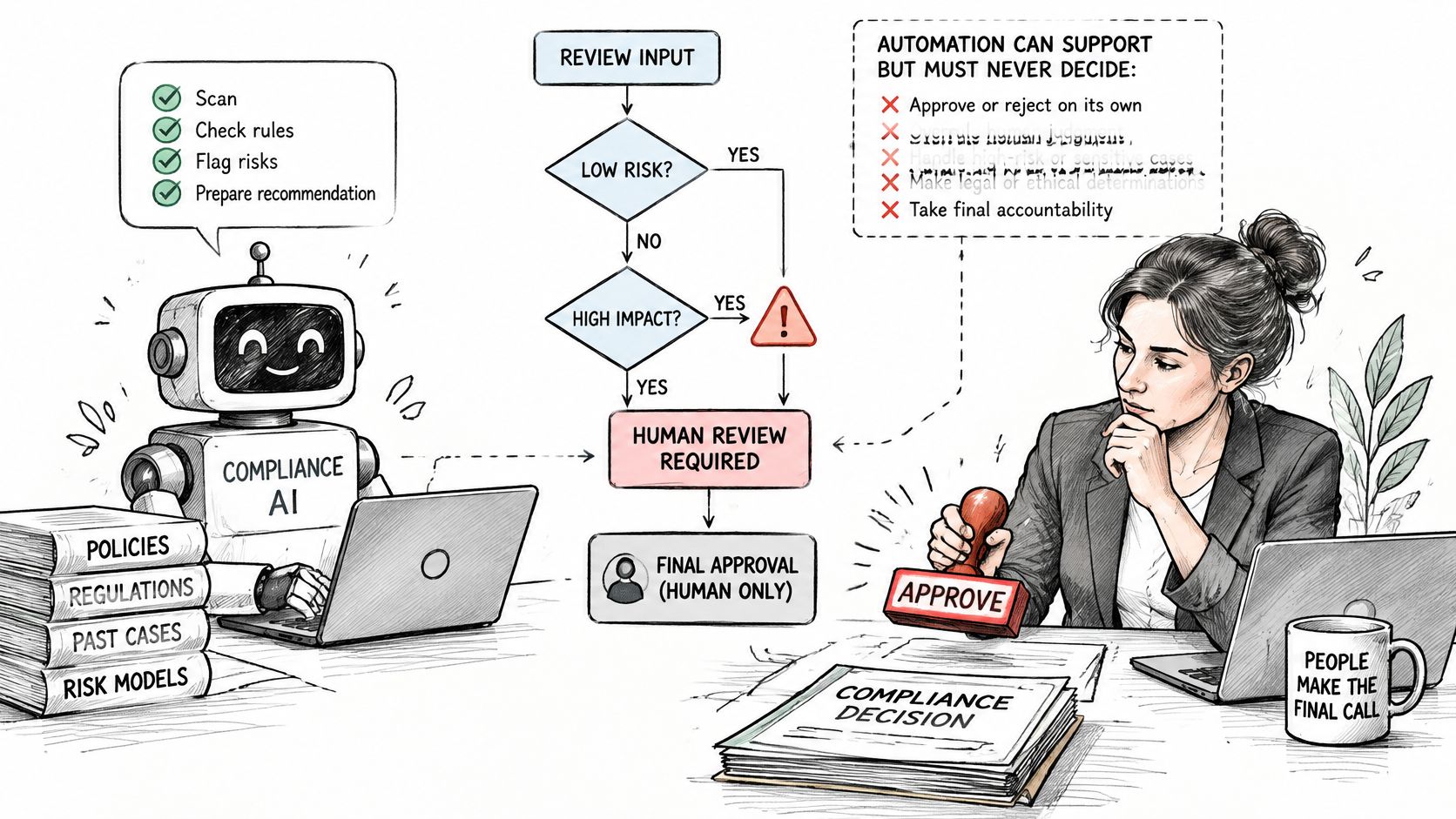
Automated support needs human review when it encounters ambiguous obligations, potentially harmful outcomes or decisions outside its approved authority. Having a person somewhere in the workflow isn't enough: the reviewer needs context, time, authority and a practical way to override the system.
The European Commission's AI Act framework assigns human-oversight and monitoring responsibilities to deployers of relevant systems, alongside provider monitoring obligations. The applicable duties depend on the system's classification and use; they aren't identical for every customer-support bot.
The boundary should be visible to both operators and reviewers.
Set decision boundaries before deployment
Use a conservative operational split:
- Automate documented answers: Let the agent explain approved procedures when it can retrieve supporting material.
- Require approval for interpretation: Send ambiguous obligations or conflicting policies to a qualified reviewer.
- Reserve consequential decisions: Keep decisions with legal effect under an accountable person's authority rather than allowing the agent to decide alone.
This is an operating safeguard, not a substitute for assessing the legal rules governing your use case. Faster processing doesn't establish that an outcome was justified.
Before saving a configuration, test representative supported, unsupported and ambiguous questions. Save only the model and prompt that pass all three types. A passing unsupported-question response should acknowledge the limitation rather than invent an answer; an ambiguous case should follow the approved clarification or escalation path.
For escalated cases, retain the proposed answer, supporting source, reviewer identity, decision and change history. Give reviewers enough conversation context to challenge the output rather than merely approve a summary.
Run the gap check
- Inspect each requirement. Mark whether your team can explain its current practice, retrieve evidence and name the responsible owner.
- Route missing evidence. Send unresolved rows to compliance or legal review with the missing record clearly identified.
- Choose the remedy. Separate rows needing a new technical control from those needing an owner, approval or completed review.
Don't solve every gap by purchasing another tool. An existing log may need an assigned reviewer; a deletion process may need completion evidence; an ambiguous policy may need a legal decision before automation continues.
The operating standard is simple: every answer should trace to a source, an owner and a record.
AgentStack offers a live walkthrough with a solutions engineer and a live agent built on your own documentation, with no credit card or commitment. Bring your gap checklist to examine how answers, approved actions and human handoffs fit your evidence-producing workflow, and visit AgentStack to arrange the walkthrough.