Your support agent answers a customer in seconds. It cites a policy, explains the next step, and sounds completely certain. The problem is that the policy applies only to one subscription tier, while the customer belongs to another. Nothing in the response looks obviously broken, yet the answer is wrong.
That's the defining failure mode of an AI knowledge base. The system can retrieve relevant words and produce fluent prose while missing the business meaning behind those words. Reliable support doesn't come from uploading more documents. It comes from governing definitions, exceptions, ownership, and evidence before the model starts answering.
Table of Contents
- Why Most AI Knowledge Bases Fail Before They Start
- Ingesting Content Without Creating Chaos
- How Chunking, Embeddings, and Governance Keep Answers Accurate
- Routing Queries Across Models to Balance Speed and Accuracy
- Deploying the Knowledge Base Across Chat, Email, and Voice
- Monitoring Responses and Iterating Toward Continuous Improvement
Why Most AI Knowledge Bases Fail Before They Start
A customer asks whether a refund applies after renewal. The support agent retrieves an article titled “Refund policy,” combines it with a billing FAQ, and answers confidently that refunds are available within the stated window. The customer has an annual enterprise contract, and its exception sits on a separate internal page.
Nothing in the response sounds broken. The retrieval system found relevant words, and the generated explanation is clear. The failure is semantic context: the system did not establish which product, plan, region, contract type, or policy version controlled the case. A document dump can retrieve text, but it cannot reliably rank competing definitions unless the organization has made their meaning and authority explicit.
The missing layer is semantic context
Semantic context tells an AI agent what a business term means, when that meaning changes, and which rule applies. “Active user” could mean someone who logged in, a billable seat, or a user who completed a qualifying event. “Resolution time” could begin when the ticket is created or when a human first responds. “Refundable” could depend on renewal status, payment method, contract language, or local rules.
A 2026 guide on building a knowledge base for AI agents identifies semantic context as a common gap and emphasizes governed definitions, canonical glossaries, and lineage instead of raw retrieval alone. That distinction matters in production. If a model must infer the meaning of a metric or exception from scattered prose, it can produce a polished answer that violates policy.
Industry data shows the readiness gap. Only 29% of leaders in a 2026 state-of-knowledge-management report considered their organizations AI-ready, while 18.6% said their knowledge was highly structured and trustworthy for AI use, according to the same AI agent knowledge-base guide. Those figures point to a governance problem, not a shortage of language models.
Practical rule: If a human support specialist would ask “which definition applies here?”, record that decision rule in machine-readable form.
Govern meaning before adding volume
Start with a glossary for business-critical terms. Give each definition an owner, scope, effective date, and source. Link policy exceptions to the canonical rule instead of burying them in unrelated articles, and preserve lineage so the agent can trace an answer to approved evidence.
Governance also defines when the agent must stop. If it cannot establish the customer's plan or the current policy version, it should request the missing detail or escalate. Fine-tuning cannot resolve contradictory source material. Governance beats volume because a smaller, coherent corpus gives retrieval and generation fewer chances to combine incompatible facts.
Ingesting Content Without Creating Chaos
The first ingestion mistake is treating every source as equally authoritative. A public help article, a draft spreadsheet, an old PDF, and a support reply may all contain the word “refund,” but they shouldn't have the same influence on an answer.
Build the source layer deliberately. The practical objective is a single retrieval foundation, not a giant folder that happens to contain everything your team has ever written.

Prioritize sources in a controlled order
-
Start with approved customer-facing content. Crawl the website and help center, then remove duplicate pages and obvious drafts. This gives the agent a stable public baseline.
-
Add operational documents selectively. Upload PDFs, Word files, PowerPoint presentations, Excel files, and images only after identifying their owner and intended audience. A pricing workbook may be useful for an internal agent and unsafe for a public chatbot.
-
Sync collaborative systems with boundaries. Notion and similar tools often contain valuable working knowledge, but they also contain meeting notes, experiments, and superseded guidance. Use workspace, page, folder, or collection boundaries where available.
-
Capture edge cases as explicit Q&A pairs. If agents repeatedly answer a rare but important question, record the approved answer and its conditions. Don't force an unusual exception into a generic FAQ.
-
Mark authority and lifecycle metadata. Record who owns the source, when it was reviewed, which audience may use it, and what supersedes it. Without this metadata, retrieval can find a document but can't judge its reliability.
A 2026 knowledge-management report found that 73% of organizations use formal knowledge-management systems, up from 61% in 2020, as reported in knowledge-management statistics. Centralization is therefore a normal operating practice, but centralization alone doesn't remove ambiguity. It can merely place competing drafts in one searchable location.
Make ingestion preserve meaning
Automatic parsing, chunking, and indexing reduce manual preparation, but they don't replace source review. Check whether tables retain their headers, whether screenshots have usable text, and whether a document's footnotes remain attached to the rule they qualify. A separated exception can be more dangerous than a missing article because it gives the agent partial confidence.
For teams configuring AgentStack, the useful workflow is to upload or sync sources from a controlled location, inspect how the platform prepares them for retrieval, and then test questions against the original documents. The document ingestion pipeline guidance is relevant here because ingestion quality determines what the retrieval layer can effectively use.
Keep one canonical version for every policy. Archive superseded material instead of leaving it active beside the replacement. If a source cannot be assigned an owner or scope, it probably shouldn't be available to a customer-facing agent.
How Chunking, Embeddings, and Governance Keep Answers Accurate
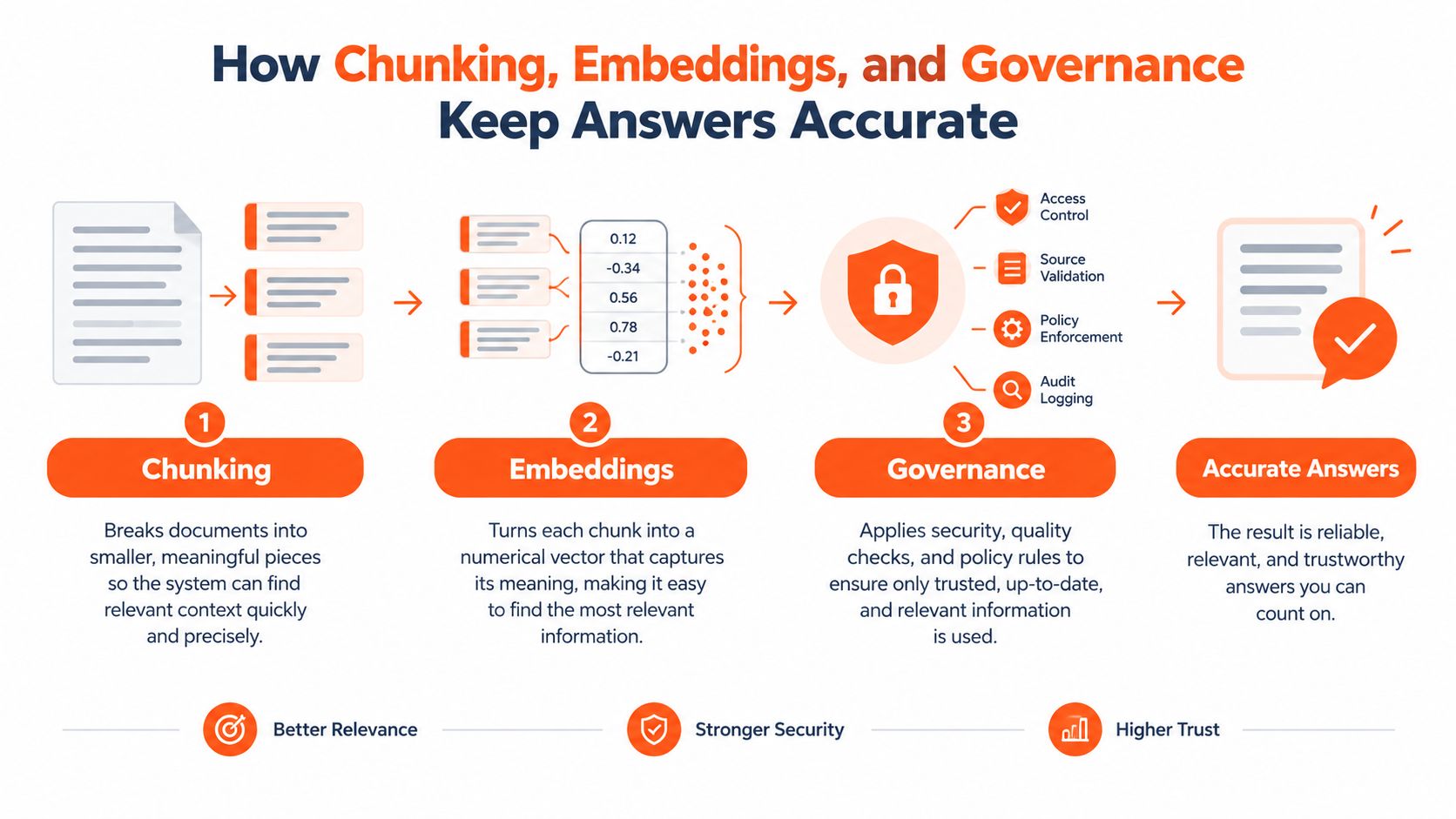
An agent can retrieve a fluent answer about the wrong plan, market, or policy version. The semantic match may be strong while the context is wrong. Accurate retrieval therefore depends on three decisions: Chunking defines the unit the system can retrieve. Embeddings connect different wording to related concepts. Governance determines whether that material is authoritative and applicable.
Teams often tune the first two and leave governance vague. The result is a capable search layer that can find similar text but cannot reliably judge which rule should control the response.
Chunk for the question, not the page layout
A long article may combine eligibility rules, exclusions, examples, and escalation steps. Retrieving the whole page gives the model more context, but also more opportunities to merge separate conditions. Retrieving a fragment from the middle of a table can remove the heading that identifies the relevant plan.
Build chunks around complete decision units. Keep a troubleshooting step with its prerequisite and expected result. Keep a policy exception with the rule it changes. Preserve table headers, scope, and qualifying notes. Chunk size should follow real question patterns, so test candidate boundaries against actual support queries rather than selecting one universal setting.
The RAG chunking strategies guide offers a practical framework for setting those boundaries. A useful review test is whether someone can understand the retrieved passage without opening several neighboring sections.
Embeddings match language, not authority
Embeddings can connect “my parcel never arrived” with a missing-shipment procedure even when the customer uses none of the internal terminology. That semantic reach helps cover the language gap between customers and documentation.
It does not establish that a source is current, permitted, or higher priority. Add metadata filters for effective status, source priority, product, market, audience, and access level where the retrieval system supports them. Governance must resolve conflicts after semantic matching has surfaced possible answers.
Definitions prevent plausible mistakes
Store important definitions as explicit records rather than burying them in prose. Each record should include:
- Canonical meaning: State the organization's approved meaning.
- Scope: Identify the product, audience, market, or workflow.
- Exceptions: Record conditions that change the standard answer.
- Lineage: Link the definition to the approved policy or system of record.
- Owner: Name the team responsible for reviewing changes.
Freshness needs the same controls. Help materials can become outdated even when indexing runs successfully. Re-indexing stale content only makes old guidance easier to retrieve. Set review triggers for product releases, pricing changes, legal updates, and repeated low-confidence answers. When a definition has no owner or scope, keep it out of the customer-facing agent until those fields are resolved.
Routing Queries Across Models to Balance Speed and Accuracy
A password-reset request and a multi-condition contract question shouldn't consume the same reasoning path. The first needs fast intent recognition and a verified action. The second may require retrieval across several policies, careful conflict handling, and a cautious escalation.
A single-model setup looks simpler because every request follows one route. In operation, it often creates two problems at once. Routine requests become slower and more expensive than necessary, while complex requests receive an answer that sounds decisive before the system has resolved the underlying ambiguity.
Match the model to the work
| Query type | Preferred handling | Why |
|---|---|---|
| Opening hours or basic account guidance | Fast model with grounded retrieval | The answer is narrow and repeatable |
| Refund status or a password reset | Fast model plus a validated action | The system should complete a known workflow, not improvise |
| Troubleshooting across product versions | Higher-reasoning model with source checks | The answer may depend on sequence, version, and symptoms |
| Policy interpretation with exceptions | Higher-reasoning model or human escalation | The system must preserve conditions and avoid overclaiming |
AgentStack documents routing between frontier models such as GPT-5.2, Claude, and Gemini, and faster models such as Grok and Haiku, based on task demands. Used properly, this lets a team reserve deeper reasoning for questions that need it while keeping routine interactions responsive.
Route on risk, not just complexity
A short question can still be high risk. “Can I delete this account?” may trigger retention, billing, legal, and data-handling requirements. Conversely, a long question may be a straightforward explanation of a documented feature.
Define routing signals around policy sensitivity, required actions, missing entities, source conflict, and confidence. If a query asks for a transaction change, route through an authenticated action and confirmation step. If retrieval returns contradictory policy versions, stop generation and escalate rather than asking a stronger model to guess.
Understanding what is AI orchestration helps here. Orchestration is not merely switching models. It coordinates retrieval, tools, guardrails, handoff, and response generation as one controlled workflow.
Measure the result by resolution quality, groundedness, escalation appropriateness, and response time. A fast wrong answer is still a support failure. A slower answer that correctly asks for a missing account detail may be the better operational outcome.
Deploying the Knowledge Base Across Chat, Email, and Voice
An accurate knowledge base still fails if customers can't reach it where they already ask for help. Deployment should reuse the same governed source layer across channels, while adapting the interaction style to each channel's constraints.
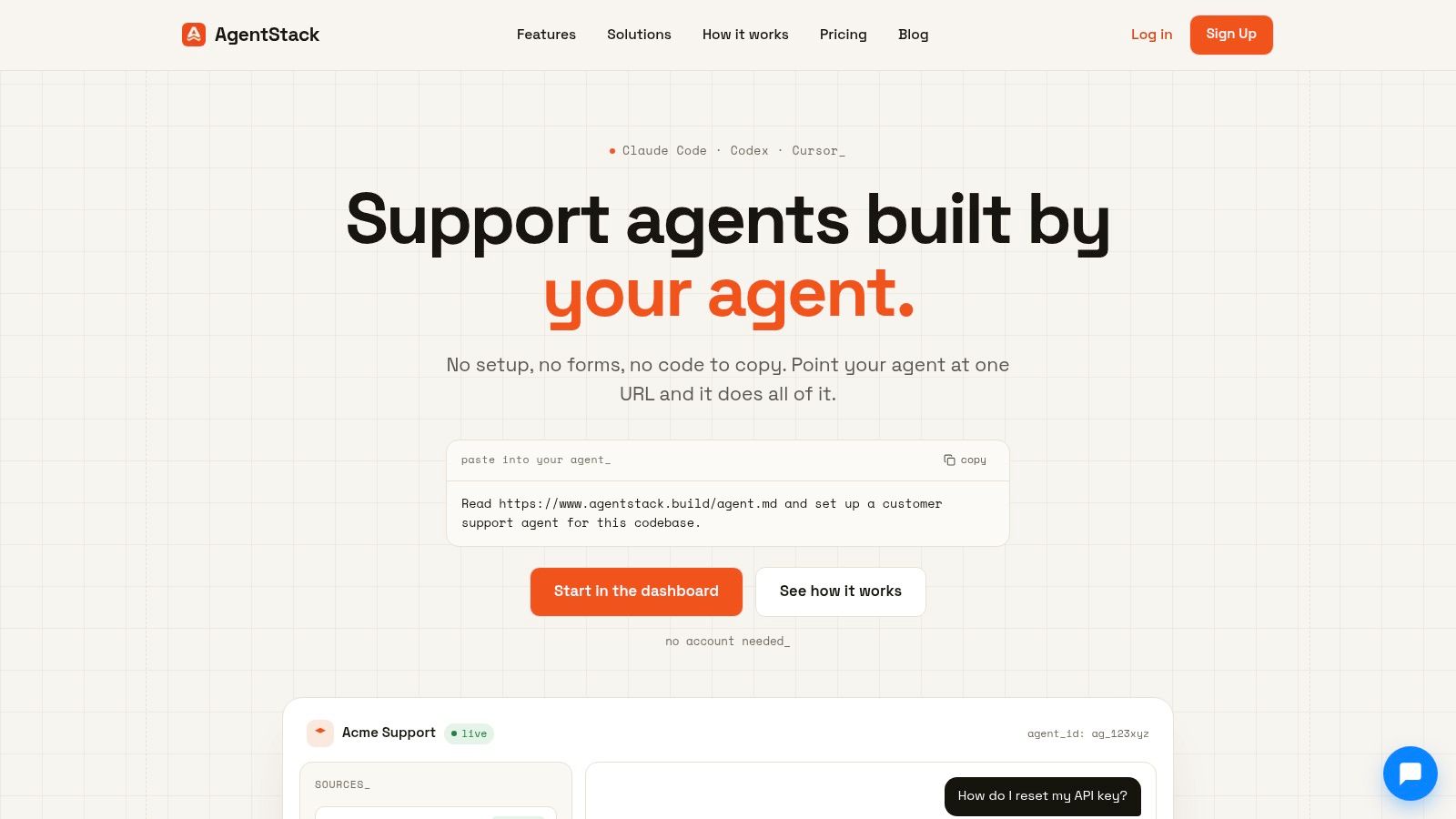
Start with the lowest-friction surface, usually a website widget. A single script tag can add an embeddable chat interface that teams can style to match their brand without building custom frontend infrastructure. That makes it practical to test retrieval and escalation with real traffic before expanding the workflow.
Design the handoff before launch
A channel rollout needs an explicit human path. Customers shouldn't have to repeat the problem after an agent fails to answer.
- Chat: Show the answer with its relevant source context, then offer escalation when the customer's situation falls outside the documented rule.
- Email: Draft replies that preserve the customer's history and include only the policy details applicable to the case.
- Slack: Resolve internal questions in threads, but respect audience permissions so confidential operational guidance doesn't leak into broad channels.
- Voice: Keep answers concise, confirm critical details aloud, and transfer when authentication, policy ambiguity, or emotional complexity exceeds the agent's boundary.
A shared inbox can unify AI and human conversations so the receiving specialist sees the question, retrieved context, actions already attempted, and reason for escalation. That continuity is more important than making the AI sound human. The handoff should feel like a workflow transition, not a reset.
Add actions only where the boundary is clear
An AI support agent becomes more useful when it can perform controlled actions such as web search, meeting booking, lead capture, or escalation triggers. Each action needs defined inputs, permission checks, confirmation requirements, and failure handling. Don't let the model infer an irreversible action from a vague request.
Developer teams can use REST API v1 or an MCP server for programmatic control and tool integration. Enterprise deployment also requires operational controls, including exportable audit logs, role-based access, GDPR support for data residency, deletion, and export, plus AES-256-GCM encryption for data in transit and at rest.
Roll out one channel first, inspect real conversations, and then reuse the same knowledge base across additional channels. One source layer with channel-specific guardrails is safer than separate bots that gradually develop conflicting answers.
Monitoring Responses and Iterating Toward Continuous Improvement
Launch day provides a starting point, not proof that an AI knowledge base works. Production conversations expose the semantic context gap: the system may retrieve related words while missing the rule, exception, audience, or product context that makes an answer correct.
Monitor questions the system answers, answers partially, and refuses. Review retrieved sources alongside the final wording. Fluent language can still hide an outdated article, a missing exception, or details incorrectly combined from two products.
Turn unanswered questions into maintenance work
Use conversation volume, resolution outcomes, sentiment trends, and unanswered questions to build a support backlog. Repeated failures usually have one of three causes:
- The required content does not exist.
- The content exists but uses unfamiliar terminology or poor chunk boundaries.
- The content conflicts with another source or omits the conditions required for its use.
Prioritize gaps by operational risk and recurrence. A missing explanation for a minor feature can wait. An unclear cancellation rule needs prompt review when the agent repeatedly gives uncertain or inconsistent answers.
Customer expectations make response-time monitoring important. Support teams need to distinguish fast resolution from fast deflection that sends the customer back into the queue. A quick answer built on the wrong context creates another contact and can be harder to detect than an explicit refusal.
Build a review loop with refusal as a success state
Assign owners to high-risk content and require human approval for policy changes. Track source age, retrieval failures, escalation reasons, and cases where the agent answered despite weak evidence. After each meaningful update, test representative questions, including edge cases and queries that previously failed.
Emerging support systems combine multimodal answers, automatic content updates, and proactive assistance. Those capabilities can move a knowledge base beyond a static article library, but automation does not replace governance. A model can detect patterns and prepare a draft. An accountable person must approve the change and confirm its scope.
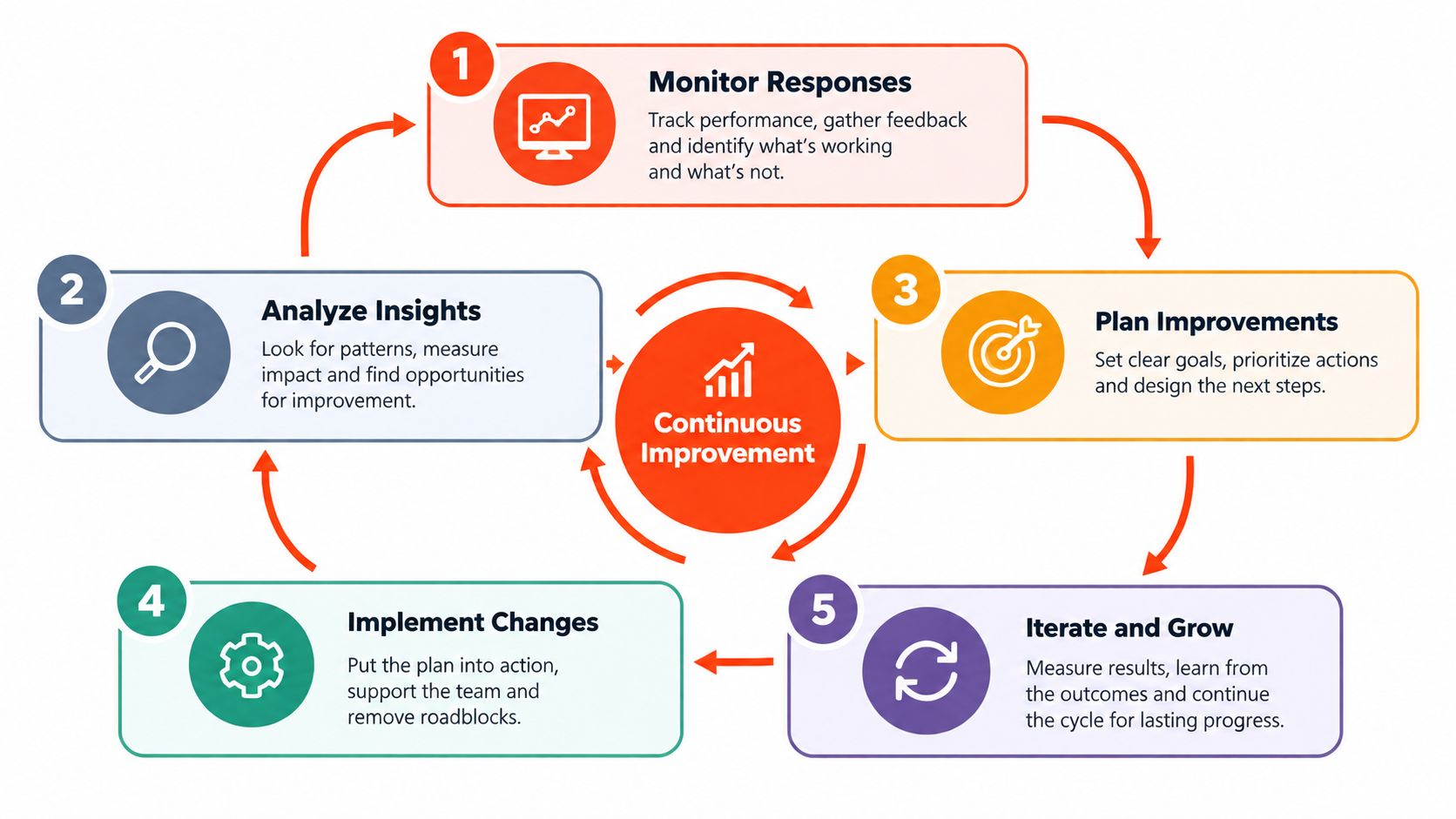
The operating loop is observe, diagnose, govern, publish, retest. Put security controls inside that loop. Audit logs and access rules let reviewers establish what changed, who approved it, and which audiences can retrieve it. The continuous improvement cycle guidance provides a practical structure for this work.
Treat “I don't know” as a controlled outcome, not a failure to eliminate at any cost. An agent that requests the missing plan, cites the applicable source, or escalates a contradiction protects trust better than one that fills a context gap with fluent speculation.
AgentStack combines website and document ingestion, multi-model routing, omnichannel delivery, shared-inbox handoff, analytics, actions, and enterprise controls in one support-agent workflow. Visit AgentStack to connect sources, test semantic accuracy against real support questions, and maintain a governed AI knowledge base after launch.