A support leader can have a polished chatbot, a well-indexed help center, and still watch the same unresolved questions arrive every day. The problem usually isn't the language model. It's choosing a first deployment with weak source content, unclear escalation rules, or no way to tell whether retrieval failed or the answer merely sounded convincing.
The most useful retrieval augmented generation use cases start with a narrow workflow and a measurable operational outcome. A website assistant may reduce routine tickets, while an agent copilot may improve consistency without exposing customers to autonomous answers. Email tolerates deeper retrieval than voice, and a live order lookup needs permissions and API actions rather than documents alone.
This list moves from customer-facing deflection to the analytics loop that tells you what to build next. Each use case focuses on its production failure mode, a practical implementation pattern, and a checkpoint you can repeat after launch. For teams evaluating tools such as Premier Broadband's AI chatbot tool, the important question isn't whether RAG can answer a question. It's whether your support operation can verify, govern, and improve the answer.
Table of Contents
- 1. Website Help Center Chatbot for Ticket Deflection
- 2. Automated Email Ticket Drafting and Auto-Replies
- 3. Agent-Assist Copilot for Human Support Reps
- 4. Internal IT and HR Helpdesk Assistant in Slack or Teams
- 5. Developer Documentation Assistant
- 6. Notion and Wiki-Grounded Knowledge Base Q&A
- 7. E-commerce Product and Order Support with Live Actions
- 8. Real-Time Voice Phone Support Agent
- 9. Pre-Sales Q&A, Lead Capture, and Meeting Booking
- 10. Knowledge Gap Detection and Content Improvement Loop
- RAG Use Cases, 10-Point Comparison
- Where to Start Pick One Use Case and Measure It
1. Website Help Center Chatbot for Ticket Deflection
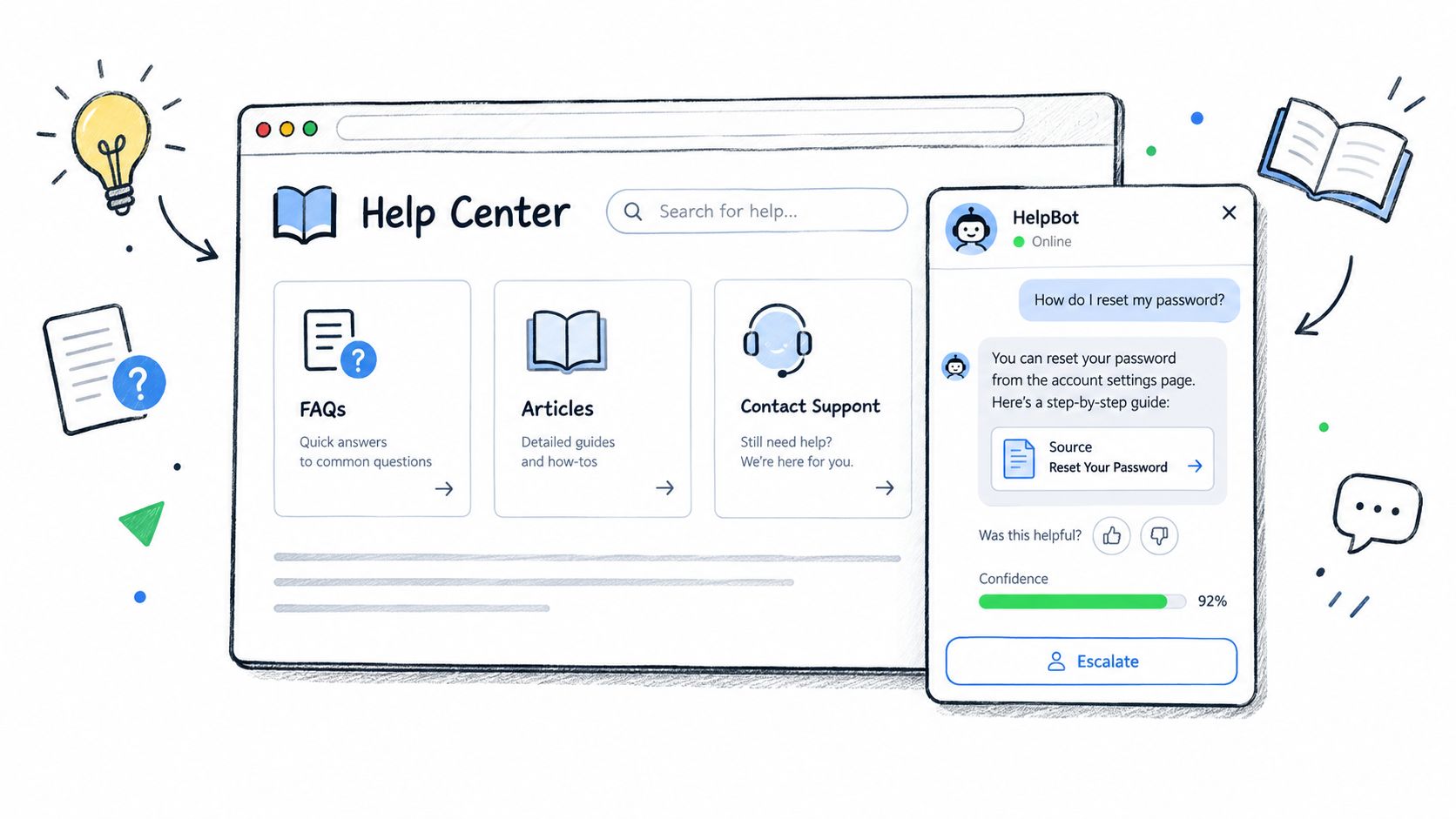
A help-center chatbot is often the quickest RAG deployment because the source material already exists in articles, FAQs, setup guides, and policy pages. The assistant retrieves relevant passages, generates an answer, shows source links, and hands the conversation to a person when the evidence is weak or the request needs an account-specific action.
The architecture follows the pattern established by Patrick Lewis and colleagues in 2020. Their RAG research paired a generator with an external dense index of approximately 21 million Wikipedia passages, and reported gains of roughly 4 to 16 percentage points on open-domain question-answering benchmarks. The paper also reported that dense retrieval outperformed BM25 by approximately 9 to 19% on passage-retrieval evaluations. These results are research findings, not a promise of equivalent support performance, but they explain why changing knowledge can sit outside the model and be retrieved at answer time. The original RAG research reference provides the historical basis.
Where it breaks
RAG amplifies contradictions. If one article says returns are allowed for thirty days and another says sixty, retrieval can surface either policy, or the model can blend them into a confident answer. Indexing every page before cleaning the help center creates a larger failure surface, not better coverage.
Start with the highest-volume question categories, remove duplicate articles, and attach ownership plus a last-updated field to every chunk. A practical first release should include a visible source, a clear “I can't confirm that” path, and escalation that preserves the conversation.
Practical rule: Measure deflection alongside customer satisfaction, escalation accuracy, and reopened cases. Deflection by itself can reward the bot for ending conversations badly.
Use this guide to reducing support ticket volume to connect the chatbot to a broader content and routing process. Your first checkpoint is simple: sample resolved and escalated conversations by category, then label whether the failure came from missing content, wrong retrieval, or incorrect generation.
2. Automated Email Ticket Drafting and Auto-Replies
Email is a forgiving environment for RAG. A support system can retrieve policy articles, product instructions, and relevant case context, draft a response, and give an agent time to review it before sending. The channel doesn't demand an immediate spoken response, so teams can afford deeper retrieval or a more capable model when the request is ambiguous.
The production mistake is enabling autonomous sending too early. Email often contains signatures, disclaimers, forwarded chains, and quoted replies that pollute the query and retrieval index. A model may treat an old agent response as current policy, especially when the thread contains several conflicting instructions.
Begin in draft-only mode. Ask agents to edit, reject, and classify drafts, then use those decisions to identify weak articles and unsafe categories. Billing disputes, legal complaints, cancellations, refunds, and unusual account changes should remain on a do-not-automate list until the team has evidence that the workflow handles them safely.
A controlled rollout pattern
- Clean the incoming message: Strip signatures, repeated quoted text, and boilerplate before retrieval.
- Preserve evidence: Log the source chunks used for each draft, so reviewers can identify whether the problem was retrieval or generation.
- Separate risk levels: Allow automation for narrow informational requests, but route disputes and irreversible requests to people.
- Review the draft, not only the outcome: An accepted draft can still contain a misleading sentence that the customer didn't challenge.
The checkpoint is an agent-review sample segmented by intent. Track source coverage, edit frequency, escalation decisions, and whether customers reopen the case. A fast draft that requires extensive correction costs more than a slower draft that agents can send with confidence.
3. Agent-Assist Copilot for Human Support Reps
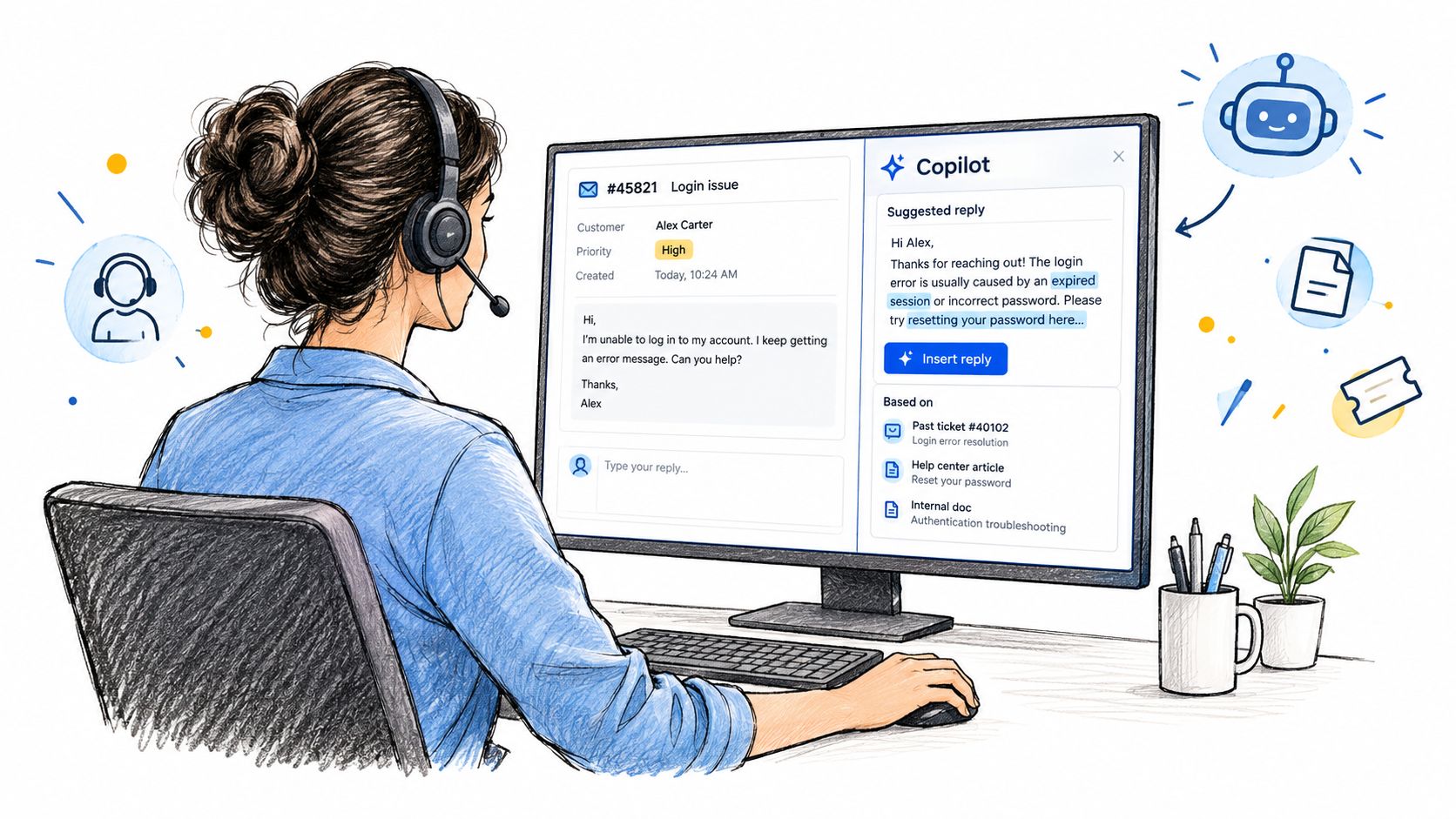
An agent copilot keeps the human in the sending loop. When a ticket opens, the system retrieves relevant documentation, approved macros, troubleshooting steps, and carefully selected resolved cases. It then proposes an answer or next action inside the agent workspace.
This is a strong entry point for complex products because the organisation gets retrieval benefits without asking the model to own the customer relationship. A junior agent can find the right procedure faster, while an experienced representative can reject irrelevant suggestions. The trade-off is that acceptance rate doesn't equal quality. Agents may accept a fluent answer under time pressure, or ignore useful suggestions because the interface hides sources.
Make the suggestion auditable
Show the supporting article, source section, and retrieval confidence beside the proposed response. Treat resolved tickets as training material only after quality labels have been applied. A case marked “resolved” may contain an improvised workaround that shouldn't become company policy.
For a product with frequent releases, review tickets created before the latest major version. Old conversations can still be useful for troubleshooting patterns, but they shouldn't outrank current documentation when interfaces or procedures have changed.
The best checkpoint combines suggestion acceptance, edit distance, source usage, and downstream resolution. If agents accept many suggestions but customers reopen those cases, the copilot is optimising for speed rather than correctness. If agents rarely accept suggestions, inspect whether retrieval is missing the article, the article is poorly written, or the proposed answer is too difficult to trust.
4. Internal IT and HR Helpdesk Assistant in Slack or Teams
Employees already ask operational questions in Slack and Teams. An internal assistant can retrieve answers from policies, wiki pages, onboarding documents, and runbooks, then create or route a ticket when self-service stops being appropriate. Typical requests include access procedures, expense rules, device setup, and regional leave policies.
This use case exposes a security problem that a public FAQ bot can avoid. A document may be relevant to the query but restricted to a department, country, employment type, or management level. Filtering the response only after retrieval is unsafe because the model may already have received the restricted text.
Permission checks belong in retrieval
Apply source-system permissions before chunks enter the model context. Preserve the user's identity, group membership, region, and channel in the retrieval request. Keep a record of the source and access decision for every answer, especially when the assistant can create tickets or trigger account workflows.
A useful launch scope is two or three high-volume topics, such as password resets or expense policy. Ask users to mark whether the answer solved the issue, and route “I still need help” responses into a weekly review queue. Resolved Slack threads can become useful retrieval material, but only after an owner verifies the resolution.
For implementation planning, see the Slack and Teams integration guide. The checkpoint is not just answer acceptance. Review permission denials, escalations, stale documents, and repeat questions by department. A low escalation rate can mean good self-service, but it can also mean employees are receiving answers they shouldn't see.
5. Developer Documentation Assistant
Developers rarely want a generic explanation when they ask about an API. They want the exact parameter, version-specific behaviour, error condition, or code pattern, with a link to the reference section they can inspect. A documentation assistant can retrieve headings, code blocks, examples, changelogs, and endpoint references, then produce a concise answer grounded in the selected version.
The common failure is flattening documentation into ordinary prose. If chunking separates a code block from its heading, or mixes two API versions, the generated answer can look plausible while using the wrong method or parameter. A semantically similar result isn't necessarily the correct result for a developer's installed version.
Preserve structure during ingestion. Store the page title, hierarchy, product version, language, code-block boundaries, and canonical URL as metadata. Filter by the version selected in the documentation interface before ranking passages. Show the source link with every code answer and encourage verification for destructive or security-sensitive operations.
Use a real question set
Create a benchmark from actual support and community questions rather than synthetic prompts. Include installation, authentication, error handling, migration, and version differences. The supplied plan calls for a test set of 50 real developer questions, which gives the team a repeatable pre-launch checkpoint without pretending that one score captures documentation quality.
Review retrieval separately from generation. If the right section isn't retrieved, changing the language model won't solve the problem. If the right section is retrieved but the answer is wrong, inspect prompt instructions, version filtering, and code rendering.
6. Notion and Wiki-Grounded Knowledge Base Q&A
A company doesn't need a formal help center to benefit from RAG. Product specifications, troubleshooting notes, release decisions, and operational policies often live in Notion or Confluence. A synchronised retrieval layer can preserve page hierarchy and answer questions for internal teams or, with stricter publishing controls, for customers.
The failure mode is treating a wiki as an approved knowledge base by default. Draft proposals, personal notes, old project pages, and contradictory decisions may all be semantically relevant. A model can't reliably infer which page represents current policy from writing style alone.
Create a published area or approved tag for customer-facing content. Keep internal and external indexes separate unless permissions are enforced at retrieval time. Add a short summary near the top of long pages, because a page can contain the right information while burying the answer beneath project history.
High-frequency questions deserve explicit Q&A pairs when the surrounding wiki prose is ambiguous. For example, a policy page can explain exceptions in detail, while a curated question and answer can state the operational response that support staff should give.
The checkpoint is sync integrity. Confirm that edited pages are reindexed, deleted pages disappear, and failed updates alert an owner. Then sample answers against the page's current version. Retrieval quality isn't stable if the source connector ceases updating without notice.
7. E-commerce Product and Order Support with Live Actions
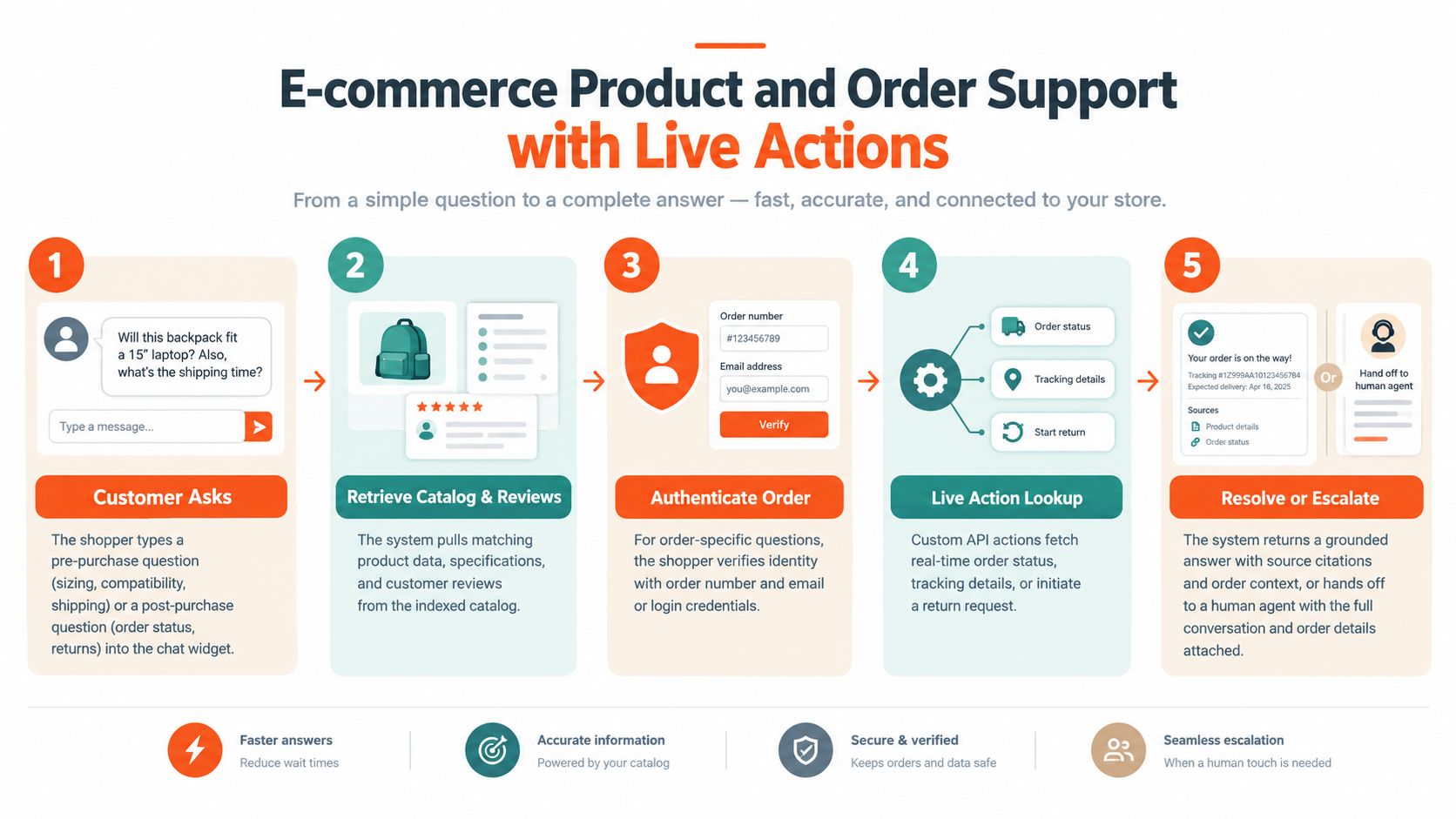
A shopper asks whether a compatible item is in stock, then wants to know where an existing order is. These requests require different evidence. Product answers can retrieve catalogue fields, compatibility notes, reviews, shipping policies, and returns content. Order answers need an authenticated action that checks the customer's actual shipment, eligibility, or return status.
Production failures usually occur at the boundary between retrieval and action. A document-only bot can explain a return policy but cannot confirm whether a parcel shipped. A tool-only bot can read an order without applying the policy that governs an exception. Route product questions to retrieval, order questions to live systems, and require the model to cite the retrieved policy before requesting an action.
Keep catalogue facts and policy text distinct
Index structured attributes separately from long descriptions. Filters can then handle size, material, compatibility, price, and availability without relying on semantic similarity alone. Refresh stock, price, and delivery data through webhooks or scheduled re-indexing. A live inventory response must take precedence over an old description.
Require verified identity before exposing order details or starting a return. Log each action call, including inputs, outputs, authentication results, and the policy passage that justified it. Keep a human approval path for refunds, exceptions, and irreversible changes.
A relevant integration path is the agentcentral MCP server for sellers. Measure product-answer accuracy, identity failures, action errors, and human overrides. Recheck these measures after catalogue updates and policy changes, because retrieval quality and action safety can drift independently.
8. Real-Time Voice Phone Support Agent
Voice agents add a strict latency and comprehension constraint to RAG. Speech recognition can mishear a product name or order number, and that error becomes the retrieval query. The system then has to retrieve, generate, and speak an answer while the caller waits through a natural conversational pause.
Voice works best for bounded intents such as appointment scheduling, account status, outage information, or simple troubleshooting. It works poorly when the caller needs a long policy explanation, the account data is ambiguous, or the agent must make a high-risk decision without confirmation.
Cache frequent retrievals and separate retrieval from slower escalation reasoning. Use a tight retrieval budget, then keep the spoken answer short enough to follow. Confirm names, dates, and order numbers before any action. When the response needs detail, offer to send a text link instead of reading a page aloud.
Test with real call recordings, including accents, interruptions, background noise, and callers who change their minds. Scripted utterances hide the recognition and turn-taking failures that dominate production. A useful checkpoint measures time to first spoken response, transfer accuracy, confirmation failures, and whether callers repeat themselves.
For teams assessing channel expansion, the AI voice agents guide gives the workflow a support-platform context.
9. Pre-Sales Q&A, Lead Capture, and Meeting Booking
A pricing-page assistant can answer product and integration questions, qualify a visitor, and book a meeting through a calendar action. The retrieval corpus might include approved product documentation, security material, implementation guidance, and pricing rules. The workflow resembles support, but the cost of an unsupported answer is commercial rather than operational.
Restrict the pre-sales corpus to reviewed content with a named owner. Product roadmaps, custom pricing, compliance claims, and contract terms need careful boundaries. If the assistant isn't certain, it should connect the visitor with sales rather than improvise a promise.
Lead capture adds another failure surface. Map fields to CRM properties before launch so the assistant doesn't create duplicate contacts or store free-text answers in unusable fields. Require the assistant to confirm the company, use case, and preferred meeting details before booking.
Review the claims, not only the conversions
A booked meeting isn't proof that the answer was accurate. Review transcripts weekly for statements about roadmap commitments, security controls, integrations, and supported volumes. Compare qualified leads with sales feedback about fit and expectation setting.
The checkpoint is a combination of source coverage, handoff quality, duplicate-record rate, and sales correction rate. A slower assistant that says “I'm not certain” at the right time can create better pipeline than a fluent one that overstates product capability.
10. Knowledge Gap Detection and Content Improvement Loop
RAG analytics can be more valuable than another front-end channel. Every question creates evidence about what customers and employees cannot find. By storing retrieval results, confidence signals, accepted answers, escalations, and unresolved outcomes, support leaders can cluster repeated gaps and turn them into a documentation backlog.
The production failure is stopping at a dashboard. A list of unanswered questions doesn't improve support unless someone owns the content change, publishes it, reindexes it, and checks whether future conversations improve. More documents can make retrieval worse when they duplicate or contradict one another.
Set a weekly review cadence with a named owner for each product area. Group questions by intent rather than exact wording, redact personal information from logs, and define retention periods that fit your privacy requirements. When an article is created or updated, record the change and compare later conversations with the original gap.
Separate the failure types
A low-confidence answer may indicate that no article exists, that the right article wasn't retrieved, that the source is ambiguous, or that the model failed to follow good evidence. Track those causes separately. The 2025 industry interview study found that RAG applications remained concentrated in domain-specific question answering, with evaluation often manual and preprocessing a central quality bottleneck. The study on RAG evaluation and preprocessing supports treating data preparation and ongoing evaluation as operational work.
A KYC and anti-money-laundering policy assistant illustrates why retrieval needs its own checkpoint. In a 60-question benchmark, dense retrieval achieved 94.7% evidence Recall@5 and a 96.0% Hit@5 rate, while hybrid retrieval reached 99.3% and 100.0%. With the strongest retrieval setup, the generation model achieved 98.3% automated task success and 100% expected-evidence citation hit rate, while warm median latency ranged from 2.275 to 3.936 seconds on an RTX 3090 system. The Microsoft engineering report shows why teams should evaluate retrieval, citations, task success, and latency separately.
RAG Use Cases, 10-Point Comparison
| Use case | Implementation 🔄 (complexity) | Resources ⚡ (effort & infra) | Expected outcomes ⭐📊 | Ideal use cases | Key advantages 💡 |
|---|---|---|---|---|---|
| Website Help Center Chatbot for Ticket Deflection | Moderate, crawler + semantic index, embed widget, escalation flows | Low–Medium compute, periodic re-indexing, content cleanup | High deflection, measurable ticket reduction and 24/7 coverage ⭐📊 | Public help centers with structured articles, FAQs | Traceable answers with citations; surfaces content gaps; quick ROI 💡 |
| Automated Email Ticket Drafting and Auto-Replies | Moderate, intent classification, thread cleaning, auto-send rules | Medium compute (can use larger models), email/CMS integration | Faster first-response times; consistency across replies; some liability risk ⭐📊 | High-volume asynchronous email support | Speeds agent productivity; enforces policy consistency; start in draft-only mode 💡 |
| Agent-Assist Copilot for Human Support Reps | Low–Medium, integrate into agent UI, retrieval over docs & tickets | Low latency UI integrations, index of prior tickets and docs | Improved consistency, reduced handle time while keeping human approval ⭐📊 | Complex products or regulated answers where humans must approve | Safer than full automation; learns from resolved tickets; human-in-loop control 💡 |
| Internal IT and HR Helpdesk Assistant in Slack or Teams | Moderate, connectors, permission-aware retrieval, ticket routing | Moderate effort to map permissions and index internal sources | Deflects repetitive internal requests; higher adoption when in-channel ⭐📊 | Enterprise IT/HR support inside Slack/Teams | Permission-aware responses; meets employees in their workflow; routes escalations 💡 |
| Developer Documentation Assistant | Moderate, version-aware retrieval, code-aware chunking | Requires structured chunking, version tags, preservation of code blocks | Faster developer onboarding, fewer setup tickets; trust sensitive ⭐📊 | API docs, SDKs, developer portals | Precise code-linked answers; reduces repetitive dev support; show source links 💡 |
| Notion and Wiki-Grounded Knowledge Base Q&A | Low, sync connectors, preserve hierarchy and metadata | Low infra but needs deduplication and sync governance | Rapid coverage for small teams; lowers onboarding cost ⭐📊 | Startups/small teams using Notion or Confluence | Leverages existing wiki with minimal rewrite; quick to deploy; use published tag filters 💡 |
| E-commerce Product and Order Support with Live Actions | High, catalog indexing + secure API actions, auth flow | Higher compute, frequent re-indexing, secure auth and audit logging | Drives conversion, reduces order-status tickets, enables live resolutions ⭐📊 | Online stores needing order lookup, returns, tracking | Live actions resolve issues (not just answer); drives sales; require audit logs 💡 |
| Real-Time Voice Phone Support Agent | High, streaming STT → retrieval → TTS, interruption handling | High compute and low-latency infra, robust ASR/TTS, noise handling | 24/7 phone coverage and immediate answers; sensitive to latency and ASR errors ⭐📊 | High-volume phone lines (scheduling, account status, after-hours) | Voice coverage with transcripts for analytics; must budget tight latency and testing 💡 |
| Pre-Sales Q&A, Lead Capture, and Meeting Booking | Moderate, retrieval + qualification flows + calendar/CRM integrations | Moderate integrations with CRM/calendar; gated approved content | Captures out-of-hours leads, shortens sales cycles; risk of misstatements ⭐📊 | Pricing/product pages for SaaS and B2B products | Converts conversations into qualified leads and meetings; require content ownership 💡 |
| Knowledge Gap Detection and Content Improvement Loop | Low–Medium, logging, clustering, analytics, content tasking | Analytics tooling, storage for logs, editorial owners to act | Prioritized content roadmap; measurable improvements in deflection over time ⭐📊 | Support leaders wanting to improve documentation and metrics | Turns unresolved queries into actionable tasks; links content changes to outcomes; redact PII in logs 💡 |
Where to Start Pick One Use Case and Measure It
Start where the knowledge already exists and the operational payoff is visible. For many teams, that means a narrow help-center chatbot, email drafting, or an agent copilot rather than a fully autonomous voice or action-taking system. The first deployment should make it easy to inspect sources, correct content, and route uncertainty to a human.
RAG introduces a retrieval step, so model quality isn't the only variable. Chunking, metadata, freshness, permissions, ranking, prompt construction, and escalation all affect the customer outcome. A stronger model won't repair a contradictory returns policy, an index that still contains deleted pages, or a permission filter applied after retrieval.
Use separate checkpoints for the two main stages. For retrieval, track whether the correct evidence appeared in the candidate set, whether the source was current, and whether the user was allowed to see it. For generation, track faithfulness to that evidence, answer completeness, citation coverage, and appropriate abstention. The benchmark evidence from the KYC assistant shows why a single “accuracy” score hides important differences between finding evidence and using it correctly.
Then add operational measures. Resolution rate tells you whether the interaction reached a useful outcome. Escalation accuracy tells you whether the system handed off when it should. Time to answer exposes channel-specific latency, while reopen rate reveals answers that sounded complete but failed in practice. For a support leader, cost per resolved interaction is more useful than cost per generated response because cheap failed answers still create work.
Latency and cost require deliberate routing. A production knowledge-management deployment described by Spheron served 2 million queries per day across 340 enterprise customers, with isolated collections ranging from 10,000 to 5 million documents. Its reported P99 latency fell from approximately 1.8 seconds to 190 milliseconds, and monthly infrastructure cost fell from $47,000 to $15,200 after moving to self-hosted bare-metal GPUs. The bare-metal RAG case study attributes the change mainly to removing network round trips and using GPU-accelerated retrieval. Those figures belong to that deployment, not to every support architecture, but they demonstrate the trade-off clearly: latency work can require infrastructure changes, not just prompt tuning.
Security deserves the same priority as speed. A system can retrieve an accurate document and still produce an unsafe answer if the document is stale, restricted, or missing an audit trail. Permission-aware retrieval should account for identity, channel, region, data sensitivity, and escalation rules. Log source provenance, access decisions, action calls, and deletion events.
Finally, let unanswered questions determine the next investment. If customers repeatedly ask for a missing setup article, write the article before adding another model. If the article exists but retrieval misses it, fix chunking, metadata, or hybrid search. If the answer is grounded but too slow for voice, cache the common path and reserve deeper reasoning for escalation. Teams using generative AI in customer-interacting applications already operate in a broad enterprise context. An O'Reilly survey reported in November 2023 found that 65% of respondents were experimenting with or already using generative AI for customer-interacting applications, with 43% experimenting and 22% actively using such systems. O'Reilly's enterprise generative AI survey describes that wider adoption context, but your own support metrics should decide what happens next.
For sales-led teams, the same discipline applies when evaluating prospecting tools for sales teams. Choose one workflow, establish a baseline, inspect failures by cause, and expand only when the evidence supports it. AgentStack can fit this operating model by combining website and document ingestion, configurable retrieval, omnichannel delivery, shared inbox handoff, actions, and analytics for unanswered questions. The platform's value depends on how carefully your team governs sources and reviews outcomes, not on adding every channel at once.
AgentStack helps teams ingest websites, documents, Notion content, and curated Q&A pairs, then deliver retrieval-grounded support across web, email, Slack, and voice. Its analytics, shared inbox, API actions, permissions, and review workflows connect the use cases in this guide to a repeatable improvement loop. Visit AgentStack to evaluate a focused support workflow and measure retrieval quality before expanding.