A customer is in your queue asking for a refund on an invoice that already went out. The policy is buried in a PDF, the billing tool is slow, and the person who usually handles exceptions is offline. Someone on the team just asked whether an AI agent could take the night shift. The useful question isn't which model sounds smartest in a demo. It's whether the software around that agent will stop a bad refund, show you why a reply went wrong, and hand the case to a person with the full story still attached.
Table of Contents
- What an AI Agent Deployment Platform Does
- How One Customer Question Moves Through the Platform
- Key Features Worth Comparing Side by Side
- Platform Types From Support Suites to Build-Your-Own
- Escalation Rules That Limit Costly Mistakes
- Testing Agents Before They Reach Customers
- Pilot One Channel Before Committing to a Platform
What an AI Agent Deployment Platform Does
Think of the support agent as a new hire who answers customers at any hour. The language model is that hire's reasoning. An AI agent deployment platform is everything around the hire: the onboarding binder, the phone lines, the filing room, and the supervisor's dashboard.
It is the software layer that moves an agent from a prototype into live customer traffic. That shift is already an operations problem. Organizational AI use rose from 55% in 2023 to 78% in 2024, according to Stanford's 2025 AI Index.
| Layer | What it does | What breaks without it |
|---|---|---|
| Knowledge ingestion | Crawls sites, parses PDFs and Office files, syncs Notion, and chunks content for retrieval | Answers drift from outdated or scattered documents |
| Model routing | Sends complex questions to frontier models and routine ones to faster models | Cost and latency spike, or simple questions get over-engineered |
| Channel delivery | Serves web chat, email replies, Slack threads, and voice from one configuration | A separate bot must be built and maintained for each channel |
| Observability | Records traces, token use, latency, resolution outcomes, and unanswered questions | Failures stay silent until customers complain |
| Governance | Applies role-based access, audit logs, encryption, and data deletion or export | Compliance gaps appear during audits or incidents |
| Human handoff | Passes the full transcript and escalation triggers to a shared inbox | Customers repeat themselves and agents lose context |
Knowledge ingestion keeps answers tied to current documents. Without it, the hire quotes last quarter's PDF. Model routing spends expensive reasoning only where the question needs it. Channel delivery stops you from maintaining a different bot for chat, email, Slack, and voice. Observability is how a wrong answer becomes a diagnosable trace instead of a mystery complaint. Governance is what an auditor asks for after an incident. Human handoff is the supervisor who takes the case without making the customer start over.
One billing question is enough to show how those layers either hold together or fail in sequence.
How One Customer Question Moves Through the Platform
A customer asks whether a billing date can change after an invoice is generated. The platform shouldn't treat that as one magic reply. It should treat it as a path you can inspect.
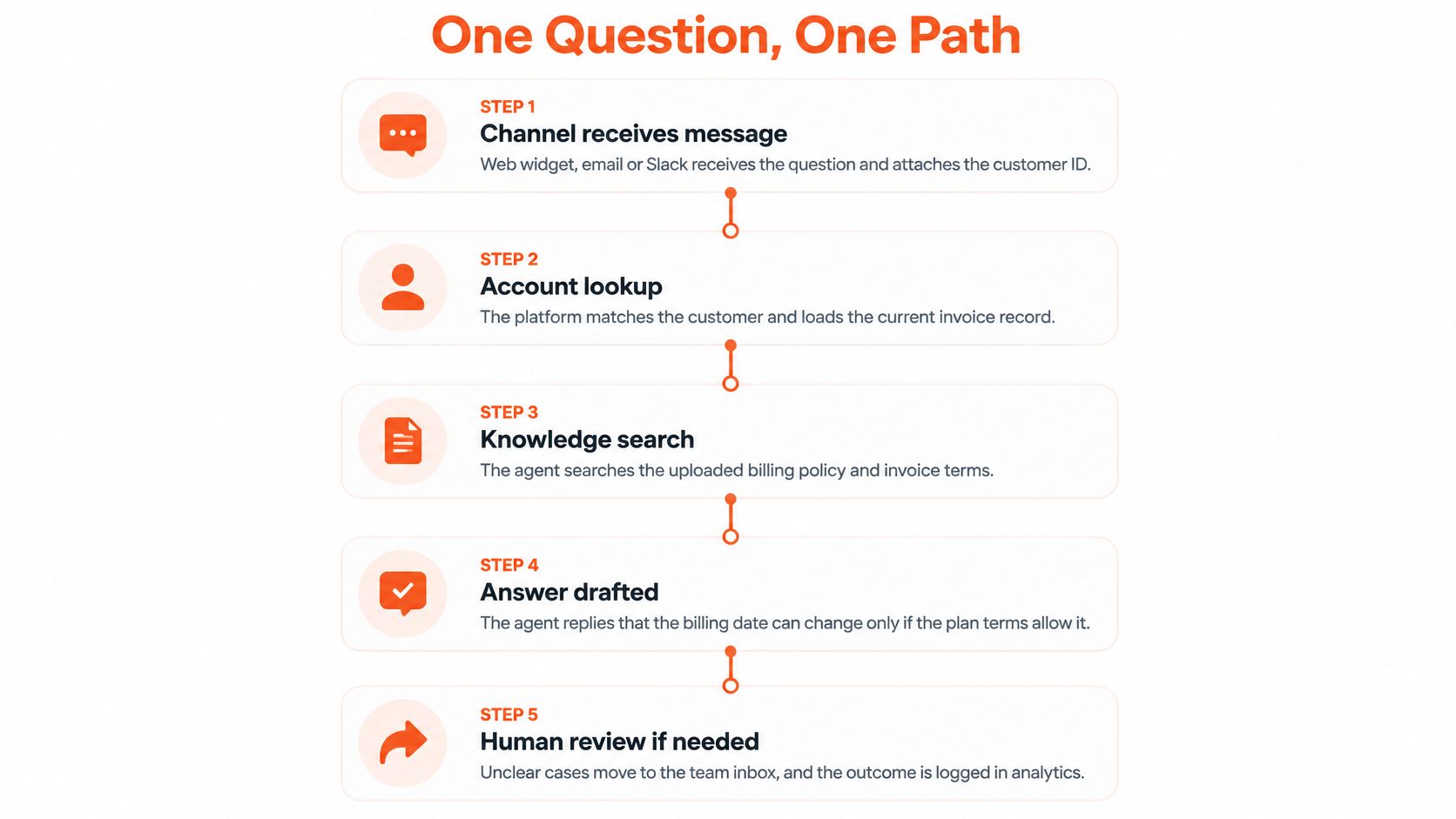
- The channel, whether a web widget, email, or Slack, receives the message and attaches a correlation ID that follows the conversation.
- Retrieval searches indexed chunks from crawled pages, PDFs, and synced Notion pages, then returns the best-matching passages.
- The router judges complexity. A multi-step policy question goes to a frontier model. A routine status question goes to a fast model.
- The model drafts an answer grounded in those passages.
- If the draft needs account data, a custom API action calls the billing system and the result comes back to the model.
- A confidence and policy check chooses among answering, asking a clarifying question, or escalating to the shared inbox.
- The final reply goes out, and every step is logged as a trace span.
Why a wrong reply isn't enough
A support lead who only sees the final sentence can't tell what failed. Google Cloud's agent observability guidance treats prompts, responses, token usage, latency, error rates, tool-call success or failure, policy enforcement, and quality signals such as correctness as things you capture in production. The same guidance calls for unit tests, trajectory analysis of multi-step decisions, and promotion from sandbox to canary to full production.
Without spans for retrieval, routing, generation, tool calls, and escalation, a slow or incorrect reply has no cause you can fix.
Retrieval may have returned a stale clause. The router may have picked a weak model. The billing call may have timed out. The agent may have repeated a step. Recording cost and latency per span lets you compare canary traffic on resolution rate, handoff rate, citation failures, p95 latency, and cost per resolved conversation before you widen the rollout.
Key Features Worth Comparing Side by Side
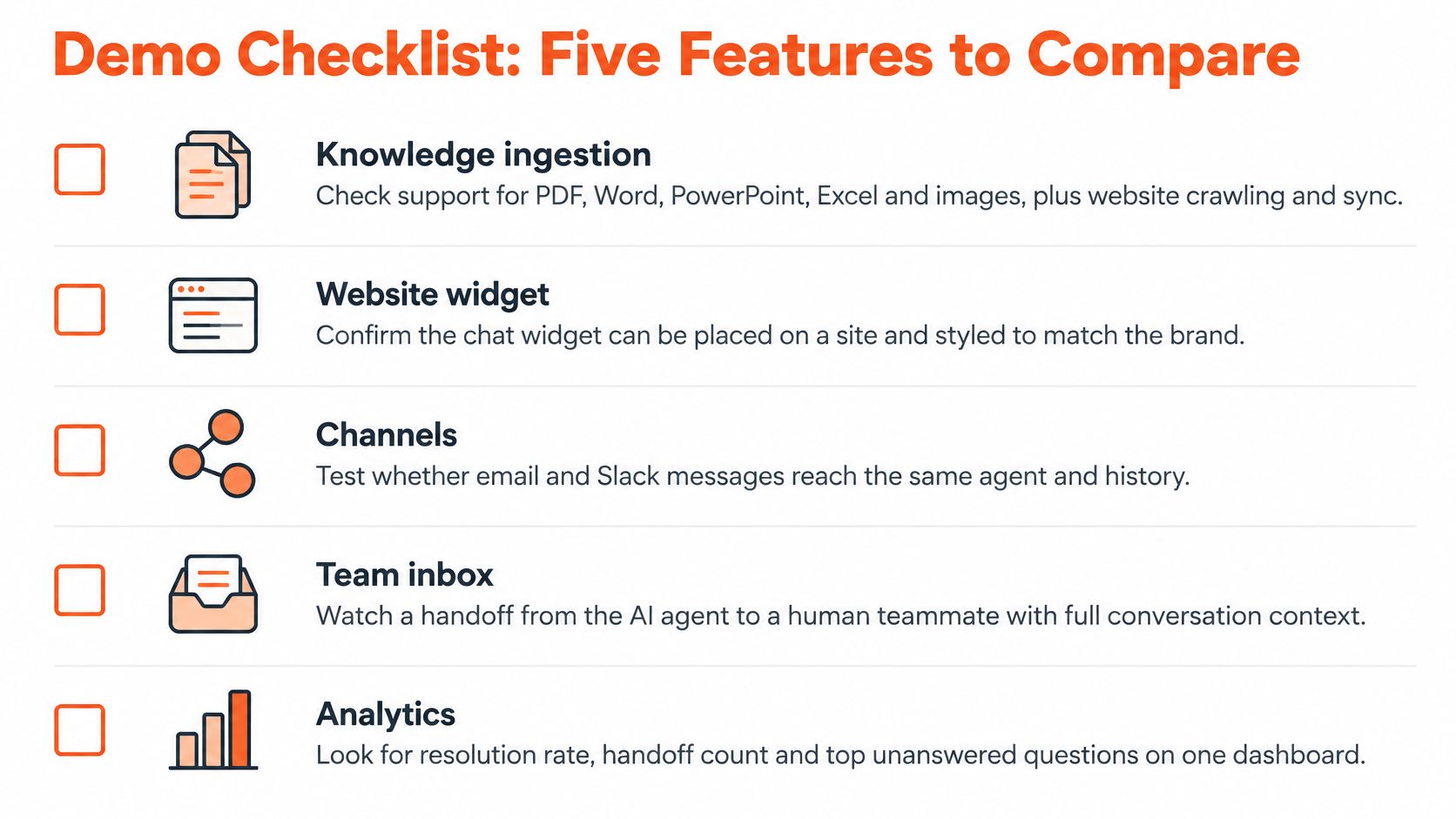
A demo should answer operational questions, not just show a polished chat bubble. Use the same checklist on every vendor. AgentStack is one worked example of a support-focused suite: a one-tag widget, routing across frontier and fast models, and GDPR controls for residency, deletion, and export. The questions below apply to any platform.
Questions worth asking out loud
- Knowledge ingestion. Ask which formats are supported, including PDF, Word, PowerPoint, Excel, and images, and whether the product crawls sites and syncs sources such as Notion rather than only accepting uploads.
- Retrieval quality. Ask whether chunking and indexing are automatic, and whether each answer cites the passage it used.
- Model routing. Ask whether you can choose or swap providers, and how the router balances accuracy, latency, and cost.
- Channels. Ask to send the same history through web chat, an email ticket reply, a Slack thread, and voice from one configuration.
- Analytics. Ask where resolution outcomes, sentiment trends, and unanswered questions show up, because unanswered questions are missing content.
- Handoff. Ask to watch a shared inbox receive the full transcript and the escalation trigger, not a one-line summary.
- Actions. Ask for a custom API action, plus meeting booking, lead capture, and web search, and who is allowed to turn each one on.
- Developer access. Ask to see a REST API and an MCP server if your engineers will control the agent from your own systems.
- Enterprise controls. Ask for role-based access, exportable audit logs, data residency, deletion, and export.
- Security. Ask how data is encrypted in transit and at rest. A concrete answer names a scheme such as AES-256-GCM rather than a badge.
- Pricing. Ask the vendor to price a 30-day pilot at your expected monthly message volume, including overage rates and what the free tier excludes. Custom domains and white-label widgets often sit outside the base quota.
A short walkthrough of routing and handoff makes those questions easier to picture before you sit in the demo.
If the vendor can't run your real billing question through retrieval, a tool call, and a handoff in one session, the rest of the feature list is still a prototype.
Platform Types From Support Suites to Build-Your-Own
Three teams can want the same outcome and pick three different builds. A support lead with solid docs and no engineers wants something that goes live this week. A platform team with strict data rules wants control over tools and models. A small engineering group wants to own every component and accepts the maintenance.

| Path | What you get | Time to first live agent | Model control | Observability |
|---|---|---|---|---|
| Support-focused deployment suite | Ingestion, widget, channels, inbox, and analytics in one product | Hours to a few days | Limited to the vendor's routing options | Built-in dashboards and unanswered-question reports |
| Agent-builder platform | Agent logic, tools, workflow controls, and governance | Weeks, depending on integrations | Broad, configured by engineers | Vendor tracing plus your own metrics |
| Build-your-own stack | Components you assemble and operate yourself | Months | Full control | Everything built and maintained by your team |
A support-focused suite bundles ingestion, the widget, channels, the inbox, and analytics. You trade some model freedom for a shorter path to the first live agent. An agent-builder platform from a model vendor or cloud provider gives engineers more control over tools, workflows, and models, and the integration work is usually measured in weeks. A build-your-own stack on cloud primitives gives full control, and your team then has to build tracing, evaluation, and governance itself.
The operating environment decides reliability
Model scores don't settle this choice. Stanford's 2025 AI Index, as discussed alongside NIST's Generative AI Profile, described RE-Bench as a 2024 benchmark for complex agent tasks. Under a two-hour budget, leading AI systems scored four times higher than human experts. At 32 hours, human experts outscored the systems two to one. Capability depends on the operating environment, not on a single model being uniformly better.
NIST released that Generative AI Profile for the AI Risk Management Framework on July 26, 2024. It complements the broader AI RMF from January 2023 and covers design, development, deployment, operation, and decommissioning. Every path still needs routing, monitoring, escalation, auditability, and handoff, plus a plan for controlled retirement.
Pick the path by who will operate the agent on a Tuesday afternoon, not by which vendor looks most impressive in a slide.
Escalation Rules That Limit Costly Mistakes
Higher automation isn't automatically a better support operation. A lower autonomous-resolution rate can beat a higher one when it blocks a costly mistake and sends a genuinely hard case to a person earlier.
The operating model comes before the model name. Routine FAQs with strong retrieval can be answered with citations, then sampled after resolution. Watch verified resolution. Ambiguous questions get one clarifying question, then escalate if they're still unclear. Watch clarification success. Refunds, cancellations, and account changes need human approval before anything is written. Watch approval turnaround. Sensitive or regulated data triggers an immediate handoff. Watch time to human takeover.
What the surveys actually point at
PwC's 2025 AI-agent survey found respondents ranking connecting agents across applications and workflows (19%), organizational change (17%), and employee adoption (14%) among key challenges. Independent research from the Infosys Knowledge Institute reported that 95% of surveyed senior executives had experienced negative consequences from enterprise AI use over the prior two years, and that none of seven safety measures, including continuous monitoring, anomaly detection, rigorous validation, access controls, human oversight, and data-quality checks, was universally adopted. The friction is the operating model, not a missing channel.
A refund the agent wasn't allowed to issue is a successful policy. A refund it issued on a timed-out billing call is a failed one, even if the customer sounded satisfied.
Track containment, verified resolution, recontact rate, transfer appropriateness, and the cost of false autonomy together. Review a sample of silent failures every week, the cases where the customer left without complaining and the answer was still wrong. Broader enterprise AI governance insights from Ekipa are useful context for who owns those rules, and a practical pattern for when to escalate an issue keeps the tiers tied to real tickets instead of a generic confidence slider.
Testing Agents Before They Reach Customers
A refund agent can pass every FAQ test and still promise money back while the billing API is timing out. One green run hides that. The release gate for account changes is what should have blocked it.
Princeton's Science of Agent Evaluation recommends running each task across five runs to measure consistency, then perturbing prompts, data formats, APIs, and infrastructure, including injected faults. Tool calls, retries, context handling, and external API failures create variance that ordinary language-model benchmarks miss.
Build the set, then break it
Keep a versioned evaluation set for routine FAQs, ambiguous requests, adversarial prompts, stale documentation, multilingual inputs, and failed integrations. Run it before every model, routing, or knowledge-base change, and compare production outcomes with the baseline so drift shows up as a release problem rather than a surprise in the inbox. A practical companion is a support quality assurance habit that treats those runs like software tests.
Security cases belong in the same set. Drop in a customer PDF with hidden instructions, retrieved web content that tries to override the agent, a query aimed at another tenant's documents, and a request for a tool the agent isn't allowed to call. A benchmark of 847 adversarial cases spanning direct injection, context manipulation, instruction override, data exfiltration, and cross-context contamination found that the evaluated defenses cut successful attacks from 73.2% to 8.7% while keeping 94.3% of baseline task performance. Measure residual risk and task success together. Don't declare the agent secure because a control list is checked.
| Agent type | Answer correctness | Tool-call safety | Escalation accuracy | Failure recovery |
|---|---|---|---|---|
| Informational FAQ chat | Above 90% on the evaluation set | Not applicable | Escalates every flagged topic | Falls back to a clear message saying the answer can't be confirmed |
| Read-only account lookup | Above 95% | Zero unauthorized data reads | Escalates on identity mismatch | Retries once, then hands off |
| Refund or account change | Stricter than FAQ chat, calibrated on your past tickets | Zero unauthorized writes, and approval required | Escalates every ambiguous request | Stops before any write, with no partial action |
Set separate gates for answer correctness, safe tool use, escalation behavior, and recovery from dependency failures. Make them stricter for agents that can modify accounts, issue refunds, or expose regulated data. Measure how often a violation happens and how severe it is, and require the thresholds before an agent leaves the sandbox. Calibrate the numbers on your own past tickets. The refund agent that kept promising refunds during an outage would have failed the write gate, because the correct behavior is to stop before any write.
Pilot One Channel Before Committing to a Platform
Many teams are earlier than the demos suggest. In 2025, only 3.3% of 215 companies using generative AI reported that AI agents were currently in use, according to Yano Research. Designing for a scale you don't have yet is how pilots turn into unfinished platforms.
Match the path to the team you actually have
A support lead with documentation and no engineers should favor a support-focused suite with a one-tag widget. An enterprise with platform engineers and strict data rules should judge agent-builder platforms, or a build-your-own stack, against the tracing and governance checks above. A SaaS team that wants agents inside its own product should weigh API and MCP access heavily, because the agent has to live in someone else's workflow. The same evaluation set should score every option, including whatever suite looks fastest to install. Channel count is a later decision. Omnichannel support software only helps after one channel has proven the escalation rules and the test gates.
A 30-day pilot stays small on purpose.
- Ingest the top 50 help articles and sync the source documents.
- Write escalation tiers for the top 10 intents, with refunds and account changes requiring approval.
- Run 100 real past tickets through the evaluation set, including at least one failed billing call.
- Launch on one channel for 10% of traffic.
- Review unanswered questions and handoffs weekly, and expand only if containment and verified resolution hold.
If the refund case from your own history still gets a promised payout while the billing tool is down, you don't have a platform decision yet. You have a gate that isn't strict enough.
AgentStack is a platform for building and deploying AI customer-support agents, with document ingestion, model routing, web, email, Slack, and voice delivery, plus handoff, analytics, and enterprise controls. If you're choosing an AI agent deployment platform, start with escalation rules and a pre-launch test set rather than a model bake-off. Visit AgentStack to see how a support-focused deployment fits a single-channel pilot.