A caller rings because an order hasn't arrived, a charge looks wrong, or an appointment needs to move. They hear a greeting, explain the problem, and wait to find out whether the system understood them or is about to trap them in a phone menu. That first exchange is where an AI voice agent for customer support earns trust, or loses it.
The technology can answer routine questions and take approved actions, but good voice support isn't just a fast model speaking aloud. It depends on a complete call pipeline, reliable connections to company systems, clear privacy boundaries, and a handoff that gives a human enough context to help. The practical question isn't only what the agent can resolve. It's also when it should stop talking.
Table of Contents
- What Happens When a Caller Reaches an AI Voice Agent
- How the Voice Agent Pipeline Actually Works
- Architecture and Integration Patterns for Support Teams
- Benefits, Trade-offs, and Where Voice Agents Earn Their Keep
- Knowing When the Agent Should Stop Talking
- Keeping Voice Support Privacy-Safe Across Borders
- Rollout Playbook and Metrics That Actually Matter
- Decisions to Make Before You Choose a Voice Agent Platform
What Happens When a Caller Reaches an AI Voice Agent
The phone rings. A customer says, “I'm calling about my order. The tracking hasn't changed.” The agent needs to recognize the request, find the right order without exposing another customer's information, and respond in a way that makes it easy to continue or ask for a person.

A well-designed system doesn't make the caller learn a special script. It listens for the caller's intent, checks whether it has enough information to proceed, and answers in short spoken turns. If the caller gives an order number, the agent can use an approved action to look up the order. If the lookup fails or the caller raises a sensitive issue, the system should offer a human rather than repeat a question or improvise.
That differs from a traditional interactive voice response (IVR) menu, where callers move through a fixed set of options. Voice agents can handle conversational requests, but they still need boundaries: what they may answer, which tools they may use, and when they must transfer the call. The broader move from scripted IVR toward conversational support is already reflected in the market outlook: one industry estimate put the global voice-bot market at approximately $2.9 billion in 2023 and projected $10.7 billion by 2030, implying roughly 20% compound annual growth (industry voice AI estimate). Treat that as an industry forecast, not an audited universal measurement.
For a support leader, the useful starting point is the call queue, not the AI terminology. Which requests repeat? Which require live account access? Which ones carry risk if the answer is wrong? Those answers determine whether a voice agent fits, how it should be connected to support operations, and what a safe escalation looks like.
How the Voice Agent Pipeline Actually Works
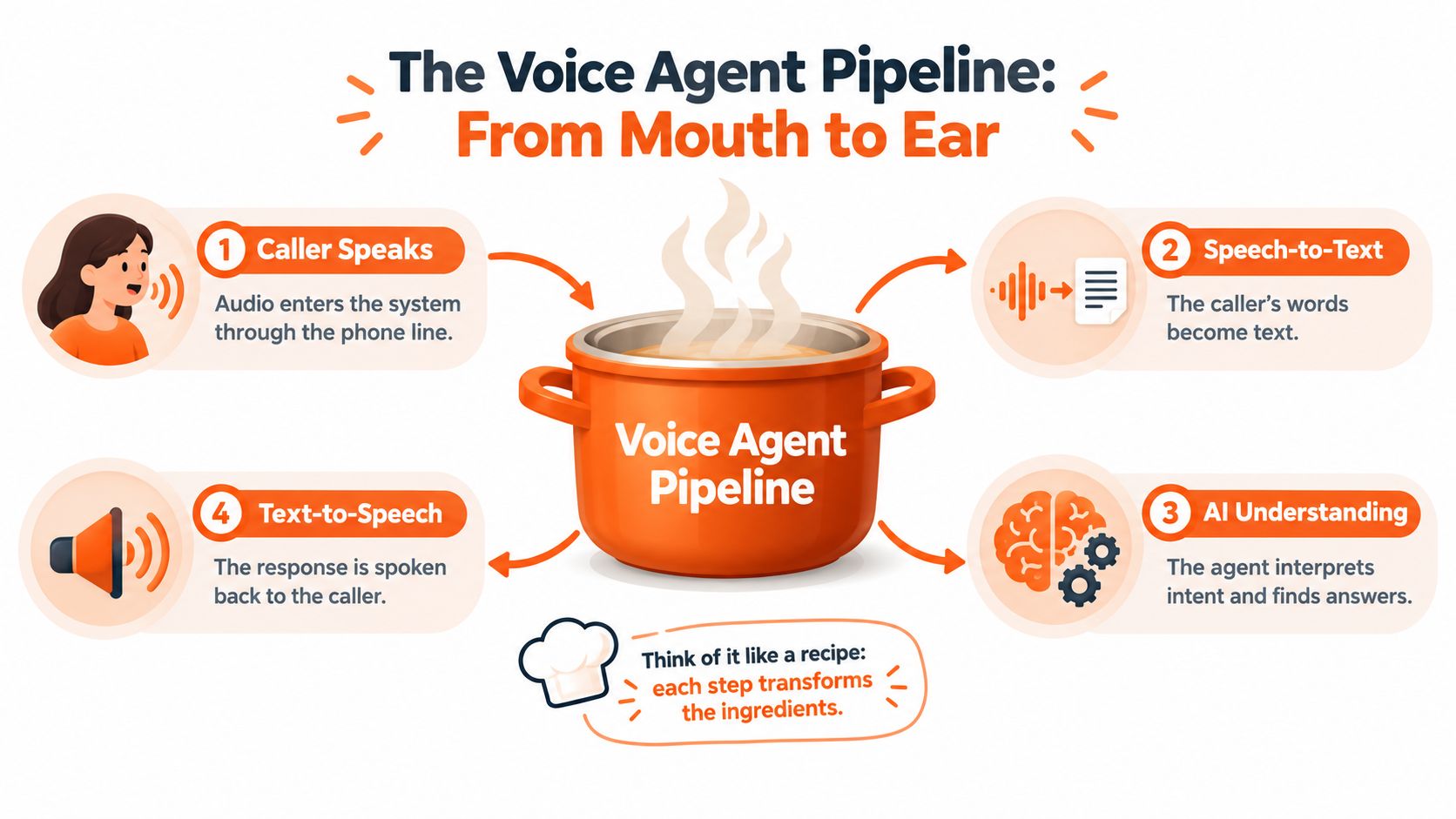
Think of a voice agent as a kitchen that turns spoken ingredients into a spoken answer. Each station has a job, and a delay or mistake at any station affects what the caller experiences. A quick language model can't compensate for audio the system misheard or a tool that takes too long to return.
From caller audio to a useful response
First, voice-activity detection and endpointing help the system distinguish speech from silence and decide when the caller has finished a turn. If endpointing cuts off too early, the agent may answer before the customer has completed an explanation. If it waits too long, the caller hears an awkward pause.
Next, speech-to-text converts audio into words. Noisy mobile connections, accents, names, and account identifiers can make this stage unreliable. The language model then interprets the request, retrieves relevant company information, and decides whether it can answer or needs an approved action, such as checking an order or creating a ticket.
Finally, text-to-speech (TTS) turns the response into audio. Streaming partial transcription and audio can make the conversation feel more responsive, because the system doesn't have to wait for every stage to finish before doing useful work.
Why the whole path matters
A practical production budget cited for voice systems allocates about 350 ms to speech recognition, 375 ms to the model's first token, and 100 ms to TTS's first audio byte, with a roughly 1,115 ms median target before orchestration overhead (voice-agent pipeline design guidance). Human turn-taking often leaves a response gap around 500 ms, so longer silences can feel unnatural. A useful common-path objective is roughly 800–1,000 ms, while teams should also track p95 latency under peak load and noisy-call conditions.
Those stages are only part of the wait. Network transport, retrieval, authentication, and synchronous tool calls also contribute. Measure from the caller finishing a turn to the first generated audio, not just the model's inference time. When a workflow must take longer, a brief spoken status update is better than leaving the caller in silence.
Architecture and Integration Patterns for Support Teams
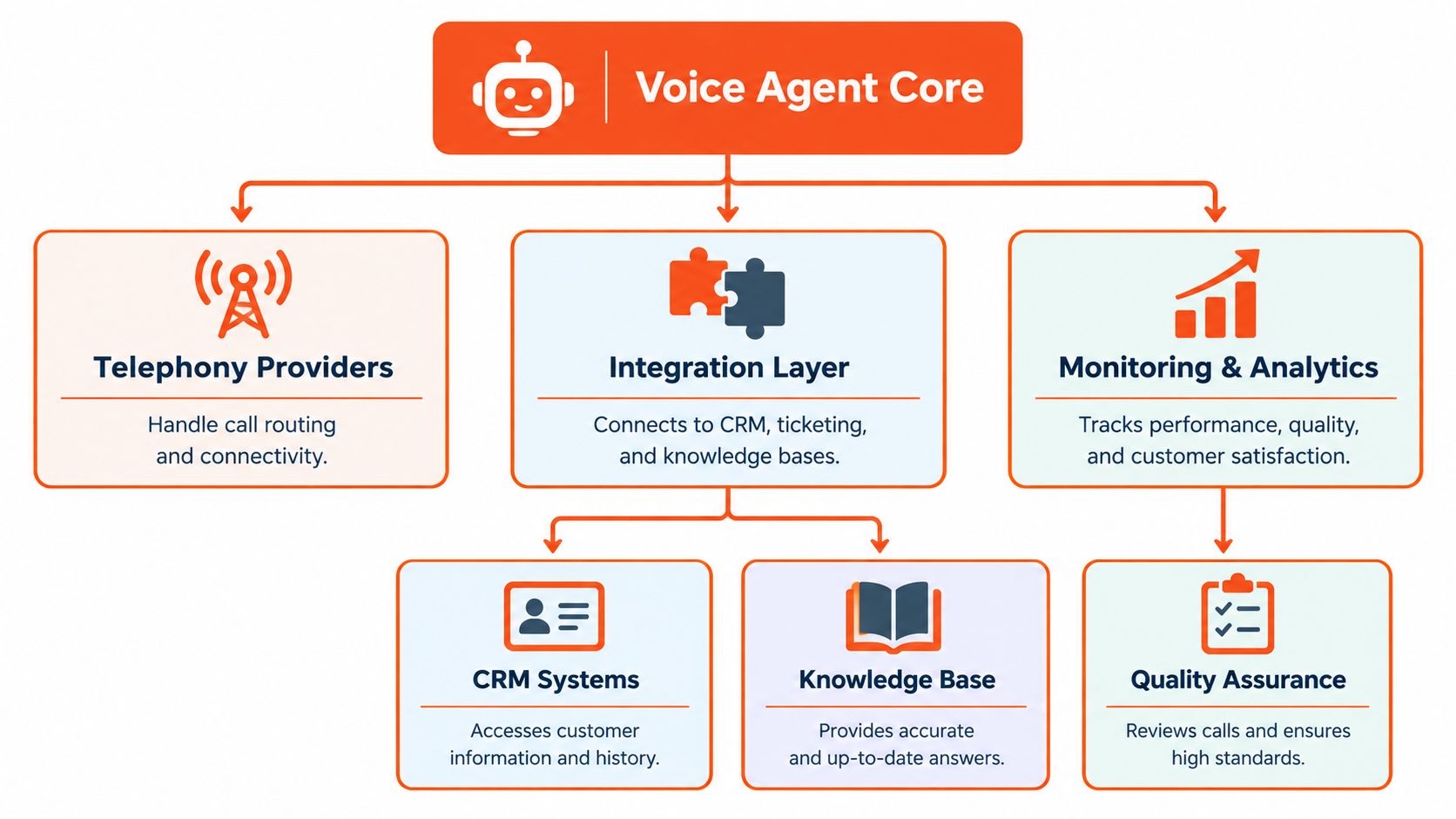
A voice agent sits inside a support system. It needs a phone connection, a way to decide what to do, access to trusted knowledge, permission to take specific actions, and a route to a person when automation reaches its limit.
The production stack around the conversation
Telephony connects calls and routes them to the agent or a human queue. The orchestration layer coordinates recognition, model selection, retrieval, and actions. A fast model can handle a routine request, while a more capable model may be appropriate when a caller's question needs careful interpretation. That routing only helps if the system can reach the right data promptly.
Knowledge retrieval grounds answers in current policies, help articles, and product documentation. Poorly maintained source content can produce confident but unhelpful answers, regardless of which model is selected. Actions are the controlled operations that change or retrieve information, such as checking account status, creating a ticket, or initiating a handoff. Keep permissions narrow: a voice agent should only be able to take actions its workflow explicitly allows.
The work doesn't end when the call does. A shared inbox gives human agents a place to review escalations, while analytics help teams see outcomes and unanswered questions. For a complementary view of how support automation fits a commerce workflow, this guide to AI support for Shopify stores offers useful context.
Buying a simpler setup or extending the stack
Some platforms package the phone connection, agent configuration, and support tools into a managed setup. That can shorten initial implementation, but a simple deployment doesn't remove the need to test authentication, knowledge accuracy, or handoff behavior. More customized systems may connect through REST APIs or an MCP server to reach internal services and tools, giving engineers greater control at the cost of more integration work.
AgentStack, for example, provides website and document ingestion, multi-model orchestration, API actions, analytics, a shared inbox, and voice delivery. The practical evaluation question is whether a platform fits your existing call routing, CRM, knowledge sources, and escalation process, and whether its logs let your team investigate failures. Those details determine whether the agent works as part of support or as an isolated phone bot.
Benefits, Trade-offs, and Where Voice Agents Earn Their Keep
A voice agent earns its place when the call has a clear goal and a safe stopping point. Repetitive, low-complexity calls are strong starting candidates: routing, common questions, account-status checks, order updates, and appointment scheduling. Automating those tasks can reduce routine work and extend service beyond staffed hours, as long as the system can verify callers and retrieve accurate information.
The trade-off appears when the conversation leaves the expected path. A speech-recognition error can derail the call, and a rigid workflow can frustrate someone with an unusual request. Sensitive or emotionally charged calls need human judgment. If the agent keeps pushing for containment instead of recognizing uncertainty, it can make a difficult interaction worse.
Adoption is selective: teams start with bounded inbound call types rather than handing over the full phone queue. A 2025 summary reported that 44% of enterprises were using voice AI for at least one inbound call type, while 12% had deployed it across more than half of their call volume. It also reported that 61% were expanding AI toward voice after introducing automation in other support areas (reported customer-service AI adoption figures). These secondary survey figures are not a globally representative census, but they support a practical approach: prove a narrow use case before increasing the agent's share of calls.
Choose a deployment pattern that fits the call mix
| Pattern | Best Call Mix | Cost Posture | Control & Risk | Time to Value |
|---|---|---|---|---|
| Full automation | Narrow, repeatable requests with reliable data and low consequence | Can reduce routine agent workload, but still needs integration and monitoring | Least human involvement; without safeguards, failures can leave callers stuck | Simple flows can be quick to launch; complex actions and authentication take longer |
| Hybrid with human fallback | Routine questions mixed with exceptions or sensitive cases | Splits work between automation and agents; costs depend on tools and staffing | Escalation can preserve control when it carries context and reaches the right queue | Supports pilots for bounded intents while human help remains available |
| After-hours only | Calls outside staffed hours, often routine or informational | Extends coverage without staffing every period; unresolved calls still need a clear route | Limits exposure while retaining a human path during business hours | A contained operational starting point |
Choose based on the work and the consequences of an error. Start with stable answers and actions that are safe to reverse or verify. Set a clear boundary for handing off when caller context, emotion, or risk exceeds what the workflow can handle.
Knowing When the Agent Should Stop Talking
An agent's ability to hand off well matters as much as its ability to resolve a call alone. If a customer says they want a person, the agent should not make them repeat the request. If authentication fails or the conversation turns into a dispute, the system should recognize that the next safe step may be a transfer, not another attempt to automate.

Trust depends on what the customer is asking the system to do. Consumer research on voice AI found that people were more comfortable with lower-consequence tasks such as package tracking than with emotionally charged or high-stakes situations. In EMEA, 5% said they would trust AI to close a bank account after a loved one's death, and 6% would let it dispute a suspicious transaction (consumer voice research). Those examples show why an agent should treat bereavement and suspicious transactions differently from routine delivery questions.
A useful handoff carries more than a transcript. It should include the recognized intent, authentication status, relevant tool results, actions already attempted, and a concise summary for the human agent. Without that context, the transfer may technically succeed while the customer still has to start over.
Design principle: Optimize for the right handoff, not autonomous resolution at any cost.
Measure whether the transfer actually helps
A useful but often overlooked measure is handoff recovery rate: whether the human resolves the issue more efficiently after an AI escalation than they would from a cold start. Track repeated-information requests alongside transfer outcomes. If customers regularly re-explain the same details, the system isn't passing context cleanly.
Define escalation triggers before launch. Include explicit requests for a human, repeated failed authentication, uncertain intent, and sensitive topics that the agent isn't authorized to handle. The human handoff workflow documentation can help teams think through how to connect agent actions with a human escalation path.
The mechanics of transferring a call matter too. This video provides another view of the handoff experience:
Keeping Voice Support Privacy-Safe Across Borders
A voice call creates more than an audio file. It can produce a transcript, summaries, analytics, model requests, and actions in connected business systems. Each artifact may contain identity details, payment information, health information, or proprietary account context, so privacy needs to be designed across the whole flow rather than added as a policy at the end.
Contact-center implementation research reports that 82% of centers process sensitive personal information, rising to 94% in financial services and 89% in healthcare (contact-center data-handling research). For teams operating across borders, the same conversation may also be subject to different rules about where data is processed, how long it is retained, and who can access it. The guide to data residency provides useful context for evaluating those location and processing questions.
Map the data before choosing controls
Start by listing each data artifact and its purpose. Does the system need to retain the original recording, or is a transcript sufficient for quality review? Which model providers process the audio or transcript? Where are call records, summaries, and analytics stored? Who can access them, and how do customers exercise deletion or export rights?
Redact sensitive fields before sending text to a language model where the workflow permits it. Route sensitive intents through restricted models or a human queue, and limit tool permissions to the minimum needed for the task. Those constraints do more than reduce exposure: they can also prevent an agent from taking an action outside its role and give investigators clearer records when something goes wrong.
Privacy can improve reliability: Narrow access makes it easier to understand what information the agent used and which actions it was allowed to take.
Keep useful signals without keeping everything
Retention rules should distinguish audio from transcripts and derived analytics. Teams can minimize stored content while still tracking operational patterns, such as unresolved intents, transfer reasons, and whether a knowledge article answered the question. Test redaction against realistic examples, including names and account identifiers, and verify that deletion and export workflows cover connected systems as well as the primary voice platform.
A jurisdiction-aware design may route calls to approved processing locations or restrict which data a model can receive. For teams mapping obligations for providers operating across regions, this practical compliance guide for non-EU AI providers can serve as a starting point for further review. It doesn't replace advice specific to your jurisdictions, systems, and data flows.
Rollout Playbook and Metrics That Actually Matter
A rollout should start with a narrow call type, not a broad promise to automate support. Choose an intent with stable answers, accessible source data, and a clear fallback. Keep the first deployment small enough that support agents can review failures and tell the engineering team what callers said.
Pilot, expand, then harden
During the pilot, test one bounded request, such as order-status questions or call routing. Review transcripts and outcomes with human agents, then fix missing knowledge and unclear prompts before increasing exposure.
When the core flow works, expand to adjacent intents with similar permissions and data needs. Don't add a new workflow just because the previous one handled its happy path. Test the awkward cases too: an unclear account identifier, a customer who changes their request mid-call, or a tool that returns incomplete information.
In the hardening phase, evaluate the full experience under real operating conditions. Include noisy mobile audio, varied accents, speakerphone calls, interruptions, emotionally charged speech, and requests involving payment or identity information. A demo in a quiet room doesn't establish production quality.
Track quality beyond containment
Call duration and containment can be useful, but they don't show whether the customer got a correct answer or reached the right person. Track p95 latency from the caller finishing a turn to the first generated audio, interruption rate, yield latency after a caller barges in, missed and false interruptions, resolution outcome, and handoff recovery rate. Review sentiment trends and the questions that analytics identify as unanswered, then update the knowledge base or workflow.
For a broader framework to connect those measures with support operations, see this guide to contact-center metrics. Choose a platform that exposes the underlying events and lets teams tune behavior. A single quality score can conceal slow responses, faulty handoffs, or unresolved calls that need attention.
Decisions to Make Before You Choose a Voice Agent Platform
The move from scripted IVR to conversational support creates more options, but the platform decision should follow the operating design. Set the rules for the caller experience before comparing vendors. The key choices are which requests to automate, when the agent must hand off, and what information and privacy controls each interaction requires.
- Which calls come first? Start with bounded requests that have stable answers and a clear outcome. Leave complex or unpredictable cases for later.
- When must the agent stop? Set handoff triggers for requests to speak with a person, failed authentication, uncertainty, and sensitive topics. A clear stop rule prevents the agent from repeating a weak answer while the caller waits.
- What context follows the caller? Require a useful transcript, intent, authentication state, tool results, and summary at handoff. Without that context, the human agent may need to ask the caller to start over.
- How will privacy work across regions? Confirm processing locations, retention, redaction, model-provider access, and deletion or export workflows. A platform must support the controls your operating regions require.
- Which operational measures matter? Define expectations for response latency, interruption handling, resolution quality, and transfer recovery. These measures show where a platform creates friction in live calls.
- How will the system improve? Check that analytics identify unanswered questions and that your team can update knowledge and workflows.
Choose two or three bounded use cases, agree on how to measure success and failure, then run a short pilot with real calls before expanding. A polished demo is not enough. Ask to see how the platform handles noisy audio, an unsuccessful lookup, and a caller asking for a person.
AgentStack provides a platform for building and deploying customer support agents across voice and other channels, with knowledge ingestion, approved actions, analytics, and human handoff workflows. Explore AgentStack to assess how those capabilities fit your support stack and plan a focused voice pilot.